You're viewing free preview questions — 5 questions previewing here — subscribe to unlock 354 more, plus the Full Question Bank, Mock Papers & Worksheets.Upgrade
The Solar System - Planets and Satellite — Free MYP5 Physics Practice Questions

1QuestionAssessment Practice
5 marks~8 minCriterion D
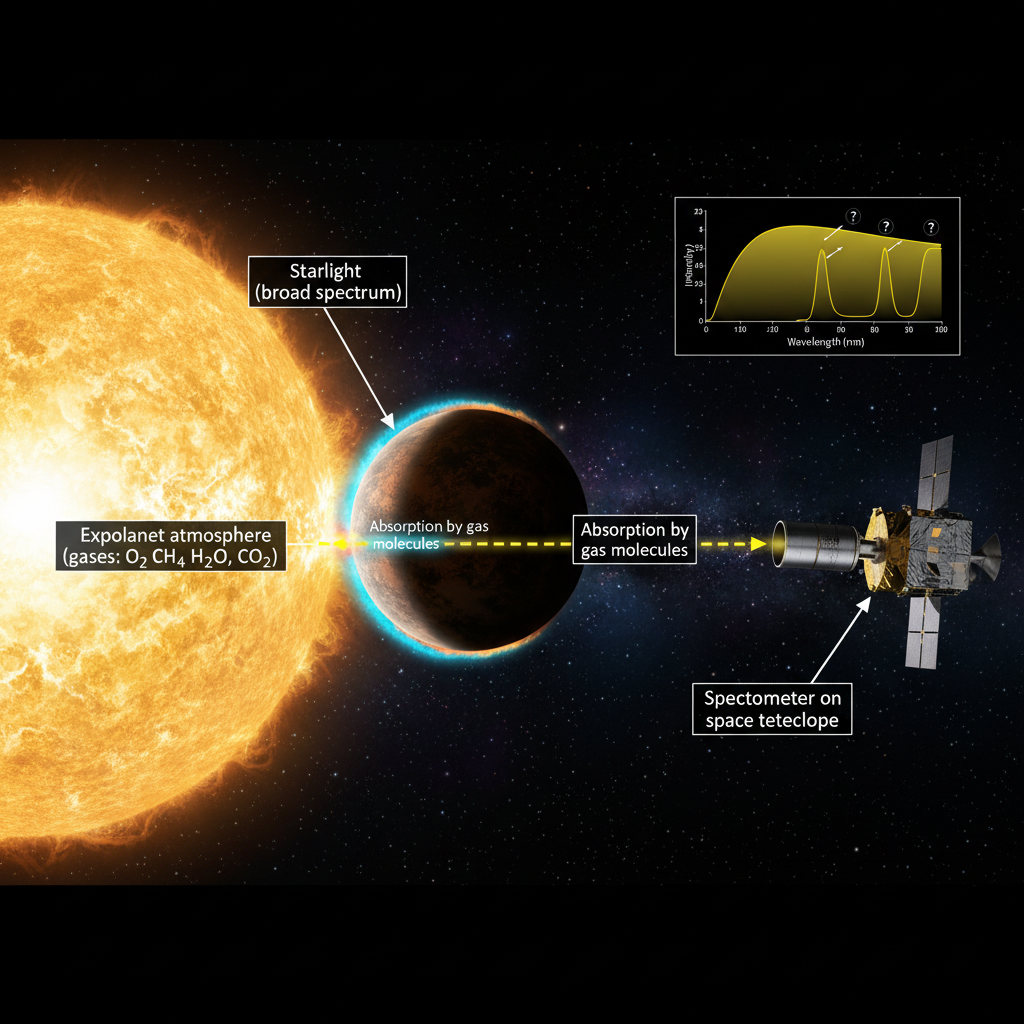
A space agency uses a spectrometer aboard an orbiting telescope to study an exoplanet's atmosphere during a transit. As starlight filters through the atmosphere, certain wavelengths are absorbed, producing a characteristic spectrum. Scientists compare this spectrum with laboratory reference spectra of gases including , , , and .
a
Explain how absorption spectra allow scientists to identify specific gases in an exoplanet's atmosphere. In your answer, refer to quantized energy levels and characteristic wavelengths. [2]
b
Discuss the advantages and limitations of using transit spectroscopy to assess whether an exoplanet could support life, considering signal-to-noise ratio, Earth's atmospheric interference, and the interpretation of biosignature gases. [3]

Solutions
2QuestionDefinition of a planetAssessment Practice
5 marks~8 minCriterion C
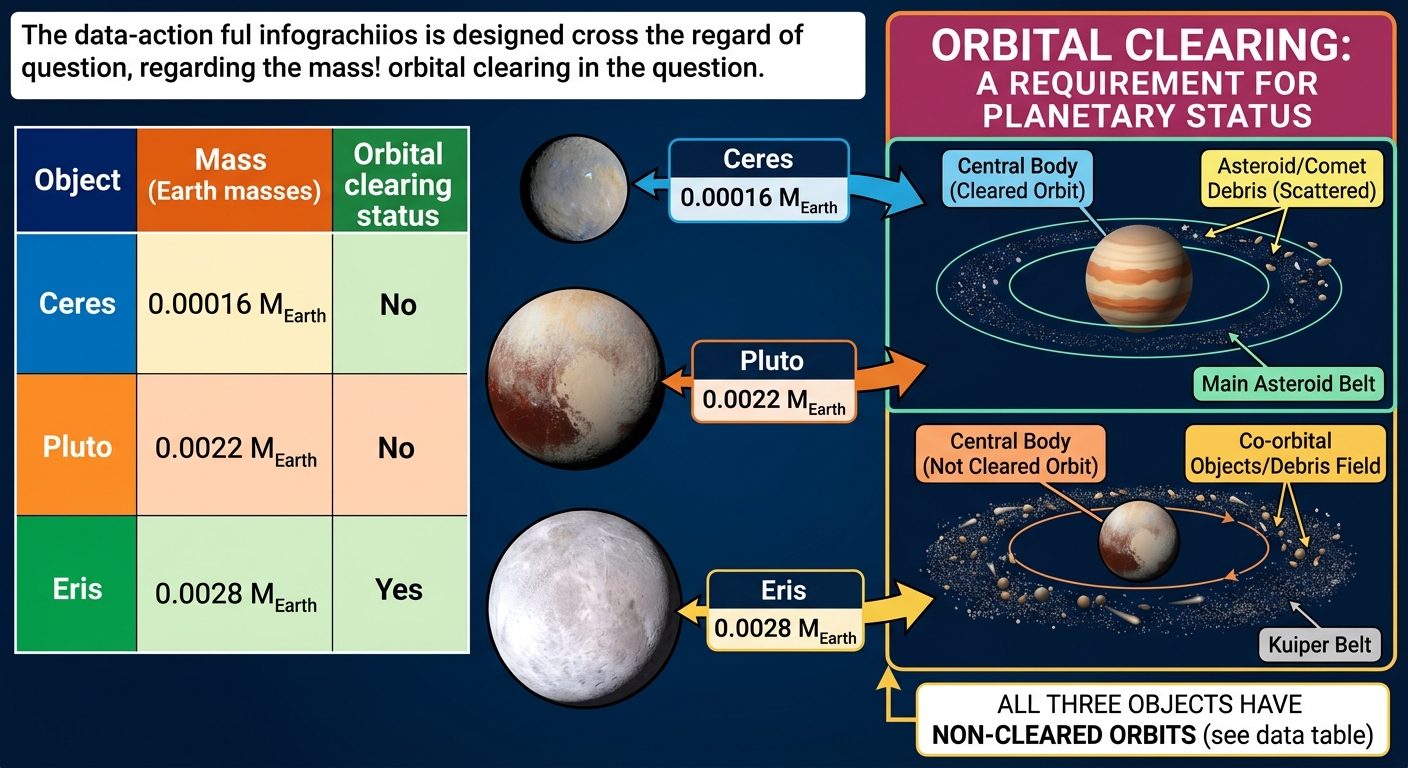
The table below shows data for three solar system objects.
| Object | Mass (Earth masses) | Orbital clearing status |
|---|---|---|
| Ceres | Not cleared | |
| Pluto | Not cleared | |
| Eris | Not cleared |
a
State the three criteria in the IAU definition of a planet. [1]
b
Using the data, explain the relationship between mass and the ability to clear an orbital neighbourhood. [2]
c
A scientist argues that if Eris were given enough additional mass, it would eventually be reclassified as a planet. Evaluate this claim, identifying what other conditions would also need to be satisfied. [2]
Solutions
3QuestionDefinition of a planetAssessment Practice
5 marks~8 minCriterion C
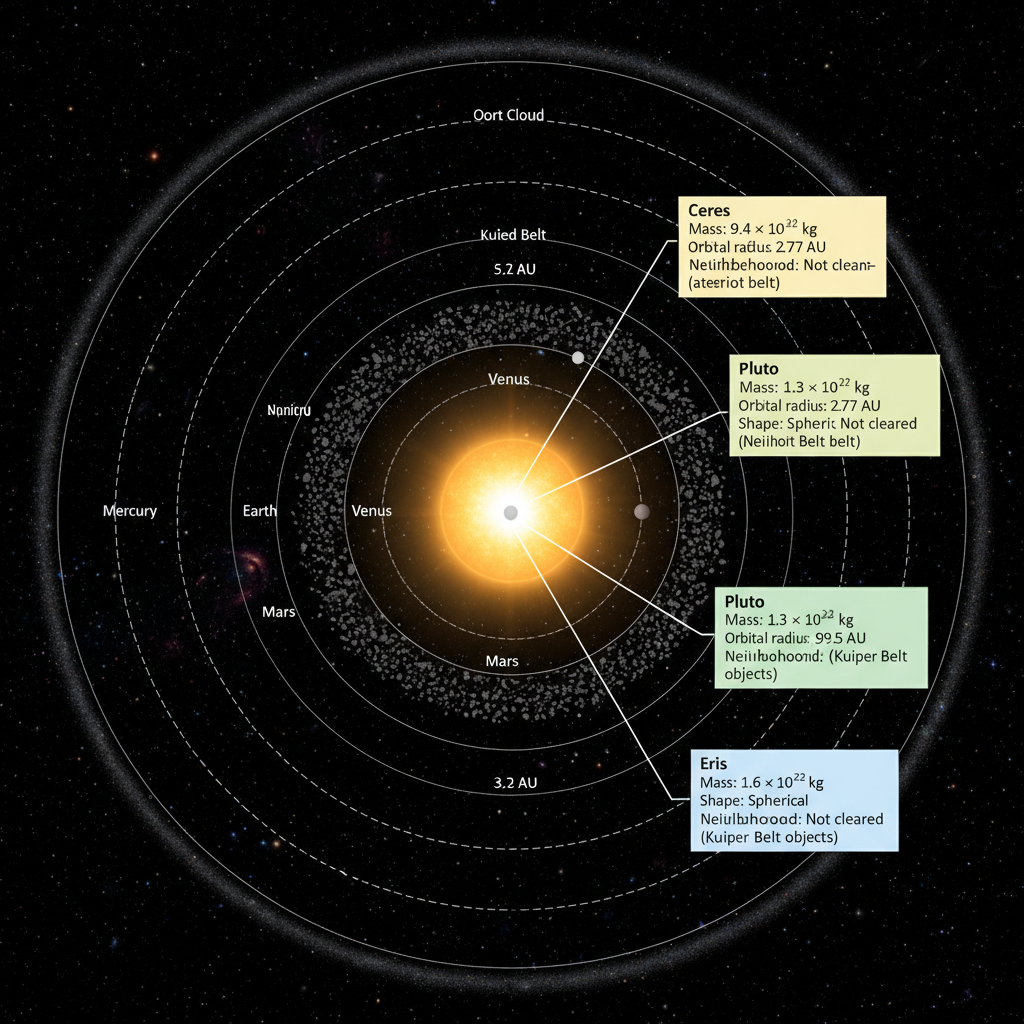
The International Astronomical Union (IAU) defines a planet as a celestial body that: (a) orbits the Sun; (b) has sufficient mass for self-gravity to pull it into a nearly round (hydrostatic equilibrium) shape; (c) has cleared the neighbourhood around its orbit. A body satisfying only (a) and (b) is classified as a dwarf planet.
Data for three Solar System bodies:
Orbital radius (AU): Ceres 2.77, Pluto 39.5, Eris 67.7
Mass (kg): Ceres , Pluto , Eris
Shape: all three spherical
Neighbourhood status: Ceres — not cleared (shares orbit with asteroid belt); Pluto — not cleared (shares orbit with Kuiper Belt objects); Eris — not cleared (shares orbit with trans-Neptunian objects)
(a) State which IAU criterion none of the three bodies satisfies, and identify the evidence from the data that supports this. [1]
(b) Explain why all three bodies satisfy IAU criteria (a) and (b), using specific data from the table. [2]
(c) Evaluate whether Ceres, Pluto, and Eris should be classified as planets or dwarf planets according to the IAU definition. Justify your conclusion by applying all three criteria to each body. [2]
Data for three Solar System bodies:
Orbital radius (AU): Ceres 2.77, Pluto 39.5, Eris 67.7
Mass (kg): Ceres , Pluto , Eris
Shape: all three spherical
Neighbourhood status: Ceres — not cleared (shares orbit with asteroid belt); Pluto — not cleared (shares orbit with Kuiper Belt objects); Eris — not cleared (shares orbit with trans-Neptunian objects)
(a) State which IAU criterion none of the three bodies satisfies, and identify the evidence from the data that supports this. [1]
(b) Explain why all three bodies satisfy IAU criteria (a) and (b), using specific data from the table. [2]
(c) Evaluate whether Ceres, Pluto, and Eris should be classified as planets or dwarf planets according to the IAU definition. Justify your conclusion by applying all three criteria to each body. [2]
Solutions
4QuestionHuman impact on space (space debris)Assessment Practice
7 marks~11 minCriterion B
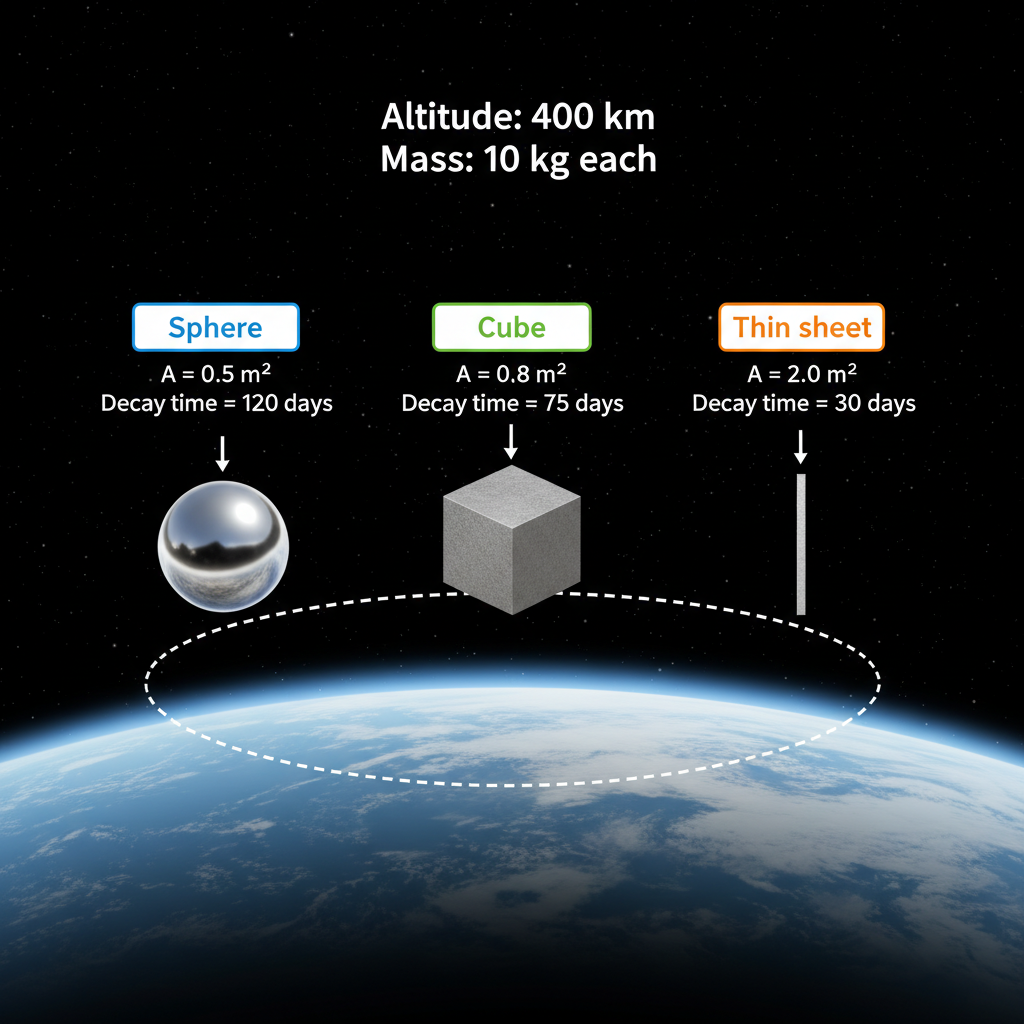
Three space debris objects, each with mass 10 kg, orbit Earth in a circular low Earth orbit at 400 km altitude. Their orbital decay times differ due to their shapes and cross-sectional areas. Atmospheric drag is described by:
where is atmospheric density, is orbital speed, for all objects, and is cross-sectional area perpendicular to motion.
where is atmospheric density, is orbital speed, for all objects, and is cross-sectional area perpendicular to motion.
| Object shape | Cross-sectional area (m²) | Decay time (days) |
|---|---|---|
| Sphere | 0.5 | 120 |
| Cube | 0.8 | 75 |
| Thin sheet | 2.0 | 30 |
a
Deduce the mathematical relationship between cross-sectional area and decay time using the data provided. [2]
b
A fourth object of identical mass and altitude has a cross-sectional area of 1.2 m². Show that its decay time is 50 days. [2]
c
Explain how cross-sectional area determines the rate of orbital decay, referring to the drag force equation and the effect of drag on orbital energy and altitude over time. [3]
Solutions
5QuestionFormation of the solar system (nebular hypothesis – basic idea)Assessment Practice
8 marks~12 minCriterion A
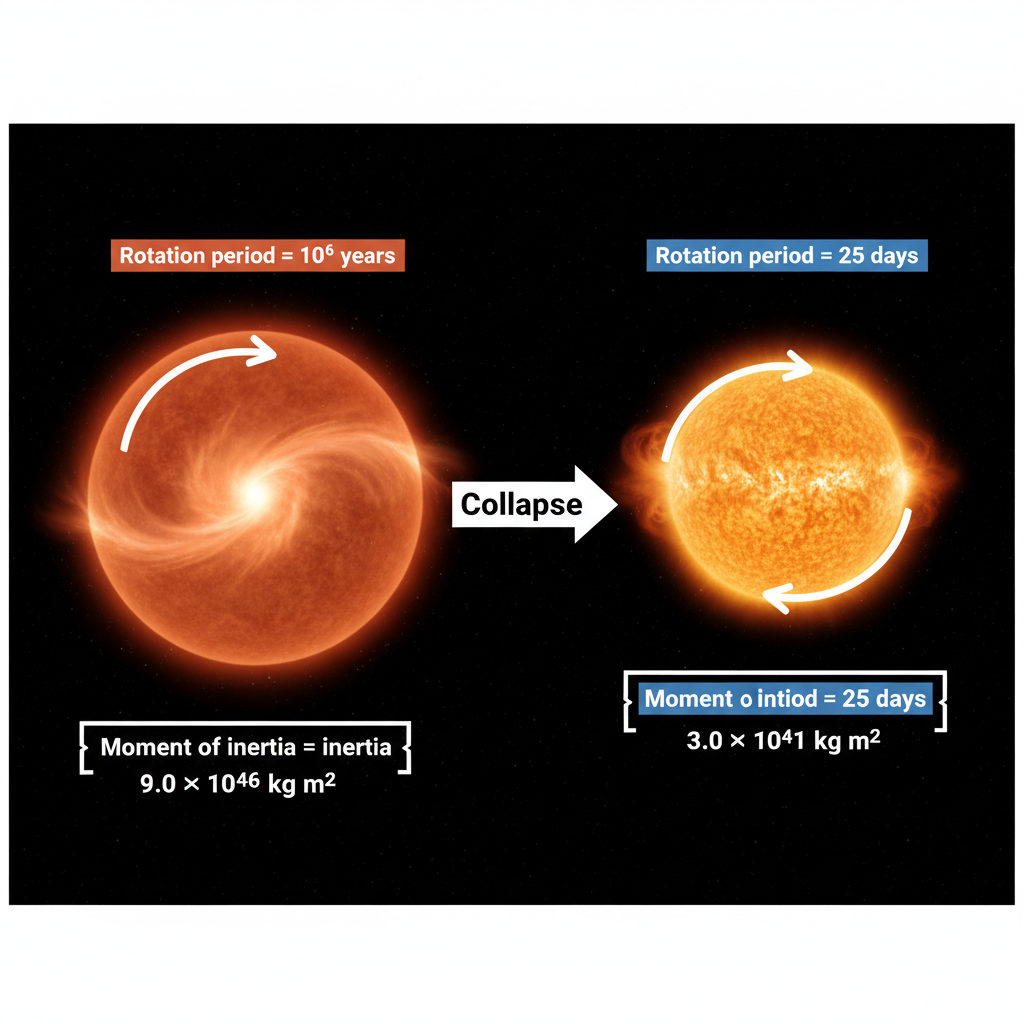
The nebular hypothesis proposes that the Sun and planets formed from a rotating cloud of gas and dust. The protosolar cloud had a moment of inertia of and rotated once every years. After collapse, the Sun has a moment of inertia of and an actual rotation period of 25 days.
a
Calculate the angular velocity of the protosolar cloud. [2]
b
Using conservation of angular momentum, deduce the expected rotation period of the Sun after collapse. Compare your result with the actual period and suggest one reason for any discrepancy. [2]
c
Calculate the change in rotational kinetic energy between the cloud and the Sun. Justify, with reference to your calculated values, angular momentum conservation, and energy transformation, why the nebula flattened into a disk rather than collapsing into a sphere. [4]
Solutions
That's every free question here — 5 of 359.
+354 more questions, plus Mock Papers & Worksheets, are waiting in Premium.