You're viewing free preview questions — 5 questions previewing here — subscribe to unlock 137 more, plus the Full Question Bank, Mock Papers & Worksheets.Upgrade
Series and Parallel Circuits — Free MYP5 Physics Practice Questions

1QuestionAdvantages and Applications of Each TypeConcept Practice
2 marks~3 minCriterion A
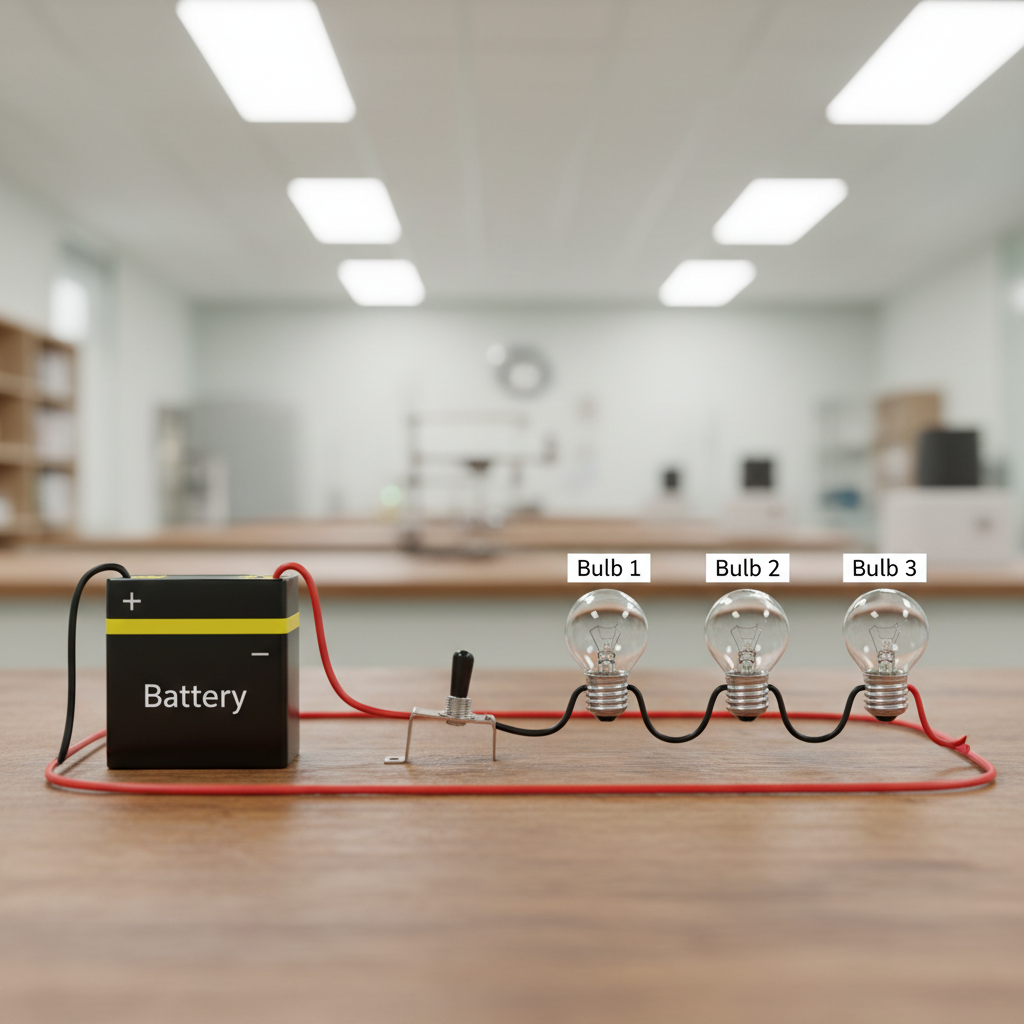
A series circuit contains a 6 V battery, a switch, and three identical bulbs connected in series.
a
Identify the component that controls whether current flows in this circuit. [1]
b
Explain what happens to the bulbs when this component is opened. [1]

Solutions
2QuestionAdvantages and Applications of Each TypeAssessment Practice
5 marks~8 minCriterion D
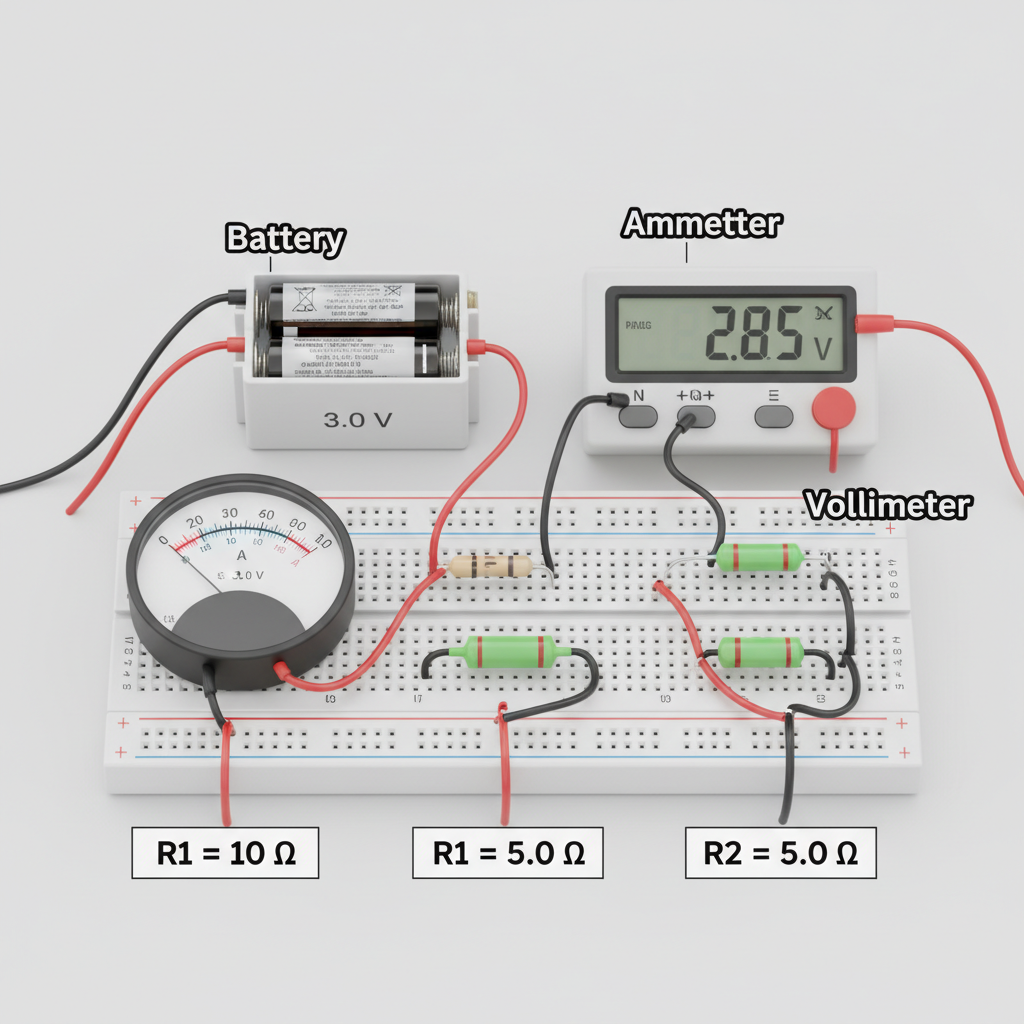
A student builds a series circuit using a 3.0 V battery, a 10 resistor , and a 5.0 resistor . Measurements give a current of 0.19 A and a terminal voltage of 2.85 V across the battery. The student claims these results do not align with the ideal series circuit model.
Evaluate the validity of this claim.
Evaluate the validity of this claim.
a
Calculate the total resistance predicted by the ideal series circuit model. [1]
b
Deduce the measured total resistance of the circuit using Ohm's law and the measured values. [1]
c
Analyse the discrepancy between the terminal voltage (2.85 V) and the rated voltage (3.0 V). In your analysis, calculate the internal resistance of the battery and evaluate whether the student's claim is correct. [3]
Solutions
3QuestionCurrent and Voltage in Series CircuitsConcept Practice
4 marks~6 minCriterion C
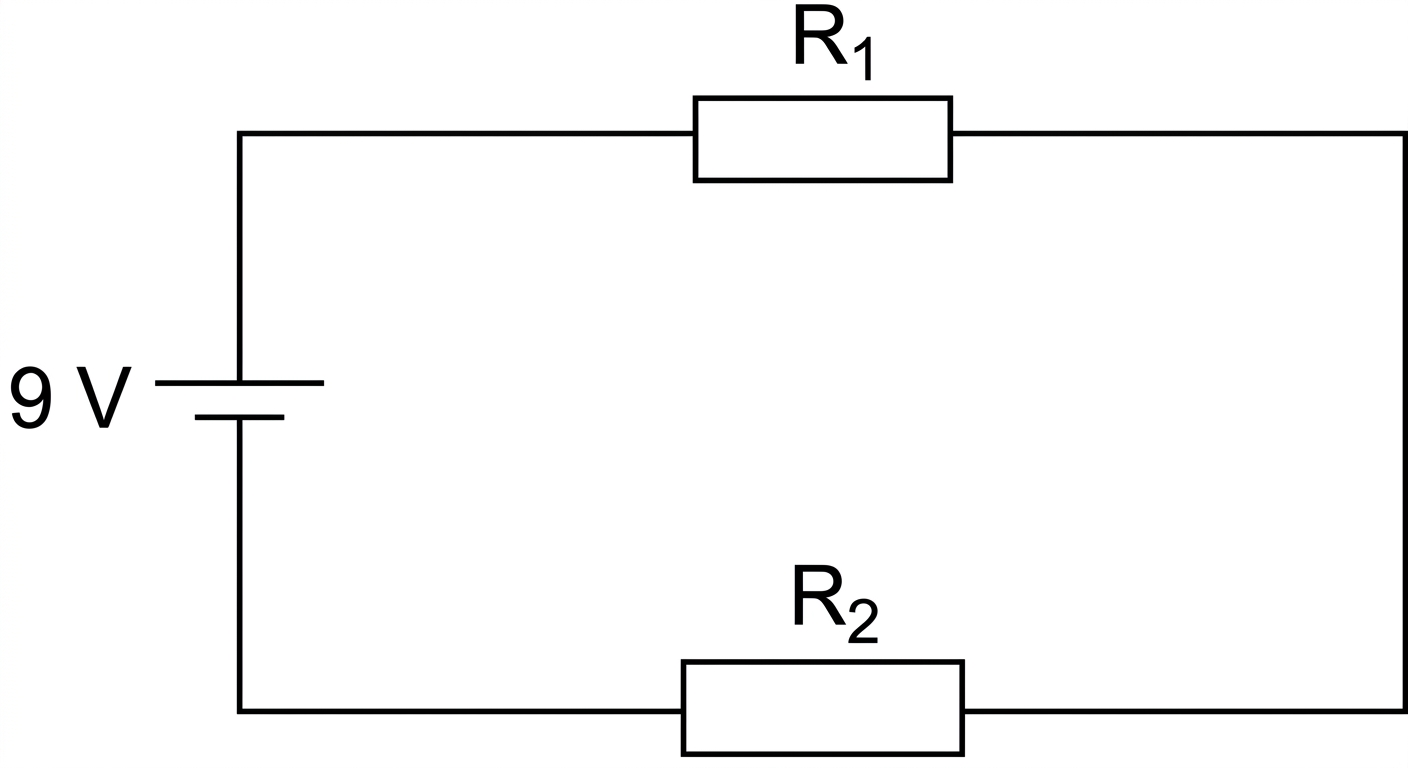
A series circuit in a school laboratory contains a 9 V battery, resistor , and resistor . A student measures the voltage drop across as 3.5 V.
a
State the relationship between the supply voltage and the individual voltage drops across components in a series circuit. [1]
b
Calculate the voltage drop across . [1]
c
A second student records voltmeter readings of 6 V across and 4 V across . Evaluate whether these readings are consistent with the 9 V supply, and justify your reasoning using the relationship from part (a). [2]
Solutions
4QuestionConstructing Simple Electrical CircuitsAssessment Practice
8 marks~12 minCriterion C
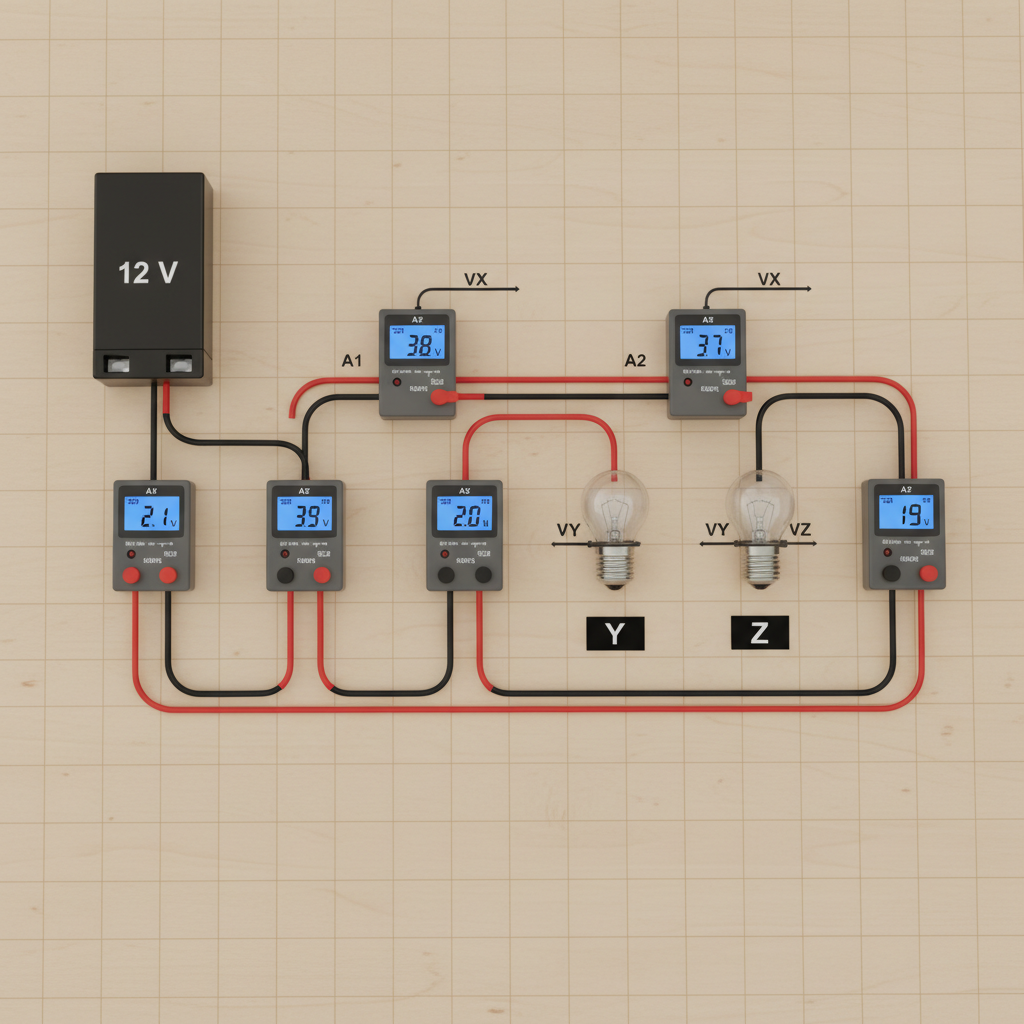
A student builds a circuit using a 12 V battery and three identical bulbs — X, Y, and Z — connected in series. Using a digital ammeter, the student records the current at three positions: before bulb X (2.1 A), between bulbs X and Y (2.0 A), and after bulb Z (1.9 A). A voltmeter measures the voltage across each bulb: X (3.8 V), Y (3.9 V), Z (3.7 V).
a
Calculate the total voltage across the three bulbs. Using the formula below, calculate the percentage difference between this total and the battery voltage. [2]
b
Using the formula below, calculate the percentage difference between the highest and lowest current readings. [2]
c
Evaluate whether the data support the conclusion that this is a true series circuit. In your response, apply Kirchhoff's voltage and current laws, reference your results from (a) and (b), and assess the role of measurement errors. [4]
Solutions
5QuestionAdvantages and Applications of Each TypeAssessment Practice
12 marks~18 minCriterion A
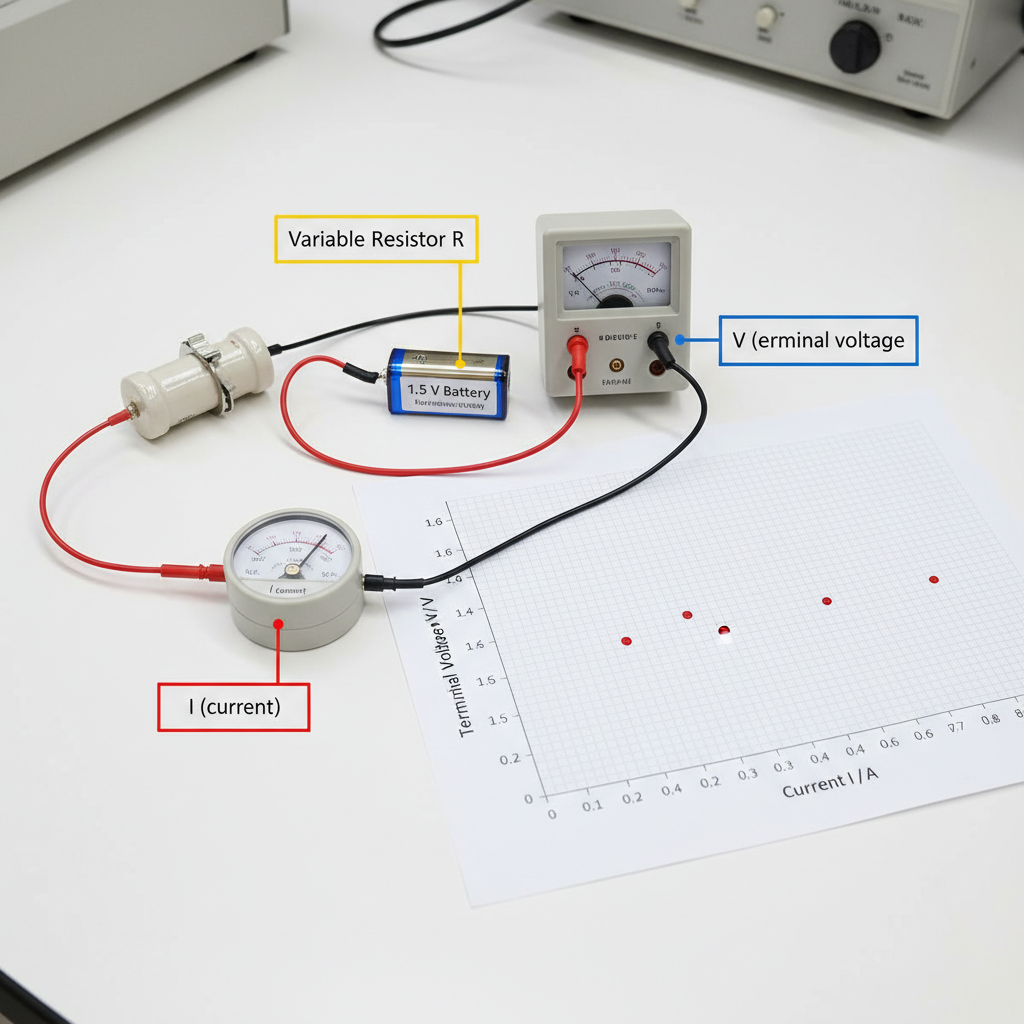
A student investigates the internal resistance of a battery by connecting it to a variable resistor. Terminal voltage is recorded for several values of current , and the results are plotted on a – graph. The graph is a straight line passing through the points and , with a -intercept at .
a
Deduce the internal resistance of the battery using the graph. Show all working. [4]
b
The relationship between terminal voltage and current is given by . Using your results from (a), calculate the electromotive force and explain how the graph confirms your answer. [4]
c
A student claims that internal resistance does not matter as long as the external resistance is large. Evaluate this claim, referring to terminal voltage, power loss, and a practical circuit context. [4]
Solutions
That's every free question here — 5 of 142.
+137 more questions, plus Mock Papers & Worksheets, are waiting in Premium.