You're viewing free preview questions — 5 questions previewing here — subscribe to unlock 135 more, plus the Full Question Bank, Mock Papers & Worksheets.Upgrade
Static and Current Electricity — Free MYP5 Physics Practice Questions

1QuestionCharging by Friction Induction and ConductionConcept Practice
2 marks~3 minCriterion A
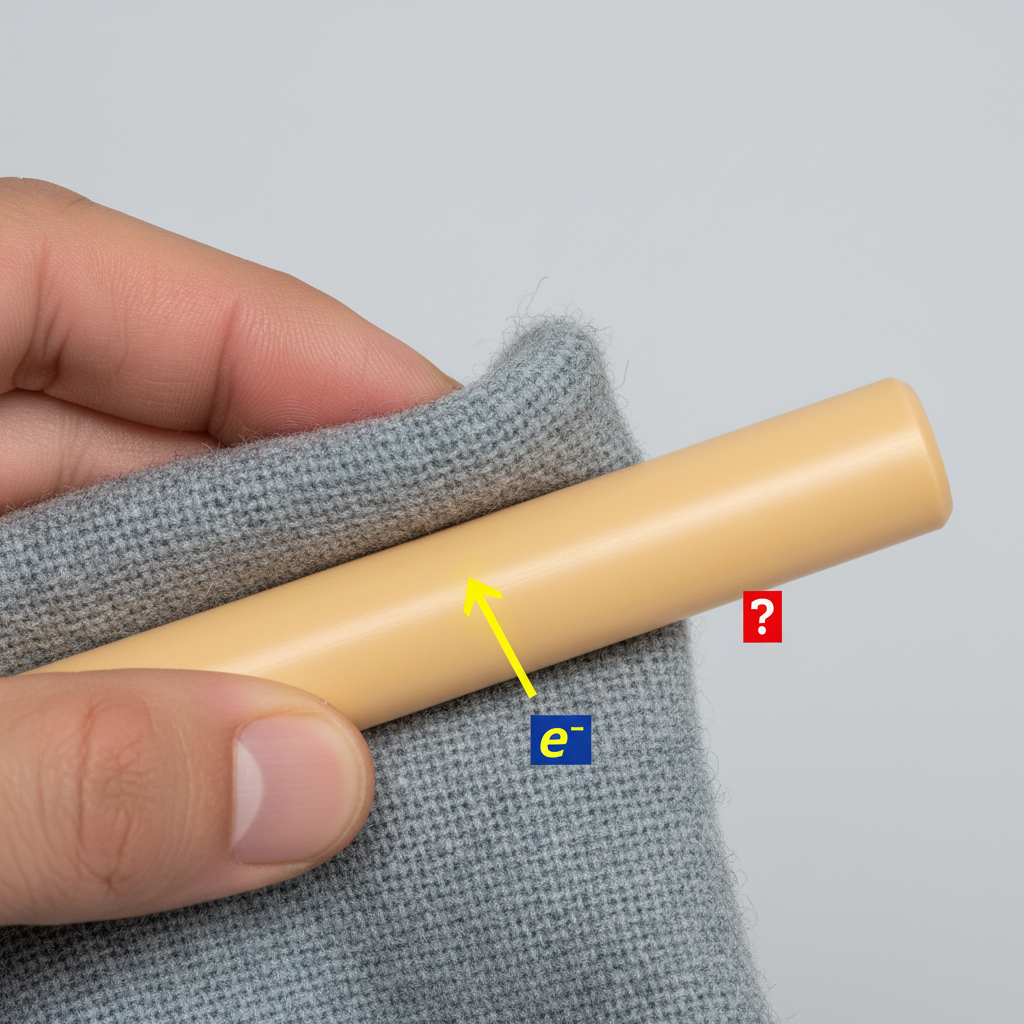
When a wool cloth is rubbed against a plastic rod, electrons transfer from the wool to the rod, as shown in the diagram.
a
State the type of charge acquired by the plastic rod after rubbing. [1]
b
The wool cloth is now held near (but not touching) a small, uncharged metal sphere suspended on a nylon thread. Explain how the sphere becomes polarised. [1]

Solutions
2QuestionCharging by Friction Induction and ConductionAssessment Practice
5 marks~8 minCriterion C
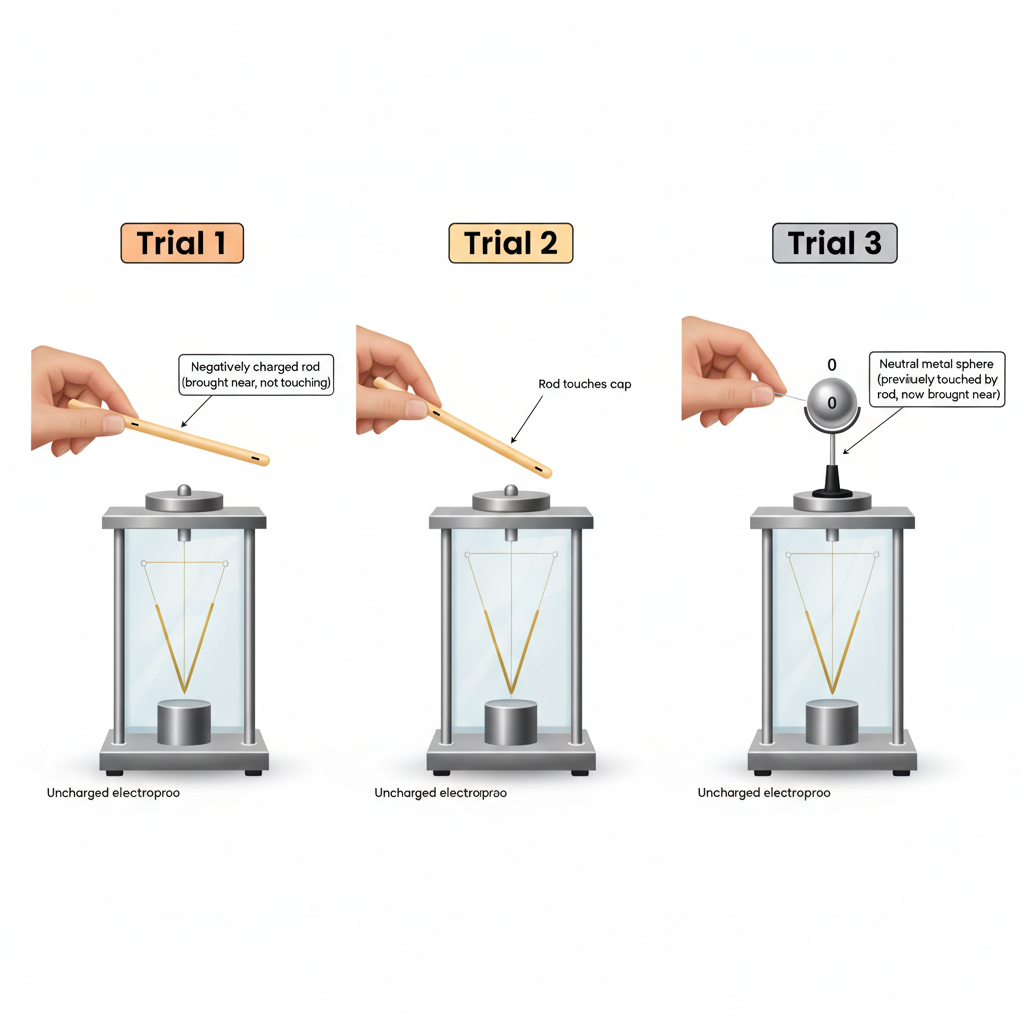
A student uses an electroscope to investigate electrostatic charging. Three trials are conducted with a negatively charged plastic rod and an uncharged electroscope.
Trial 1: The rod is held near (not touching) the metal cap. The gold leaves diverge, then return to their original position when the rod is removed.
Trial 2: The rod touches the metal cap. The leaves diverge and remain diverged after the rod is removed.
Trial 3: The rod touches a neutral metal sphere; the sphere is then held near (not touching) the cap. The leaves diverge, then return when the sphere is removed.
Trial 1: The rod is held near (not touching) the metal cap. The gold leaves diverge, then return to their original position when the rod is removed.
Trial 2: The rod touches the metal cap. The leaves diverge and remain diverged after the rod is removed.
Trial 3: The rod touches a neutral metal sphere; the sphere is then held near (not touching) the cap. The leaves diverge, then return when the sphere is removed.
a
Identify the charging method demonstrated in Trial 1 and Trial 2. [2]
b
Explain, using charge transfer and charge distribution, why the leaves remain diverged in Trial 2 but return to their original position in Trial 1. [2]
c
Evaluate the extent to which these three trials provide valid evidence for the standard electrostatic model of charging. In your response, discuss what Trial 3 demonstrates and identify limitations that affect the validity of the conclusions. [1]
Solutions
3QuestionElectric Field Concepts IntroductoryAssessment Practice
5 marks~8 minCriterion C
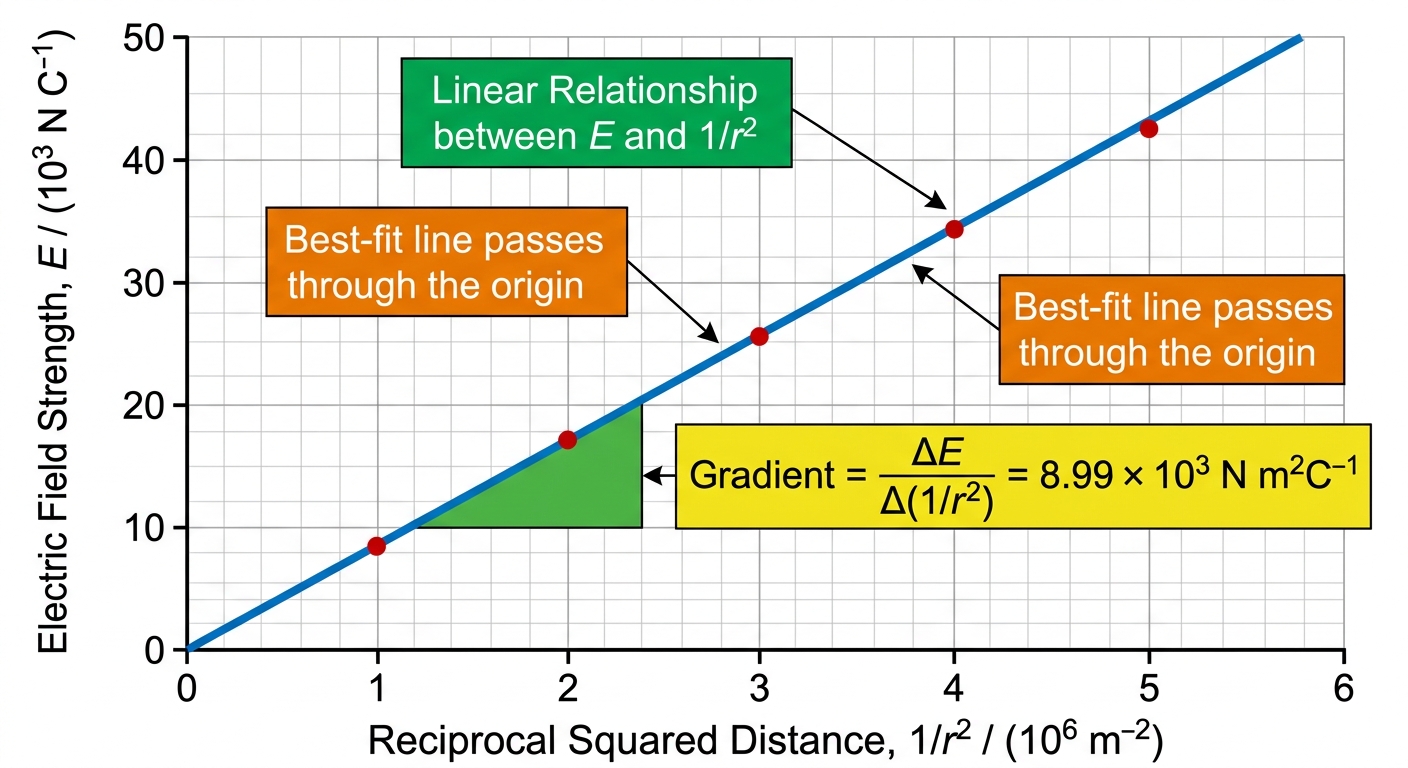
In an experiment, a student measures the electric field strength (in N/C) at several distances (in metres) from a small charged sphere. The data are plotted with on the y-axis and (in m) on the x-axis. The graph is a straight line through the origin with gradient N m C.
The electric field around a point charge is given by , where N m C.
The electric field around a point charge is given by , where N m C.
a
Show that the equation can be written in the linear form , and identify the gradient in terms of and . [1]
b
Calculate the magnitude of the charge . [2]
c
The sphere is replaced by a second sphere carrying a charge of C, placed at the same location. Analyse how the electric field strength at a fixed distance would differ from your result in (b), and explain what the negative sign indicates about the field. [2]
Solutions
4QuestionCharging by Friction Induction and ConductionAssessment Practice
6 marks~9 minCriterion D
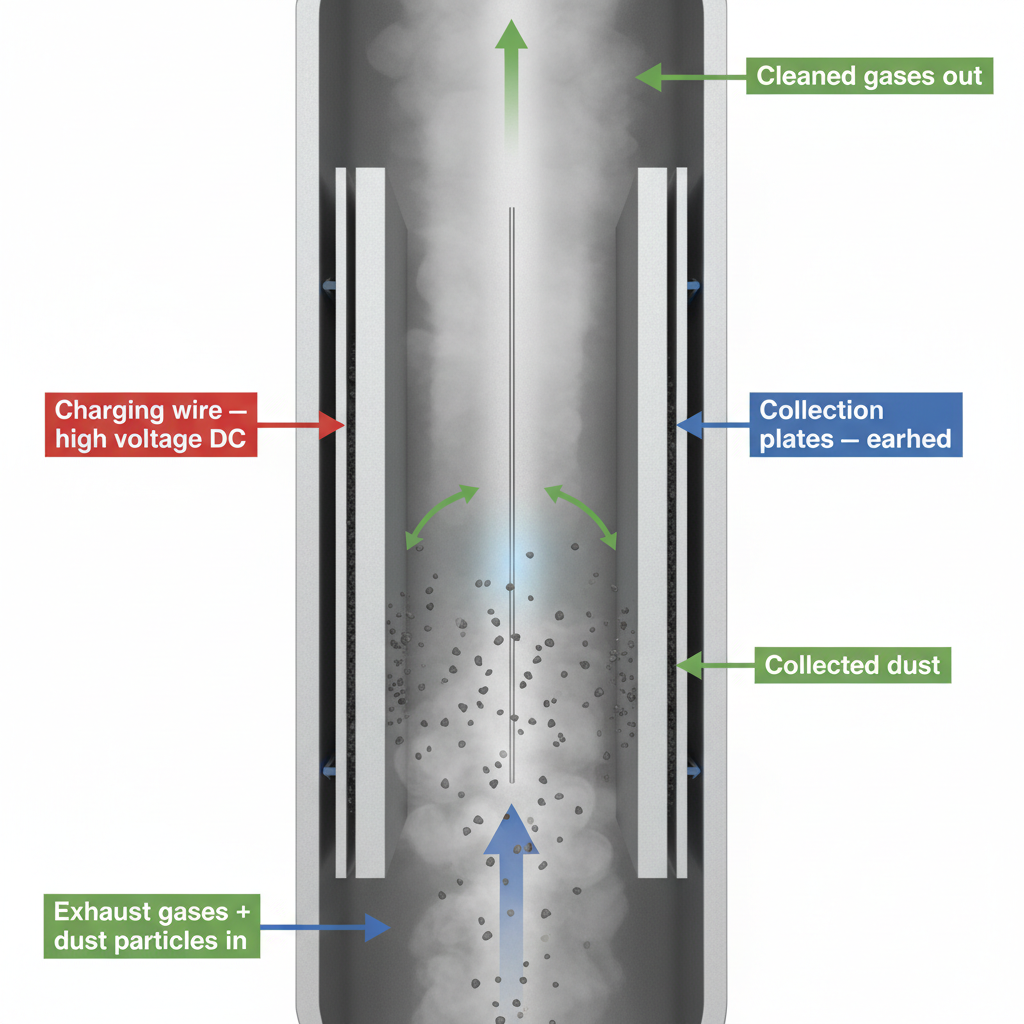
Coal-fired power plants use electrostatic precipitators (ESPs) to reduce particulate pollution. Inside an ESP, exhaust gases pass between a negatively charged wire and grounded collection plates. Dust particles enter the strong electric field, become charged, and are drawn to the plates, where they accumulate and are periodically removed. ESPs can capture up to 99% of particulate matter, yet they consume significant electrical power and generate toxic solid waste containing heavy metals such as lead and mercury.
a
Explain the process by which dust particles become charged inside an ESP and are subsequently removed from the exhaust gases. [2]
b
Analyse the trade-off between the air-quality benefits of ESP operation and its associated energy costs. [2]
c
Evaluate whether ESPs provide a comprehensive solution to coal-plant pollution, identifying one specific limitation in your response. [2]
Solutions
5QuestionCharging by Friction Induction and ConductionAssessment Practice
7 marks~11 minCriterion D
An electrostatic precipitator (ESP) removes smoke particles from exhaust gases in a coal-fired power plant. Gas passes through a chamber containing a high-voltage wire and oppositely charged collector plates. As a smoke particle approaches the wire, it becomes negatively charged by induction and is subsequently attracted to the positively charged collector plates.
a
Explain how a neutral smoke particle becomes negatively charged by induction as it approaches the high-voltage wire. [2]
b
Explain why the negatively charged particle moves toward the collector plate rather than returning toward the wire. [2]
c
Evaluate the effectiveness of an ESP when the collector plates are coated with a thick layer of high-resistivity dust and gas flow rate through the chamber is significantly increased. [3]
Solutions
That's every free question here — 5 of 140.
+135 more questions, plus Mock Papers & Worksheets, are waiting in Premium.