You're viewing free preview questions — 6 questions previewing here — subscribe to unlock 39 more, plus the Full Question Bank, Mock Papers & Worksheets.Upgrade
Back

Latent heat and changes of state — Free MYP5 Physics Practice Questions

Free questions

Open in full, with answers, mark scheme and examiner insights.

Question 1Criterion C · Band 1-4 · Easy · 4 marksrevisionprep.com

Heating and cooling curves

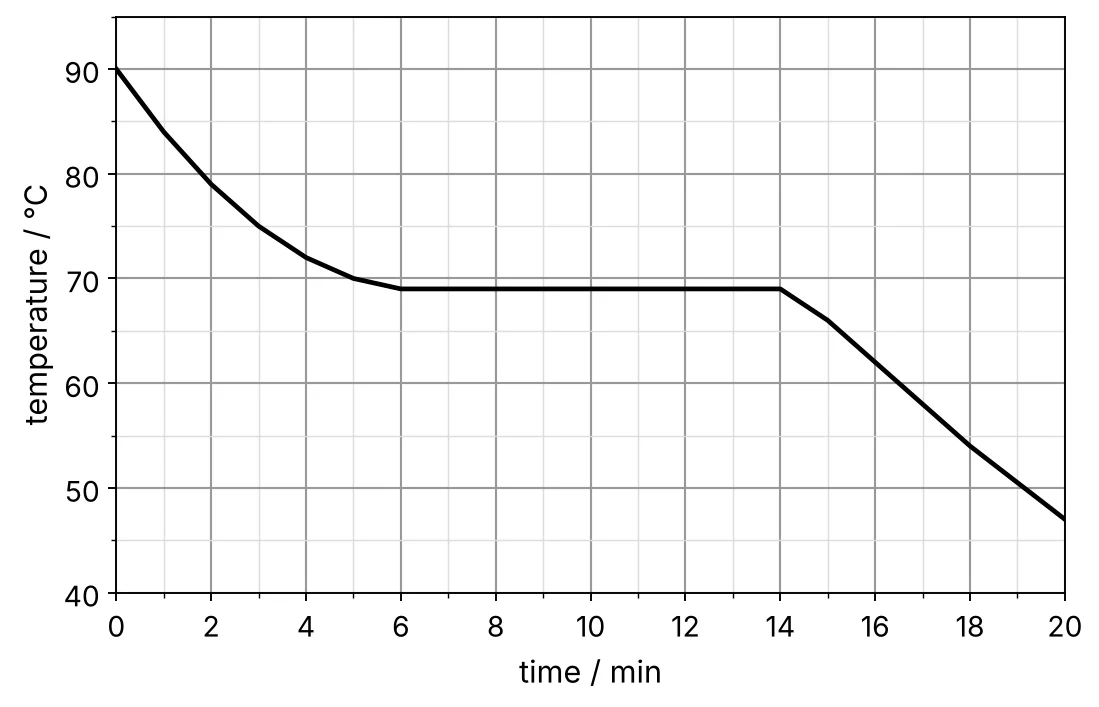
Stearic acid is a solid that melts at a fixed temperature. A test tube of molten stearic acid is left to cool and its temperature is recorded every minute. The graph shows the results.
Question diagram
(a)
Use the graph to state the freezing point of stearic acid. [1]Criterion C (ii) · Level 1-2
(b)
Explain why the temperature stays constant between 6 and 14 minutes even though the stearic acid is still losing energy to the surroundings. [3]Criterion C (iii) · Level 3-4

revisionprep.com

Summary Answer

Not available for this question.

Model Answer

Not available for this question.

Marking Scheme

Not available for this question.

Examiner Insights

Not available for this question.

Question 2Criterion A · Band 1-4 · Easy · 4 marksrevisionprep.com

Evaporation and cooling

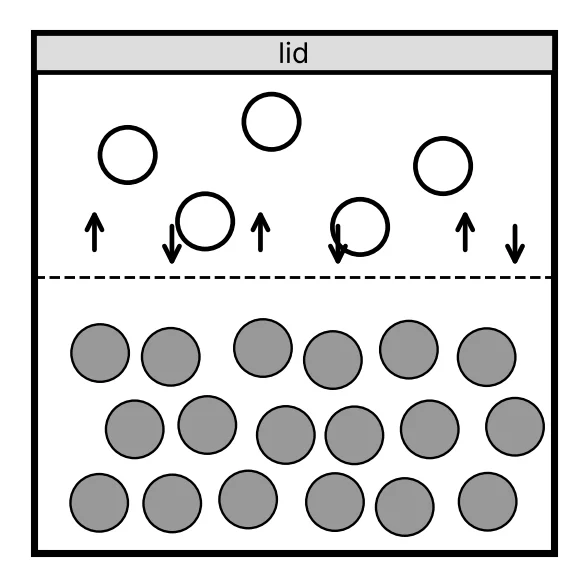
The diagram shows a liquid in a container with a tight lid. The arrows show particles leaving and returning to the surface of the liquid.
Question diagram
(a)
State what happens to the level of the liquid in the container over a long time. [1]Criterion A (i) · Level 1-2
(b)
Explain why evaporation continues but the level of the liquid stops falling. [3]Criterion A (iii) · Level 3-4

revisionprep.com

Summary Answer

Not available for this question.

Model Answer

Not available for this question.

Marking Scheme

Not available for this question.

Examiner Insights

Not available for this question.

Question 3Criterion A · Band 1-6 · Medium · 6 marksrevisionprep.com

Specific latent heat: E = mL

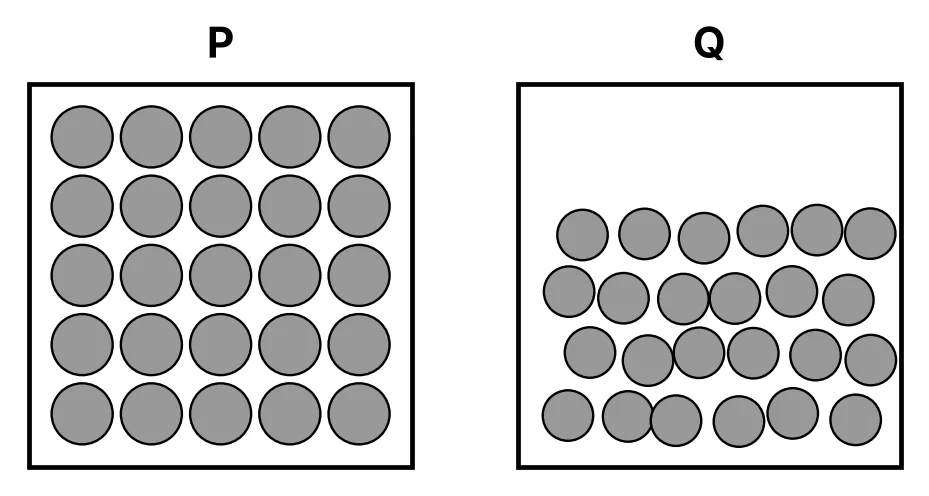
The diagrams show the arrangement of particles in a sample of water at 0 °C in two different states, P and Q. A heater supplies energy at a steady rate while the sample changes from state P to state Q.
Question diagram
(a)
State which diagram shows the solid. [1]Criterion A (i) · Level 1-2
(b)
Describe how the arrangement and the movement of the particles change as P changes to Q. [2]Criterion A (i) · Level 3-4
(c)
The thermometer reading stays at 0 °C while the sample changes from P to Q, even though the heater is on. Explain why. [3]Criterion A (iii) · Level 5-6

revisionprep.com

Summary Answer

Not available for this question.

Model Answer

Not available for this question.

Marking Scheme

Not available for this question.

Examiner Insights

Not available for this question.

Question 4Criterion A + C · Band 1-6 · Medium · 8 marksrevisionprep.com

Heating and cooling curves

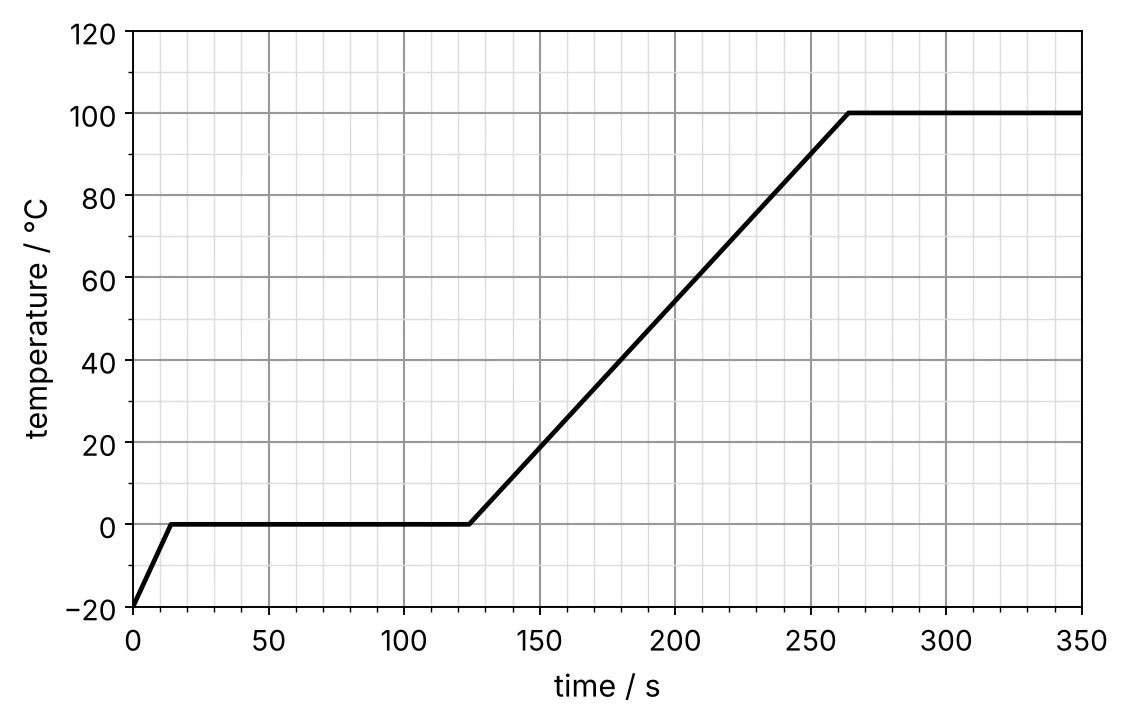
A block of ice of mass 0.50 kg at -20 °C is heated by an electric heater of power 1500 W. All the energy from the heater is transferred to the ice and to the water it forms. The graph shows how the temperature changes with time. The specific heat capacity of ice is 2100 J kg⁻¹ °C⁻¹ and of water is 4200 J kg⁻¹ °C⁻¹.
Question diagram
(a)
Use the graph to state the time at which the ice starts to melt and the time at which it finishes melting. [2]Criterion C (ii) · Level 1-2
(b)
Calculate the energy supplied by the heater while the ice is melting. [2]Criterion A (ii) · Level 3-4
(c)
Calculate the specific latent heat of fusion of ice from these results. [2]Criterion A (ii) · Level 5-6
(d)
The line is less steep for liquid water than for ice. Use the information in the question to explain why. [2]Criterion C (iii) · Level 5-6

revisionprep.com

Summary Answer

Not available for this question.

Model Answer

Not available for this question.

Marking Scheme

Not available for this question.

Examiner Insights

Not available for this question.

Question 5Criterion B + A · Band 1-8 · Challenge · 11 marksrevisionprep.com

Specific latent heat: E = mL

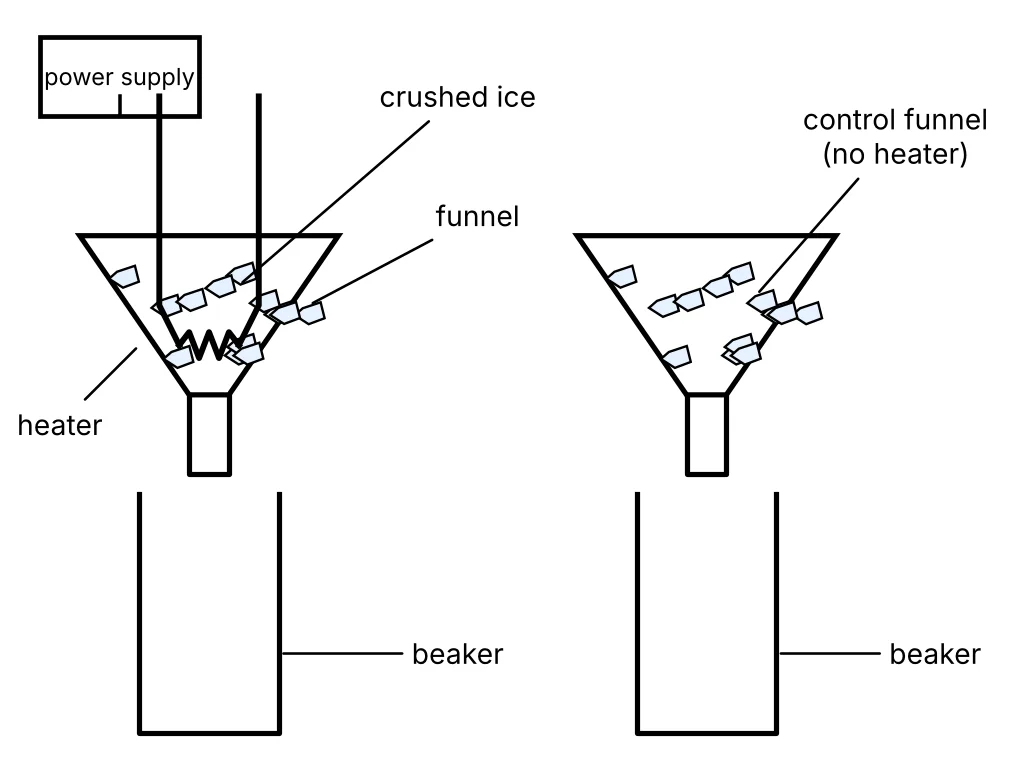
A student measures the specific latent heat of fusion of ice using the apparatus shown. An electric heater of power 120 W is switched on for 250 s. The ice in both funnels starts at 0 °C. The mass of water collected in the beaker under the heater funnel is 0.085 kg. The mass of water collected in the beaker under the control funnel is 0.010 kg.
Question diagram
(a)
Calculate the energy supplied by the heater. [2]Criterion A (ii) · Level 1-2
(b)
Calculate the mass of ice melted by the heater. [1]Criterion A (ii) · Level 1-2
(c)
Calculate the specific latent heat of fusion of ice from these results. [2]Criterion A (ii) · Level 3-4
(d)
Explain why the student uses the control funnel. [2]

(e) The accepted value is 3.3 × 10⁵ J kg⁻¹, so the student's value is too high. Explain why a mass that is too small gives a value that is too high, suggest a reason for the small mass, and describe two changes to the method that would give a value closer to the accepted one. [4]
Criterion B (iv) · Level 3-4

revisionprep.com

Summary Answer

Not available for this question.

Model Answer

Not available for this question.

Marking Scheme

Not available for this question.

Examiner Insights

Not available for this question.

Question 6Criterion D + A · Band 3-8 · Challenge · 10 marksrevisionprep.com

Evaporation and cooling

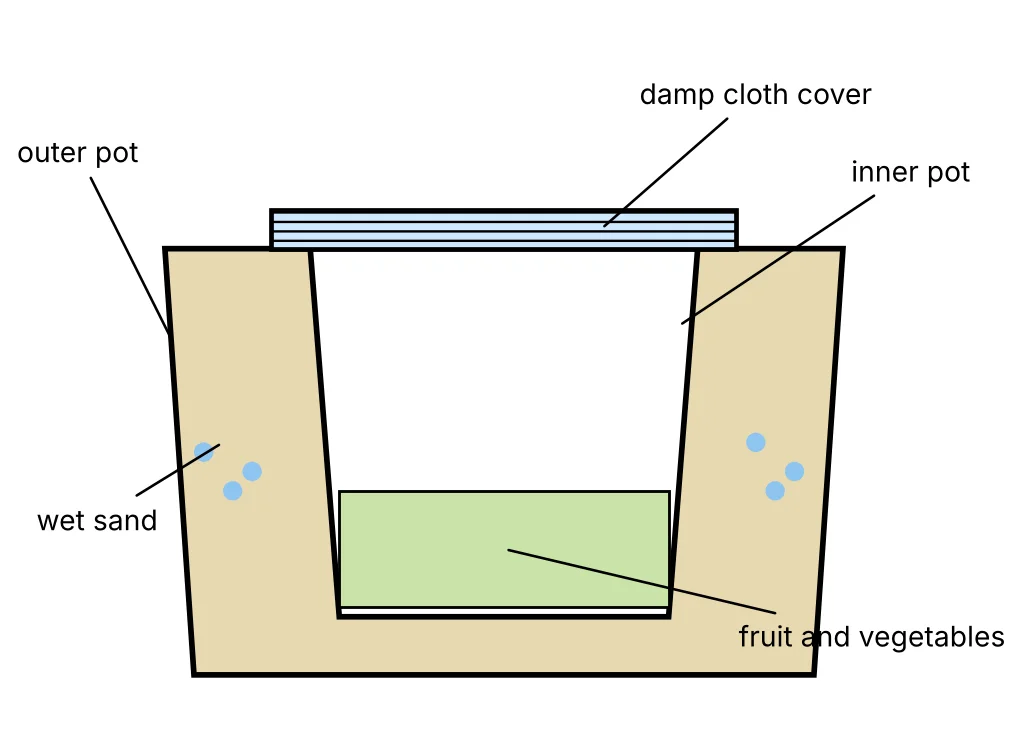
In hot regions some families keep tomatoes in a pot-in-pot cooler. A small pot is placed inside a larger pot and the gap between them is filled with wet sand. The top is covered with a damp cloth, as shown. About 0.30 kg of water evaporates from the sand and cloth each day. Take the specific latent heat of vaporisation of water as 2.4 × 10⁶ J kg⁻¹. The table shows how long tomatoes last. A pot-in-pot cooler costs about 5 dollars to make.

conditionsoutside air / °Cinside the cooler / °Ctomatoes last / daysno cooler, dry season38383pot-in-pot, dry season382414pot-in-pot, humid season32296\begin{array}{|l|c|c|c|}\hline \text{conditions} & \text{outside air / °C} & \text{inside the cooler / °C} & \text{tomatoes last / days} \\ \hline \text{no cooler, dry season} & 38 & 38 & 3 \\ \hline \text{pot-in-pot, dry season} & 38 & 24 & 14 \\ \hline \text{pot-in-pot, humid season} & 32 & 29 & 6 \\ \hline\end{array}
Question diagram
(a)
Calculate the energy removed from the cooler each day by the evaporating water. [2]Criterion A (ii) · Level 3-4
(b)
Use the table to explain how the cooler reduces food waste in the dry season and why it works less well in the humid season. [3]Criterion D (i) · Level 5-6
(c)
A village without electricity is deciding between pot-in-pot coolers for each family and one shared solar refrigerator that costs 600 dollars. Evaluate the two options from at least two perspectives, such as economic, social or environmental. [5]Criterion D (ii) · Level 7-8

revisionprep.com

Summary Answer

Not available for this question.

Model Answer

Not available for this question.

Marking Scheme

Not available for this question.

Examiner Insights

Not available for this question.

That's every free question here — 6 of 45.

+39 more questions, plus Mock Papers & Worksheets, are waiting in Premium.

Upgrade