You're viewing free preview questions — 6 questions previewing here — subscribe to unlock 63 more, plus the Full Question Bank, Mock Papers & Worksheets.Upgrade
Back

Work, power and efficiency — Free MYP5 Physics Practice Questions

Free questions

Open in full, with answers, mark scheme and examiner insights.

Question 1Criterion C + A · Band 1-4 · Easy · 4 marksrevisionprep.com

Power: P = W/t

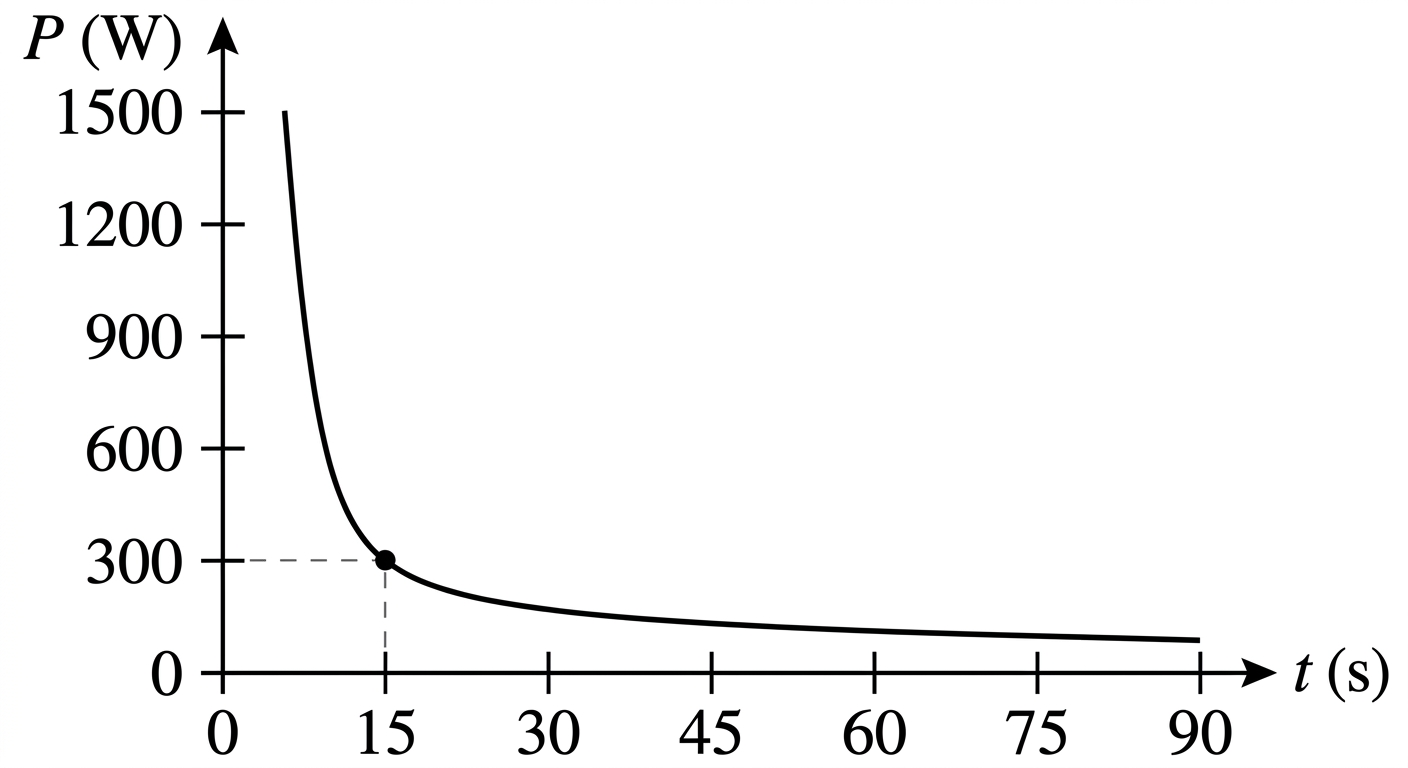
A harbour crane lifts identical shipping containers. Each lift needs 4500 J of work. The graph shows how the crane's power output PP depends on the time tt taken for one lift.
Question diagram
(a)
State the equation linking power, work done and time. [1]Criterion A (i) · Level 1-2
(b)
Calculate the power output when a lift takes 45 s, and check your answer against the graph. [1]Criterion C (ii) · Level 3-4
(c)
Explain the shape of the graph. [2]Criterion C (ii) · Level 3-4

revisionprep.com

Summary Answer

Not available for this question.

Model Answer

Not available for this question.

Marking Scheme

Not available for this question.

Examiner Insights

Not available for this question.

Question 2Criterion A + C · Band 1-4 · Easy · 4 marksrevisionprep.com

Units: joules, watts and conversions

A motor lifts a 5.0 kg mass through a fixed height of 2.0 m. The graph shows how the motor's power output depends on the time taken for the lift. Take g=10g = 10 N kg−1^{-1}.
(a)
Calculate the work done against gravity in each lift, with its unit. [1]Criterion A (ii) · Level 1-2
(b)
Use the point (5 s, 20 W) on the graph to show that power × time gives the work done in joules. Explain why the unit W s is the same as the joule. [2]Criterion C (ii) · Level 3-4
(c)
The motor is replaced with one that delivers 0.25 kW. Calculate the time for the same lift. [1]Criterion A (ii) · Level 3-4

revisionprep.com

Summary Answer

Not available for this question.

Model Answer

Not available for this question.

Marking Scheme

Not available for this question.

Examiner Insights

Not available for this question.

Question 3Criterion A + C · Band 3-6 · Medium · 7 marksrevisionprep.com

Work done: W = Fd

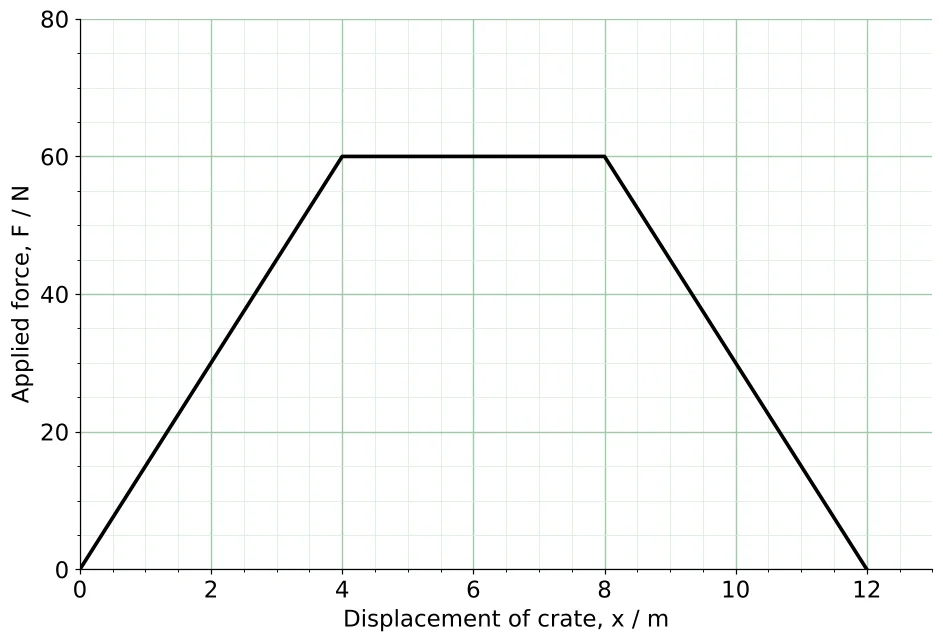
A worker drags a 20 kg crate in a straight line across a warehouse floor. The graph shows how the applied force varies with the displacement of the crate. The crate starts from rest.
Question diagram
(a)
Determine the total work done by the worker over the 12 m. [3]Criterion C (ii) · Level 3-4
(b)
Friction does 300 J of work against the motion of the crate over the 12 m. Calculate the speed of the crate at x=12x = 12 m. [3]Criterion A (ii) · Level 5-6
(c)
Explain why the kinetic energy of the crate at x=12x = 12 m is less than the work done by the worker. [1]Criterion A (i) · Level 3-4

revisionprep.com

Summary Answer

Not available for this question.

Model Answer

Not available for this question.

Marking Scheme

Not available for this question.

Examiner Insights

Not available for this question.

Question 4Criterion A + C · Band 3-6 · Medium · 8 marksrevisionprep.com

Efficiency = useful output ÷ total input × 100%
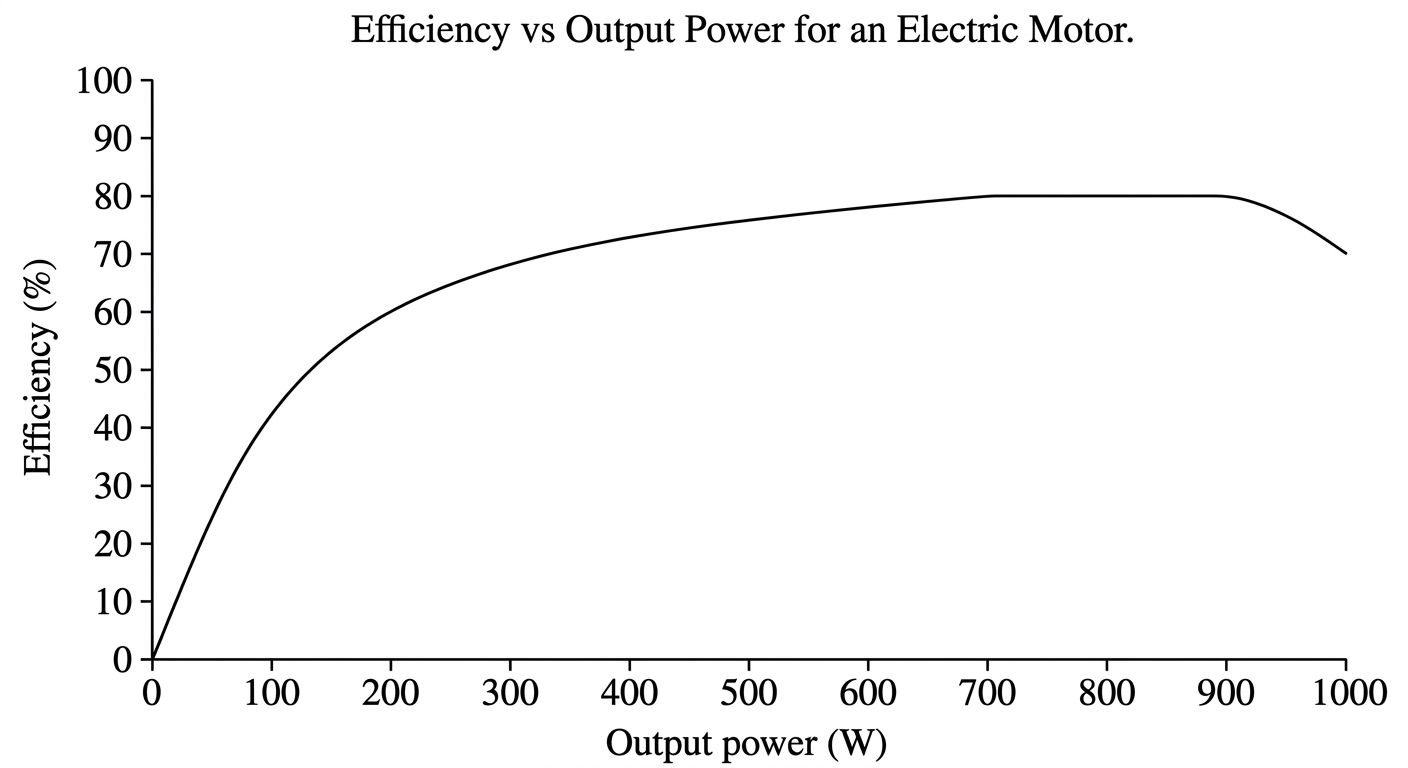
An electric motor is tested over a range of useful output powers. The graph shows how its efficiency varies with output power. The motor has fixed internal losses, such as friction in the bearings, that stay roughly the same at every output power.
Question diagram
(a)
Describe the trend shown by the graph. [2]Criterion C (ii) · Level 3-4
(b)
Explain why the efficiency is very low at small output powers. [2]Criterion A (i) · Level 5-6
(c)
Use the graph to determine the electrical input power needed when the motor delivers 400 W of useful output. [2]Criterion C (ii) · Level 5-6
(d)
An engineer says the motor should always be run at 800 W because that is where it is most efficient. Evaluate this advice for a motor that only needs to deliver 400 W. [2]Criterion A (iii) · Level 5-6

revisionprep.com

Summary Answer

Not available for this question.

Model Answer

Not available for this question.

Marking Scheme

Not available for this question.

Examiner Insights

Not available for this question.

Question 5Criterion B + C · Band 5-8 · Challenge · 10 marksrevisionprep.com

Work done: W = Fd

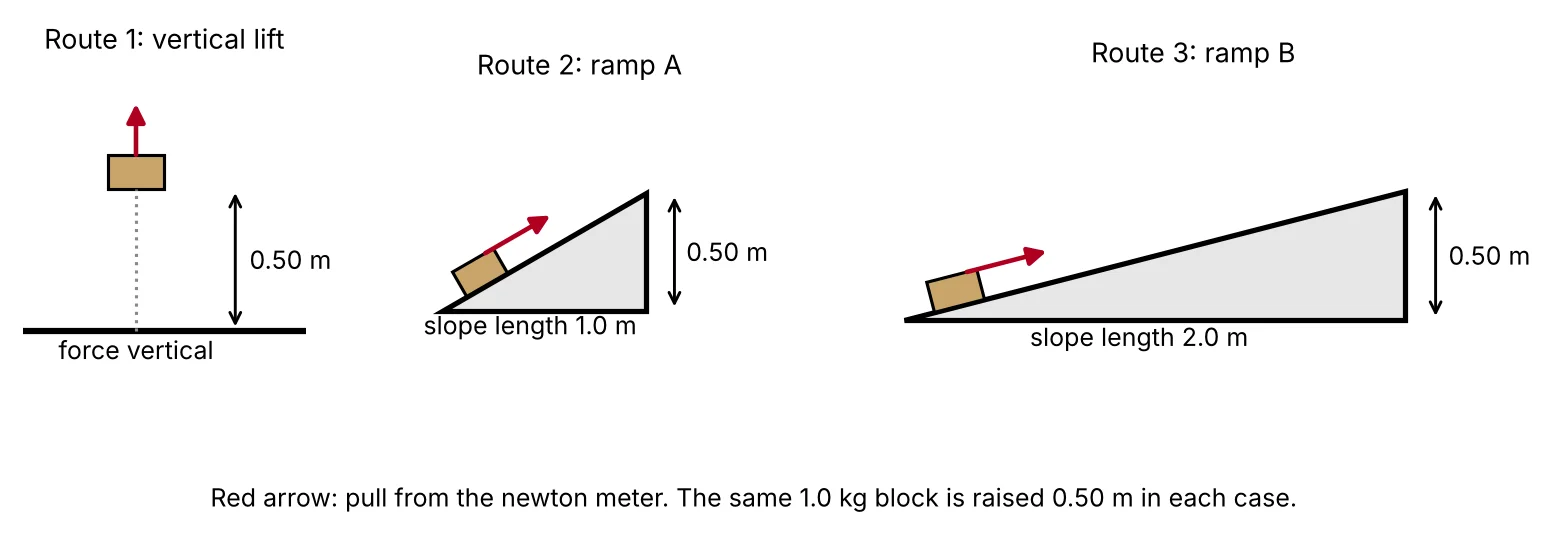
A student asks: does the route taken to raise a load change the work she must do? She raises the same 1.0 kg block through a vertical height of 0.50 m by three routes, as drawn: lifting it straight up, and pulling it up two ramps with the same surface. She pulls the block at a steady speed with a newton meter held parallel to its path. Take g=9.8g = 9.8 N kg−1^{-1}.
Question diagram
(a)
Formulate a testable hypothesis about how the work done by the student depends on the length of the route, and explain it using scientific reasoning. [2]Criterion B (ii) · Level 5-6
(b)
Identify the independent variable and the dependent variable, and explain how two other variables are controlled in this investigation. [3]Criterion B (iii) · Level 5-6
(c)
Explain why the newton meter must be held parallel to the route and the block pulled at a steady speed. [2]Criterion B (iv) · Level 5-6
(d)
The student's results are shown in the table. RouteNewton meter reading (N)Distance moved along the route (m)Vertical lift9.80.50Ramp A6.21.0Ramp B4.02.0\begin{array}{|l|c|c|}\hline \text{Route} & \text{Newton meter reading (N)} & \text{Distance moved along the route (m)} \\ \hline \text{Vertical lift} & 9.8 & 0.50 \\ \hline \text{Ramp A} & 6.2 & 1.0 \\ \hline \text{Ramp B} & 4.0 & 2.0 \\ \hline\end{array} Use the results to calculate the work done on each route. Evaluate your hypothesis, and explain what the results show about the force needed and the work done. [3]Criterion C (ii), C (iii) · Level 7-8

revisionprep.com

Summary Answer

Not available for this question.

Model Answer

Not available for this question.

Marking Scheme

Not available for this question.

Examiner Insights

Not available for this question.

Question 6Criterion D + A · Band 3-8 · Challenge · 10 marksrevisionprep.com

Improving Efficiency in Machines and Devices
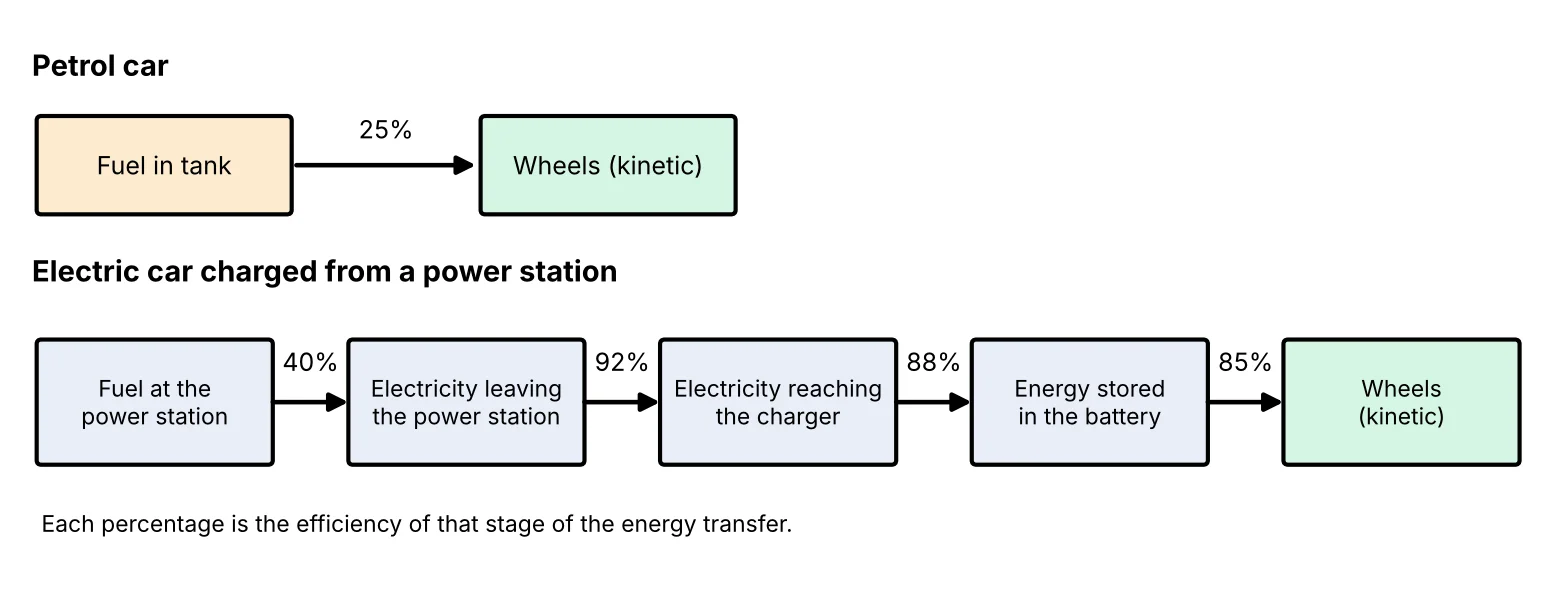
The diagram shows the efficiency of each stage in transferring energy to the wheels of a petrol car and of an electric car that is charged from a fossil-fuelled power station. A journey needs 50 MJ of kinetic energy at the wheels.
Question diagram
(a)
Calculate the overall efficiency of the electric car from the fuel at the power station to the wheels. [2]Criterion A (ii) · Level 3-4
(b)
Calculate the energy from the fuel needed for the journey in the petrol car and in the electric car. State how much less energy the electric car needs. [2]Criterion A (ii) · Level 5-6
(c)
Using your results, explain one way in which electric cars could reduce the environmental impact of transport, and one reason why the benefit is small when the electricity comes from burning fuel. [2]Criterion D (i) · Level 5-6
(d)
A country plans to replace petrol cars with electric cars. Discuss the economic implications and one social implication of the plan, and give a justified conclusion about whether the change is worthwhile. [4]Criterion D (ii), D (iii) · Level 7-8

revisionprep.com

Summary Answer

Not available for this question.

Model Answer

Not available for this question.

Marking Scheme

Not available for this question.

Examiner Insights

Not available for this question.

That's every free question here — 6 of 69.

+63 more questions, plus Mock Papers & Worksheets, are waiting in Premium.

Upgrade