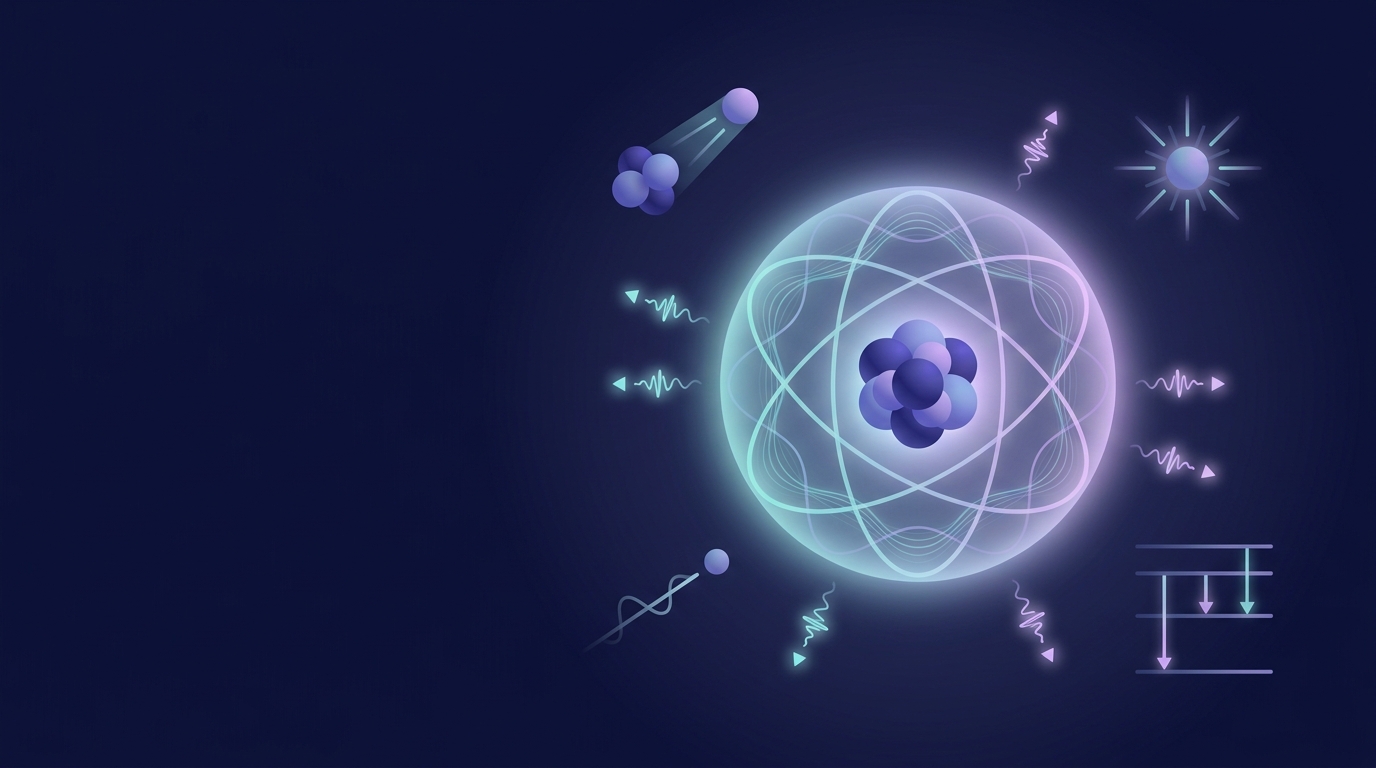
Atomic Physics
Atomic physics here is detective work, not memorisation. You never see a nucleus directly — you reconstruct it from how alpha particles bounce off gold foil, how long a sample takes to lose its activity, and how far radiation travels through paper, aluminium or lead. Every real exam question in this bank rewards the same skill: pull two actual numbers off a table or graph and use them to justify a conclusion about structure — not just recite 'protons are positive.'
Overview — The Shape of Atomic Physics
This topic builds in one direction: what an atom is made of, why some combinations of protons and neutrons are stable and others aren't, what happens when an unstable nucleus gives way (decay), what actually comes flying out (alpha/beta/gamma), and finally what that means for how we handle it safely. Almost every mark in the exam bank comes from linking a specific number in a table to a specific structural or safety conclusion.
- Historical route: Thomson's plum pudding → Rutherford's gold foil evidence → Bohr's planetary model → the modern electron cloud model.
- Nuclide identity is fixed by two counting numbers only: atomic number (protons) and mass number (protons + neutrons) — everything about isotopes and ions follows from getting these two right.
- Decay is random for a single nucleus but statistically reliable for a huge sample — that contradiction is exactly what half-life exploits.
- Radiation type (alpha/beta/gamma) trades ionising power against penetrating power in opposite directions — the more damaging up close, the less it travels.
The shape of the chapter
Command terms that decide your mark
| Command term | What it demands | AO | Mark-earning move |
|---|---|---|---|
| Describe | State a pattern or feature in detail, with no reasoning required | AO1/AO2 | Cite at least two actual data values or a clear trend direction — 'it decreases' alone scores 0/2 on pattern questions like the scattering-angle tables |
| Explain | Give the reason or mechanism linking a cause to an effect | AO2 | Must include the causal link ('...because...') — a bare fact with no mechanism only earns half marks |
| Justify | Support a stated conclusion with specific evidence | AO3 | Reference the actual data ('only 5 particles at 180°'), not just the general theory by itself |
| Identify | Name or select from given information | AO1 | One word/phrase is enough — extra explanation isn't credited and wastes time |
| Deduce | Use given data to reach a conclusion that isn't stated outright | AO3 | Show the working chain (Z → protons → charge check), not just the final answer |
| Evaluate | Weigh strengths and limitations to reach a balanced judgement | AO3 | Must give a benefit AND a limitation plus a final judgement — one-sided answers cap at half marks |
Key point
Overview