Fields
D.1–D.4
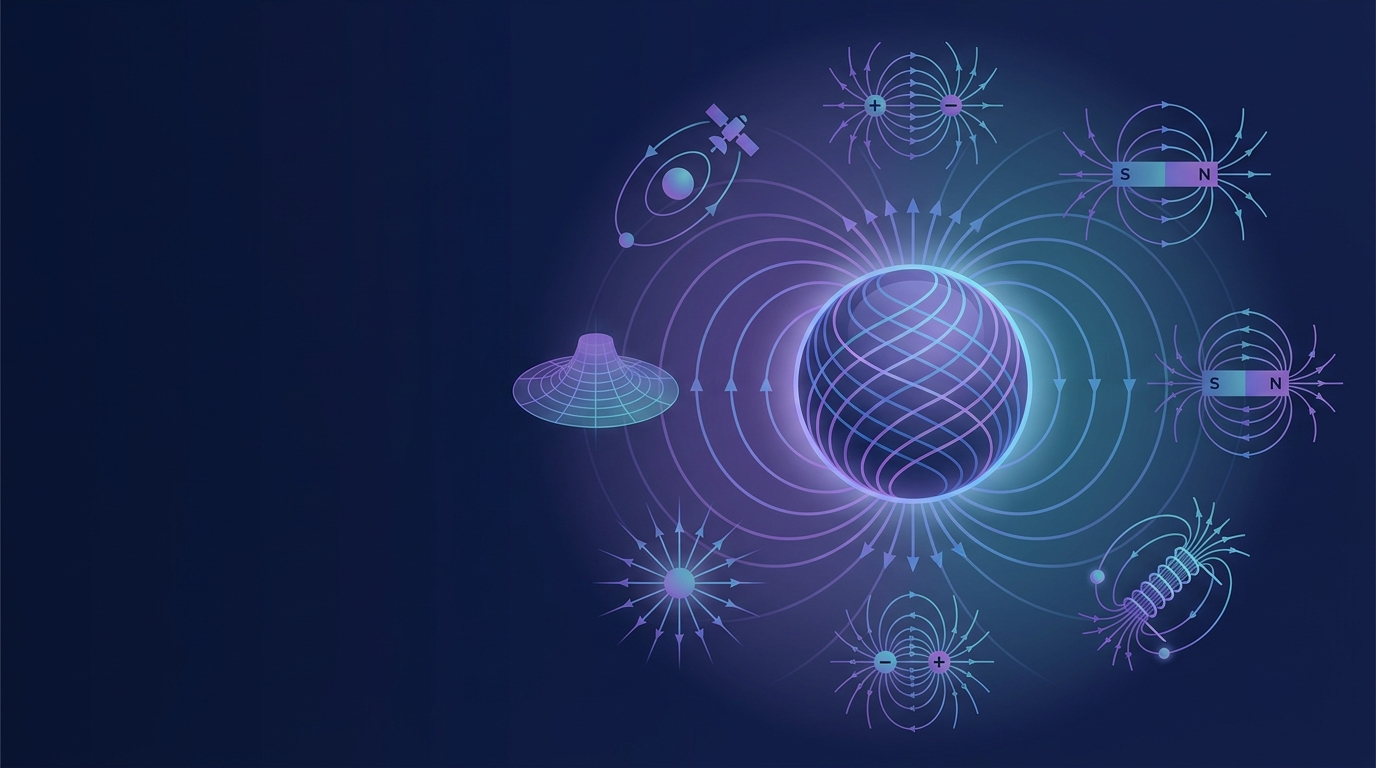
Fields is where gravity, electricity and magnetism finally get shown to be the same trick played three times: a source (mass, charge, or moving charge), a field that falls off as or sits uniform between plates, and a potential that tells you the energy cost of moving through it. HL bolts on two whole subtopics that SL never sees — motion in combined electric and magnetic fields, and electromagnetic induction — and a huge fraction of the marks in this theme come from just two calculation types: transformer turns ratios and induced emf from . Get those automatic, then spend the rest of your revision on the sign conventions ( is always negative), the vector-vs-scalar traps ( vs , vs ), and the direction rules (Lenz's law, ) that separate a 6 from a 7.
Overview
Why every field question looks the same underneath
Strip away the context and every field problem asks the same three questions: what's the source, is the field radial () or uniform, and does the force do work as the object moves? Gravitational and electric fields share identical mathematical form — inverse-square force, a scalar potential, potential energy that depends on separation — differing only in the constant of proportionality and in whether the force can ever be repulsive. Magnetism is the odd one out: the force on a moving charge is always perpendicular to velocity, so it can steer a particle but never change its speed.
HL adds two subtopics built entirely on that magnetic quirk and on one further idea — a changing field creates its own emf, and hence its own current, without any battery in sight. D.3 (motion in electromagnetic fields) and D.4 (induction) are HL-only; if you're revising both levels, don't assume SL content covers transformers or circular motion in -fields — it doesn't.
The shape of the chapter
Command terms this topic actually tests
| Command term | What it demands | AO | Mark-earning move |
|---|---|---|---|
| Determine | Obtain a numerical answer with the working that leads to it | AO2 | Full marks need the substituted equation AND the final value with units — a bare correct number can still drop 1 mark. |
| Derive | Start from a stated law (Newton's second law, energy conservation) and manipulate algebra to reach the given expression | AO2 | Every line must follow logically; skipping the step that cancels a variable (e.g. cancelling for escape velocity) loses the method mark even if you quote the right final line. |
| Sketch | Draw an approximately correct shape with key features labelled, not a precisely plotted curve | AO2 | For or against , marks go to showing the curvature (not a straight line) and correct intercepts/asymptote — not to ruler-perfect plotting. |
| Explain | Give a reason tied to a named physics principle, not a restated fact | AO3 | Writing 'Lenz's law' with no link to energy conservation or the specific direction in that scenario typically earns 0 of the 2 marks on offer. |
| Compare | State similarities AND differences between two named things | AO3 | Only listing differences (or only similarities) caps the mark at half credit — the classic gravitational-vs-electric field question tests exactly this. |
Key point
Overview