Wave Behaviour
C.1–C.3 (Wave Behaviour)
Every 'the ray bends' or 'the pattern spreads' question in this topic collapses to one of three ideas: how a wave's speed changes at a boundary, how two or more waves add up when they overlap, and how a restoring force proportional to displacement produces perfectly repeating motion. HL papers don't test new concepts here so much as they test whether you can move fluently between an equation, a graph, and a physical mechanism — that's exactly where marks get lost.
Overview — how this topic fits together
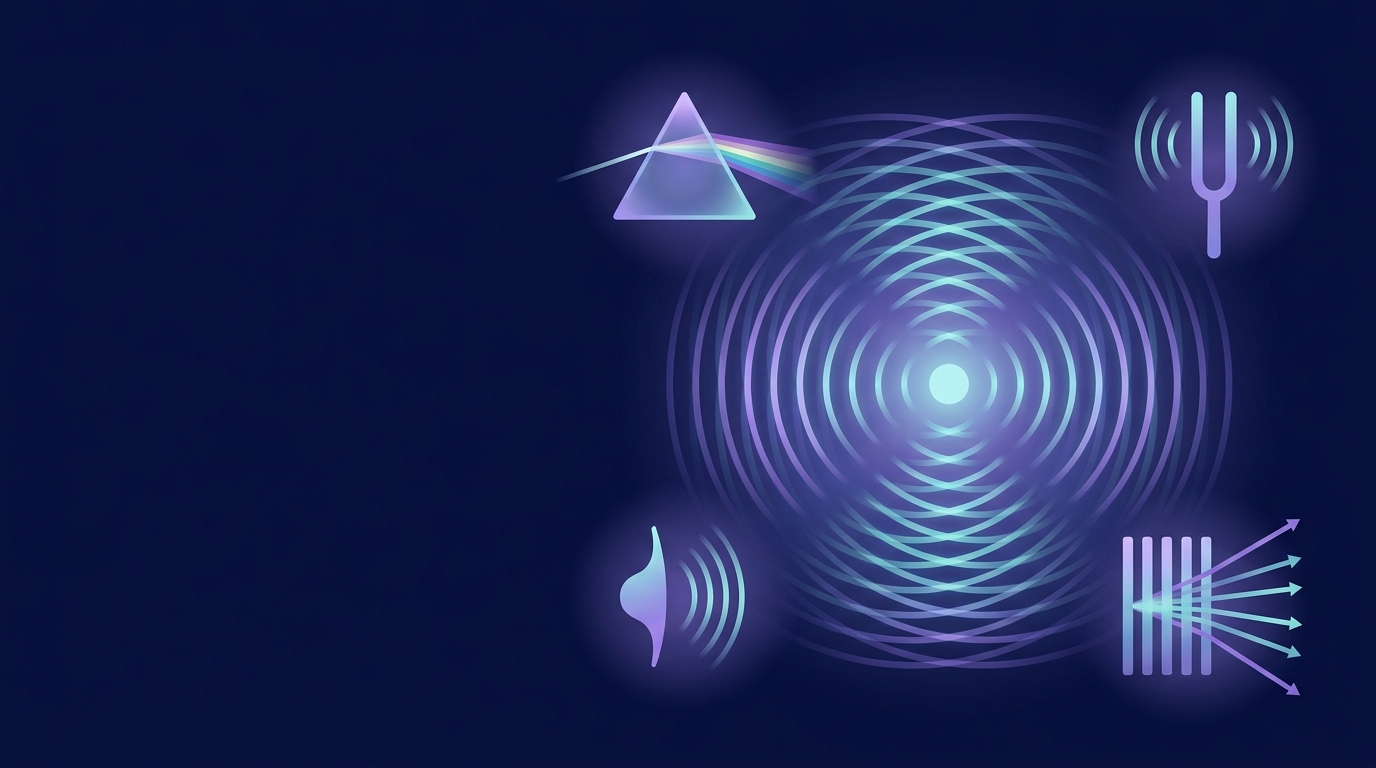
Wave Behaviour splits into three linked ideas. Simple harmonic motion (C.1) gives you the mathematical engine — a restoring force proportional to displacement — that underlies oscillators from pendulums to atoms. The wave model (C.2) gives you the vocabulary for describing ANY travelling disturbance (amplitude, wavelength, intensity). Wave phenomena (C.3) is where those waves meet boundaries, gaps, and each other — reflection, refraction, diffraction, interference, polarization.
- SHM is a mechanism (restoring force ∝ -displacement) — it explains WHY something oscillates the way it does.
- The wave model is a description — it gives you the numbers (λ, T, f, v, I) to characterise any wave once it exists.
- Wave phenomena are boundary and overlap effects — what happens when a wave meets an edge, a slit, a new medium, or another wave.
The shape of the chapter
Command terms this topic actually tests
| Command term | What it demands | AO | Mark-earning move |
|---|---|---|---|
| State | Give a specific fact or law, no justification needed. | AO1 | 1 mark for the bare correct statement — e.g. 'angle of incidence = angle of reflection, both from the normal' scores full marks with zero working. |
| Describe | Give a detailed account of features, not necessarily reasons. | AO1/AO2 | One marking point per distinct feature — e.g. for a diffraction pattern, 'central max is widest/brightest' and 'secondary maxima decrease in intensity' are two separate marks. |
| Explain | Supply the physics mechanism/reasoning behind a result. | AO2 | Zero credit for stating the correct outcome alone — you must give the causal chain, e.g. 'f fixed → v decreases → λ decreases via v = fλ'. |
| Determine | Obtain a numerical answer with working shown. | AO2/AO3 | Method marks survive an arithmetic slip; a bare correct number with no substitution risks losing every method mark. |
| Sketch | Draw the approximate shape with labelled axes and key features. | AO2 | Examiners check shape, intercepts and labelled turning points (e.g. diffraction zeros) — a smooth but unlabelled curve loses marks. |
| Deduce | Reach a conclusion using the specific data given in the question. | AO3 | Must explicitly use the stated numbers — a generic correct explanation that ignores the given path difference/angle scores lower. |
Key point
Overview