Photosynthesis · Paper 1 — Free Biology SL Practice Questions
Free questions
Open in full, with answers, mark scheme and examiner insights.
Energy conversion and oxygen from water
Which is the balanced equation for photosynthesis in which glucose is the product?
revisionprep.com
Summary Answer
Not available for this question.
Model Answer
Not available for this question.
Marking Scheme
Not available for this question.
Examiner Insights
Not available for this question.
Pigments, chromatography, absorption and action spectra
A student used a spectrophotometer to measure the absorbance of a spinach leaf extract. Some values are marked on the graph.
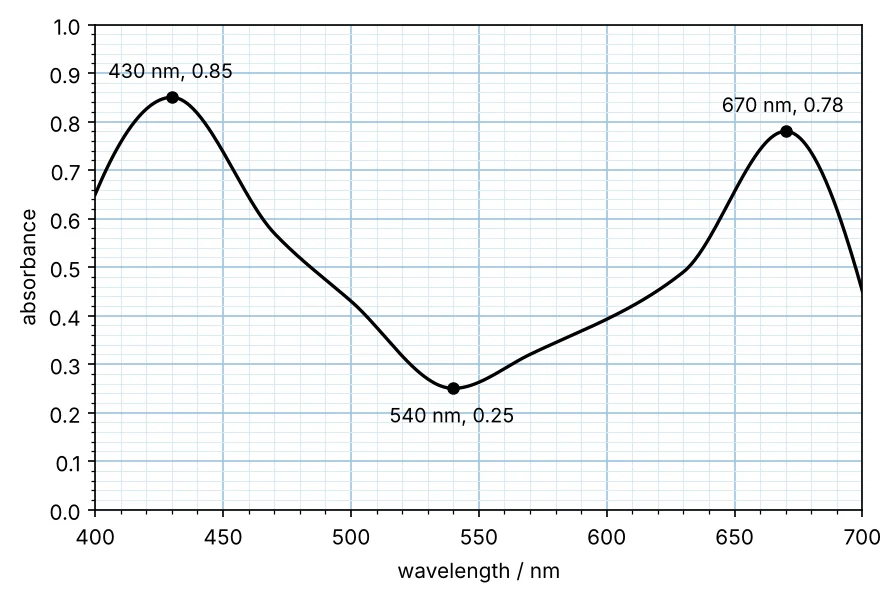
State the wavelength at which the extract absorbs most strongly.
Calculate the absorbance at 540 nm as a percentage of the absorbance at 430 nm.
Explain why the extract looks green.
Predict the shape of the action spectrum for spinach leaves, and give a reason.
revisionprep.com
Summary Answer
Not available for this question.
Model Answer
Not available for this question.
Marking Scheme
Not available for this question.
Examiner Insights
Not available for this question.
Energy conversion and oxygen from water
Discs of equal area were cut from leaves of a plant at 06:00 and at 12:00 on a sunny day, dried and weighed.
The results are shown in the table.
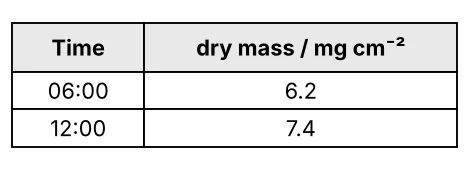
Calculate the mean rate of increase in dry mass per hour.
Explain the increase in dry mass.
Explain why this value underestimates the rate of photosynthesis.
revisionprep.com
Summary Answer
Not available for this question.
Model Answer
Not available for this question.
Marking Scheme
Not available for this question.
Examiner Insights
Not available for this question.
Pigments, chromatography, absorption and action spectra
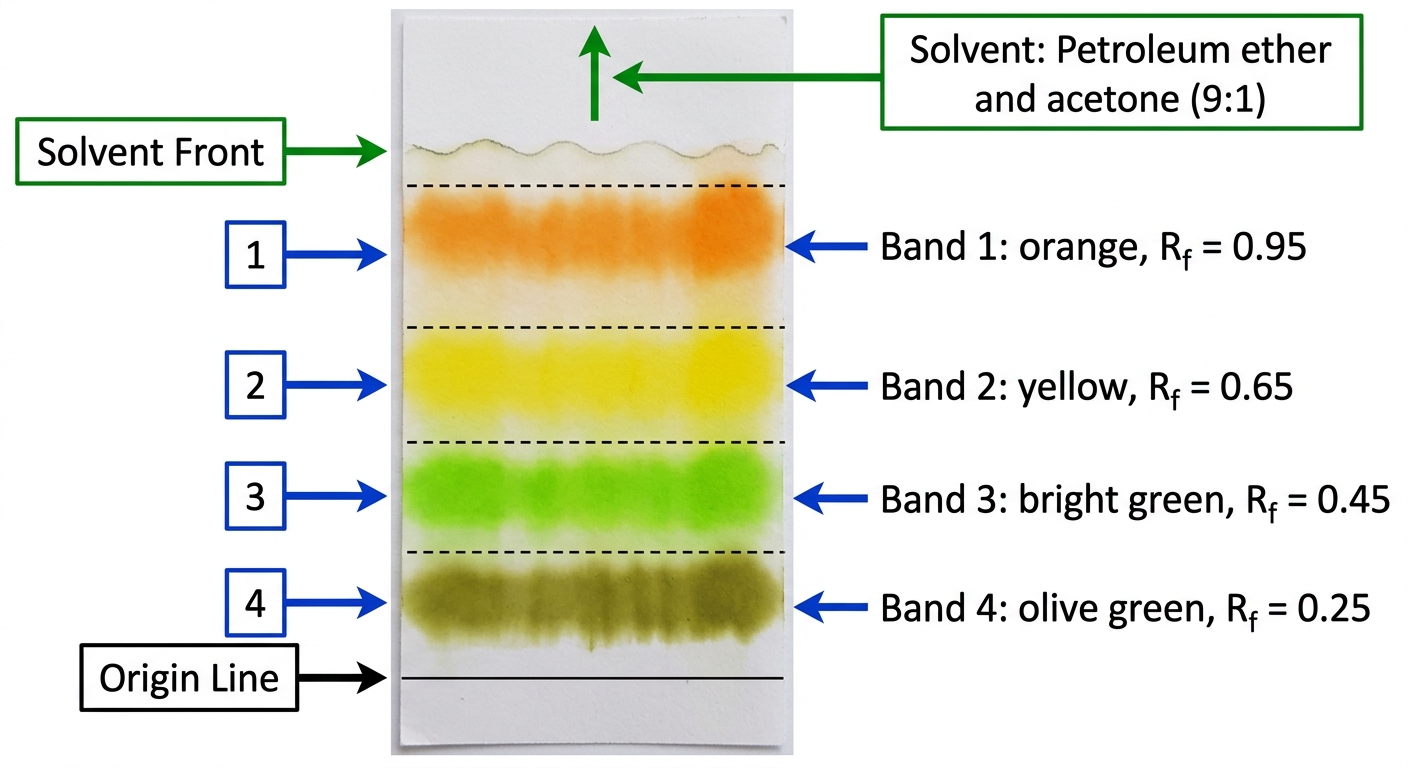
The chromatogram was made from a maple leaf in autumn. Reference Rf values in this solvent: carotene 0.95, xanthophyll 0.65, chlorophyll a 0.45, chlorophyll b 0.25. In autumn, chlorophyll is broken down faster than carotenoids. Which bands would fade first if the experiment were repeated a week later?
revisionprep.com
Summary Answer
Not available for this question.
Model Answer
Not available for this question.
Marking Scheme
Not available for this question.
Examiner Insights
Not available for this question.
Pigments, chromatography, absorption and action spectra
Pigments from a green lettuce leaf and from a brown seaweed were separated using the same solvent. The solvent front moved 80 mm.
The results are shown in the table.
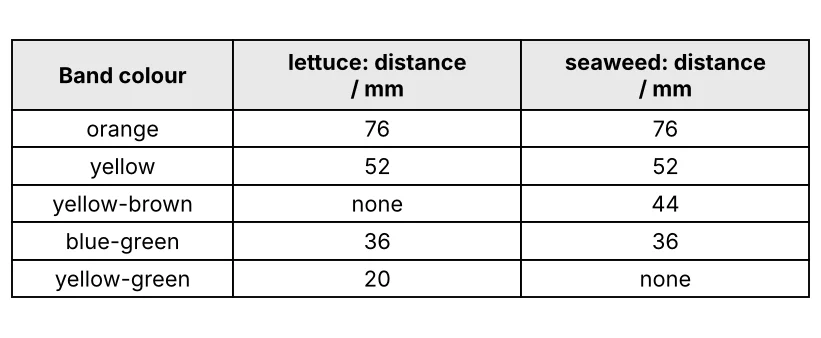
Identify the pigment present in lettuce but absent from the seaweed.
Calculate the Rf value of the yellow-brown pigment.
The yellow-brown pigment absorbs mainly blue-green light, which reaches deeper water than red light. Explain how this pigment helps the seaweed to grow at depth.
Suggest why chlorophyll a is found in both organisms.
revisionprep.com
Summary Answer
Not available for this question.
Model Answer
Not available for this question.
Marking Scheme
Not available for this question.
Examiner Insights
Not available for this question.
Pigments, chromatography, absorption and action spectra
DCPIP is a blue dye that becomes colourless when it gains hydrogen. Chloroplast suspensions with DCPIP were lit under three conditions, as shown in the figure. DCMU is a herbicide.
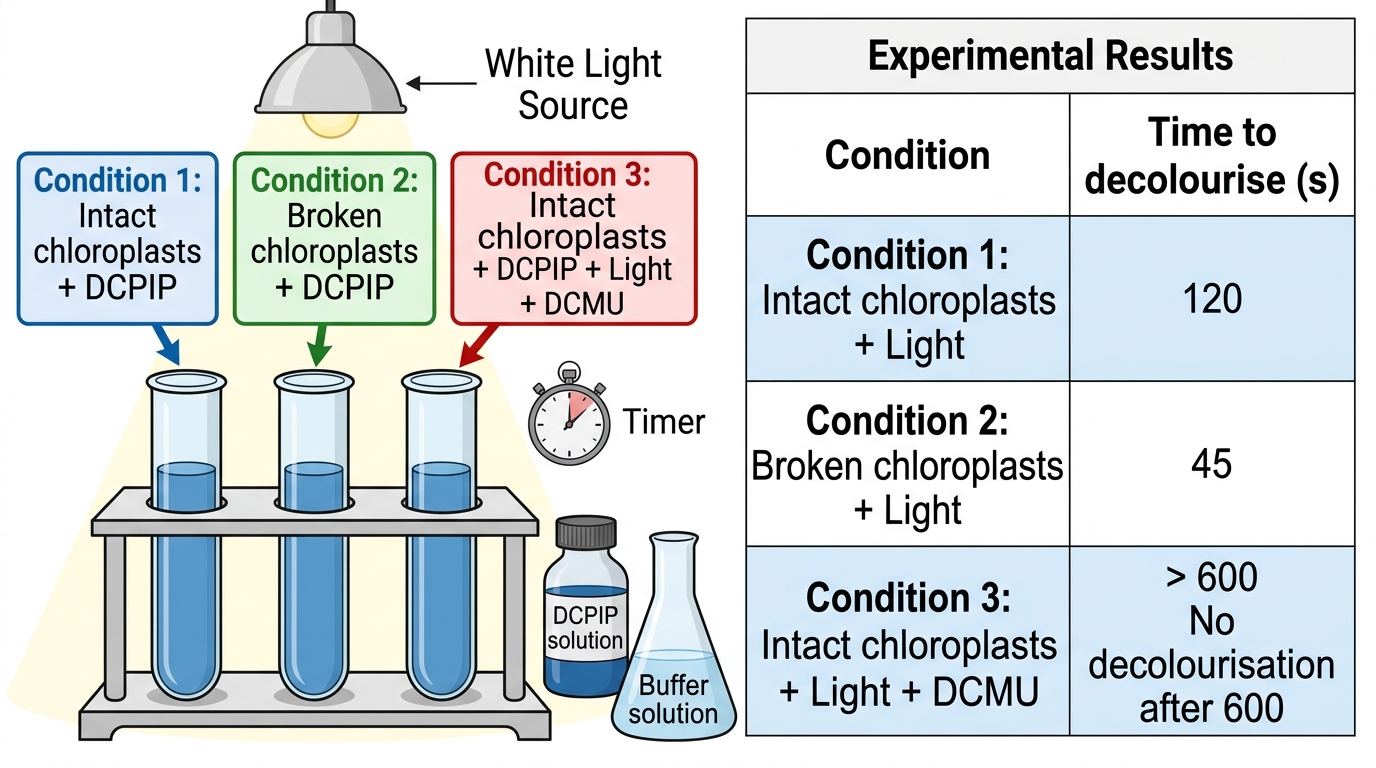
Determine the rate of decolourisation, as 1 / time, for conditions 1 and 2.
Explain why DCPIP becomes colourless when chloroplasts are lit.
Suggest why broken chloroplasts decolourised DCPIP faster than intact chloroplasts.
Explain the result for condition 3, and why DCMU kills plants.
State a control needed to demonstrate that light is required.
revisionprep.com
Summary Answer
Not available for this question.
Model Answer
Not available for this question.
Marking Scheme
Not available for this question.
Examiner Insights
Not available for this question.
That's every free question here — 6 of 73.
+67 more questions, plus Mock Papers & Worksheets, are waiting in Premium.