You're viewing 3 free preview questions for Biology SL — subscribe to unlock 60 more, plus the Full Question Bank, Mock Papers & Worksheets.Upgrade
Defence Against Disease · Paper 2 — Free Biology SL Practice Questions
1MasterySAQ-SVaccines and immunity5 marksPaper 2~8 min

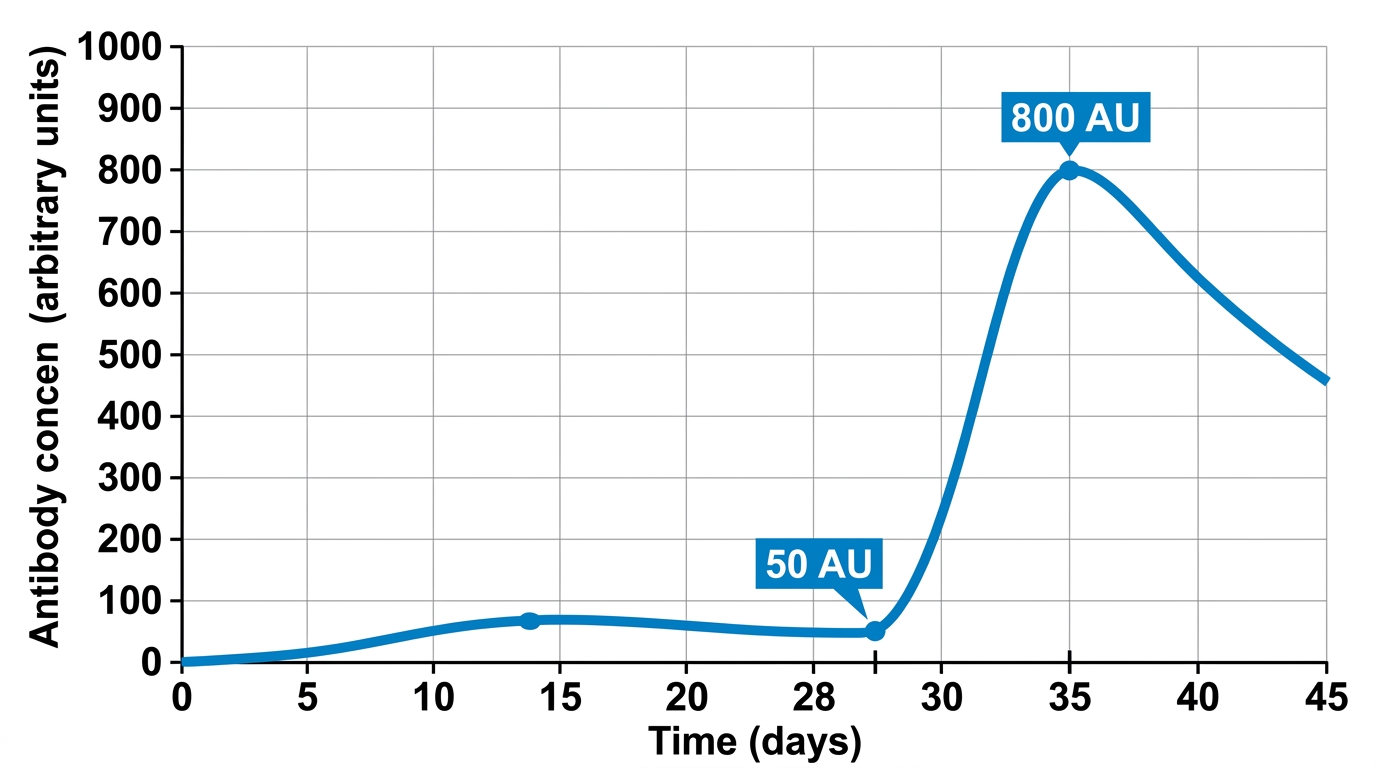
The graph below shows antibody concentration in the blood of a patient following two doses of a vaccine. The first dose was given on day , and the second dose (booster) was given on day .
(a)
State one role of a booster dose of a vaccine. [1 mark]
(b)
The antibody concentration day was . After the booster, the peak antibody concentration reached on day .
Calculate the factor by which the peak antibody concentration increased compared to the concentration just before the booster. [2 marks]
(c)
Using the graph and your knowledge of immunology, evaluate whether peak antibody concentration alone is a sufficient measure of the effectiveness of a booster dose. [2 marks]

Solutions
2MasterySAQ-SImmune response: Innate vs adaptive immunity6 marksPaper 2~9 min
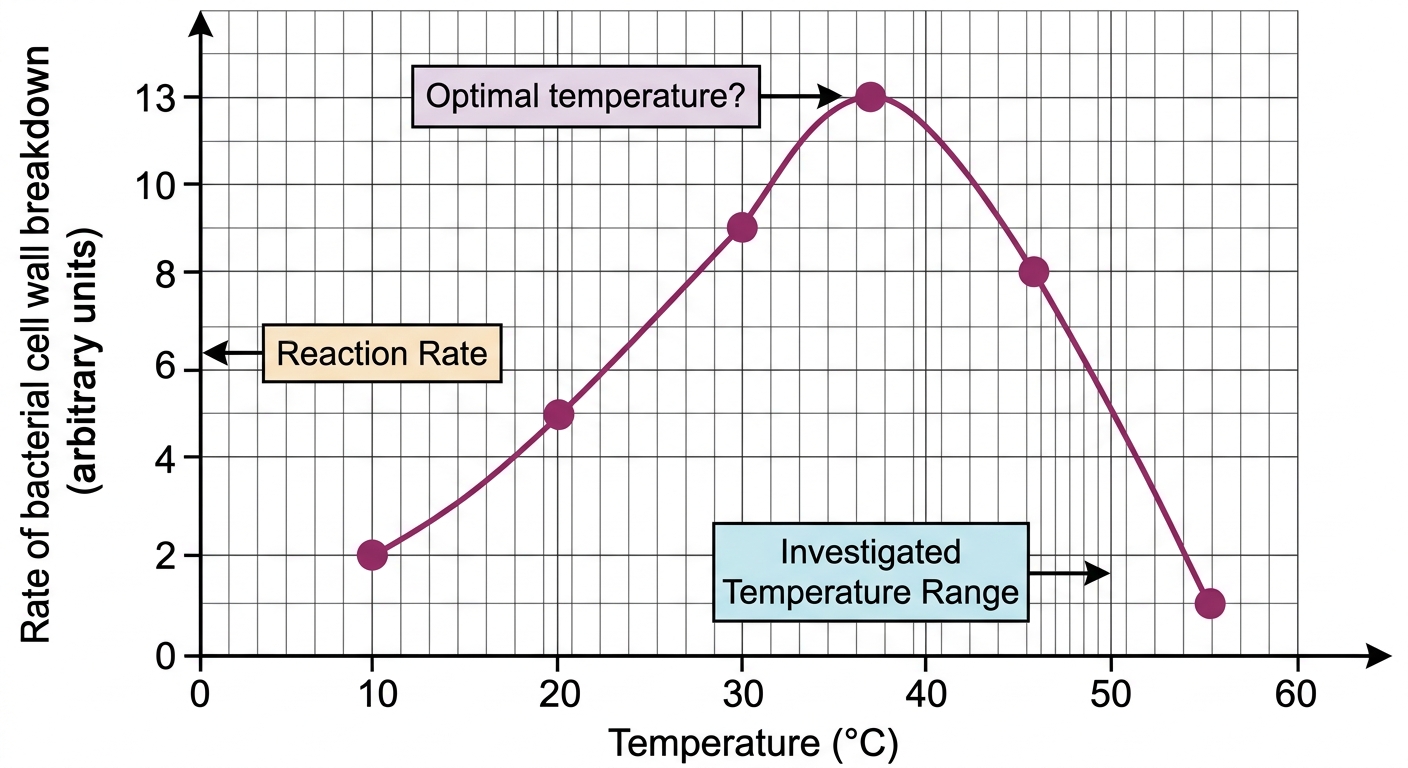
A student investigates the effect of temperature on the activity of lysozyme, an enzyme found in tears and saliva. The student measures the rate of bacterial cell wall breakdown at different temperatures. The results are shown in the table below.
Temperature () — Rate (arbitrary units)
—
—
—
—
—
(a)
Describe the role of lysozyme innate immunity. [2 marks]
(b)
Describe the pattern shown in the data for the rate of bacterial cell wall breakdown between and . [2 marks]
(c)
Calculate the percentage decrease in the rate of breakdown when temperature increases from to . [2 marks]
Solutions
3ChallengeSAQ-LVaccines and immunity7 marksPaper 2~11 min
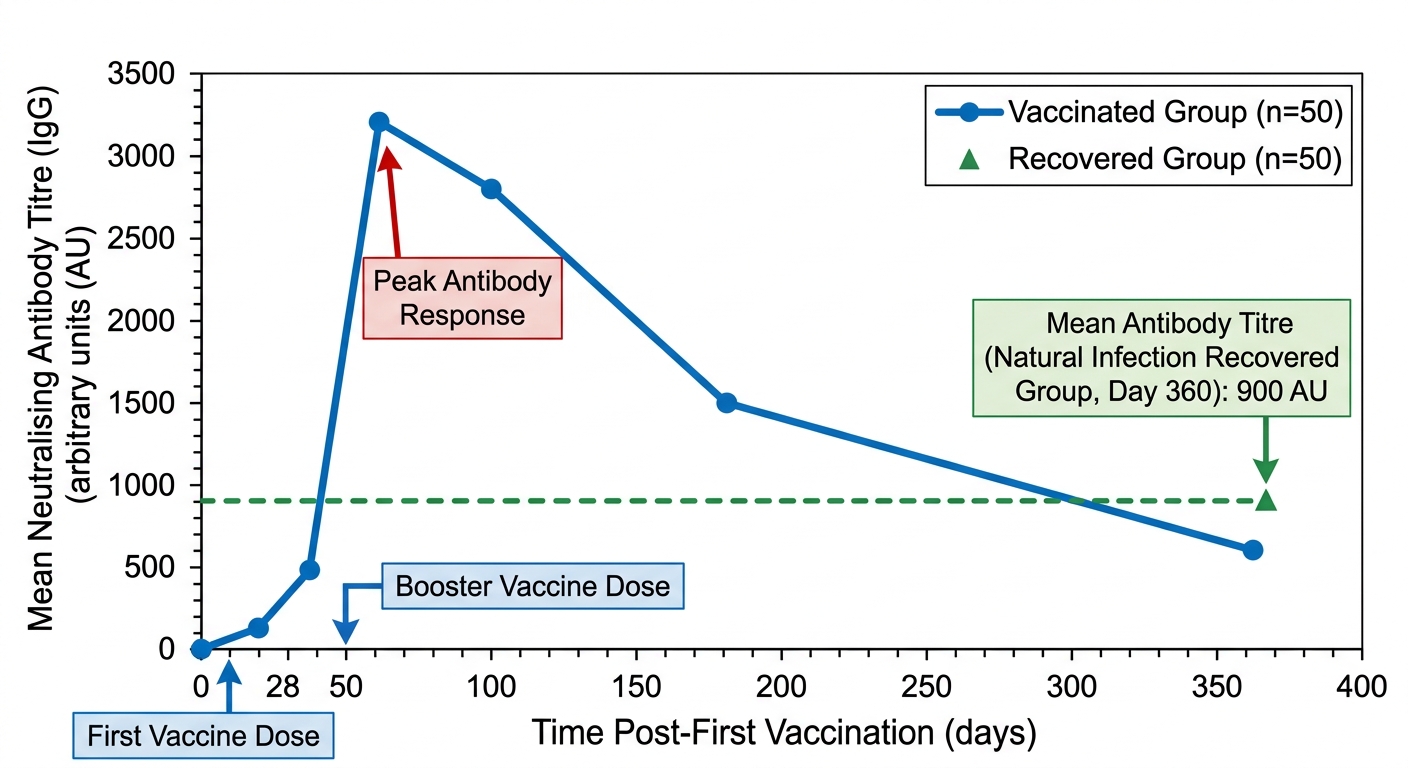
In a clinical trial for a novel mRNA-based vaccine against a newly emerged viral pathogen, researchers measured the concentration of neutralising antibodies (IgG) in the blood of 50 volunteers over a 12-month period. The vaccine was administered in two doses: the first dose at day 0 and a booster dose at day 28. The mean antibody titres (in arbitrary units, AU) are shown below:
Day — Mean antibody titre (AU)
| 0 |
14 — 120
28 — 480
42 — 3200
90 — 2800
180 — 1500
360 — 600
A separate group of 50 volunteers who had previously recovered from natural infection with the same virus showed a mean antibody titre of at day 360 post-infection.
(a)
Calculate the percentage decrease in mean antibody titre from the peak value (day 42) to the value at day 360 in the vaccinated group. Show your working. [2 marks]
(b)
Explain the immunological mechanism that causes the increase in antibody titre between day 28 and day 42, specifically referencing the roles of memory B cells and the booster dose. [3 marks]
(c)
Using the data provided and your knowledge of immunological memory, evaluate whether the vaccinated group or the naturally infected group is likely to have more durable long-term protection at day 360. [2 marks]
Solutions
That's every free question here — 3 of 63.
+60 more questions, plus Mock Papers & Worksheets, are waiting in Premium.