You're viewing 3 free preview questions for Biology SL — subscribe to unlock 54 more, plus the Full Question Bank, Mock Papers & Worksheets.Upgrade
Enzymes and Metabolism · Paper 2 — Free Biology SL Practice Questions
1MasterySAQ-SEnzyme kinetics and inhibition5 marksPaper 2~8 min

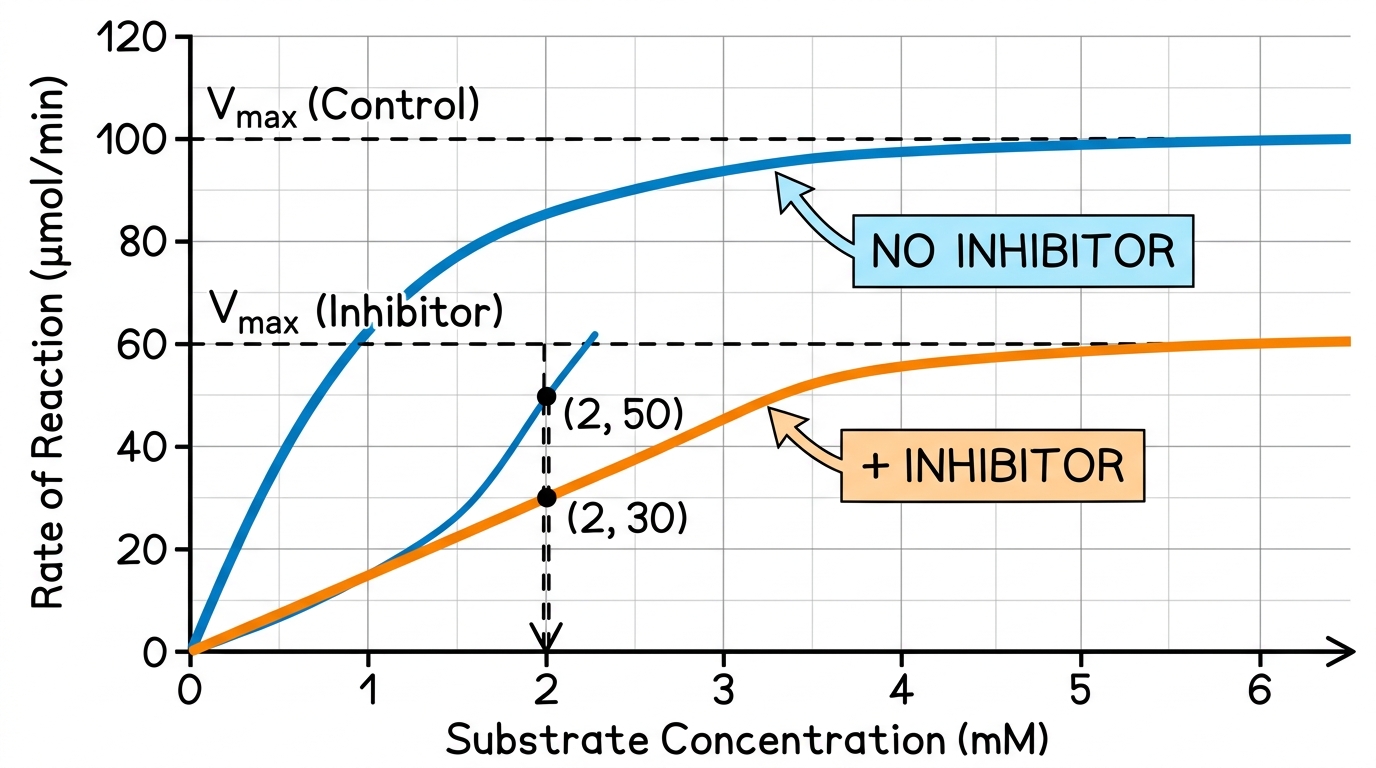
A researcher investigates an enzyme-catalysed reaction. The graph below shows reaction rate against substrate concentration under two conditions: no inhibitor (control) and with an inhibitor present.
Graph description: Michaelis–Menten curves. Control curve: hyperbolic, , . Inhibitor curve: hyperbolic, , .
(a)
State the effect of the inhibitor on . [1 mark]
(b)
State the effect of the inhibitor on . [1 mark]
(c)
Using your answers to (a) and (b), identify the type of inhibition and explain how the inhibitor affects enzyme function. [2 marks]
(d)
A second inhibitor is tested. This inhibitor increases from to but leaves unchanged. Deduce what would happen to the reaction rate if substrate concentration were raised to a very high value, and explain how this differs from the behaviour of the first inhibitor. [1 mark]

Solutions
2MasterySAQ-SEnzyme kinetics and inhibition6 marksPaper 2~9 min
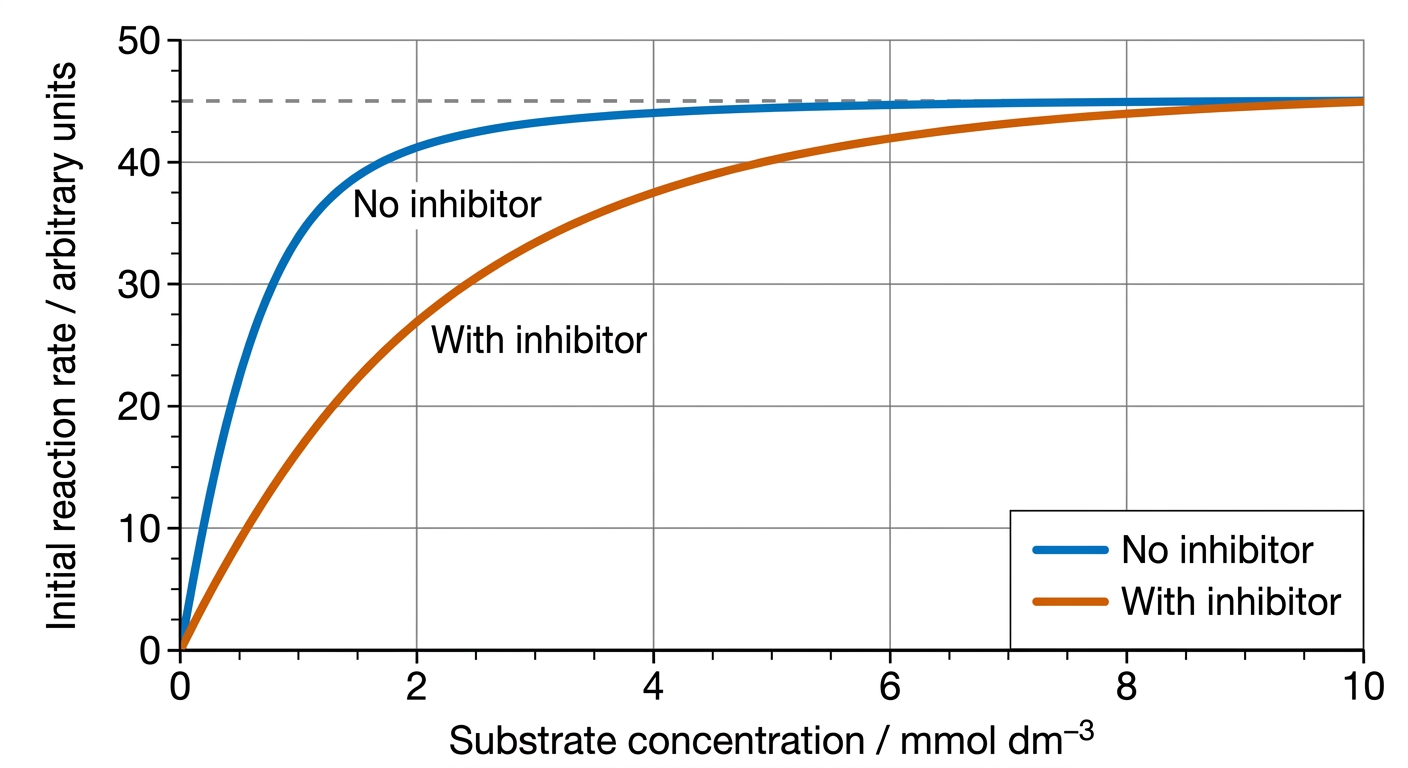
The enzyme lactate dehydrogenase (LDH) catalyses the reduction of pyruvate to lactate in human muscle cells during anaerobic respiration. A student investigates the effect of an inhibitor on the rate of this reaction. The student measures the initial reaction rate at various substrate (pyruvate) concentrations, both without the inhibitor and with a fixed concentration of the inhibitor. The results are shown in the graph below.
(a)
State the type of inhibition shown by the inhibitor. [1 mark]
(b)
The Michaelis-Menten constant () for LDH without the inhibitor is . Using the graph, estimate the value when the inhibitor is present. [2 marks]
(c)
Calculate the factor by which has changed when the inhibitor is present. [1 mark]
(d)
Explain how the type of inhibition identified in (a) affects the apparent without changing . [2 marks]
Solutions
3ChallengeSAQ-LEnzyme kinetics and inhibition6 marksPaper 2~9 min
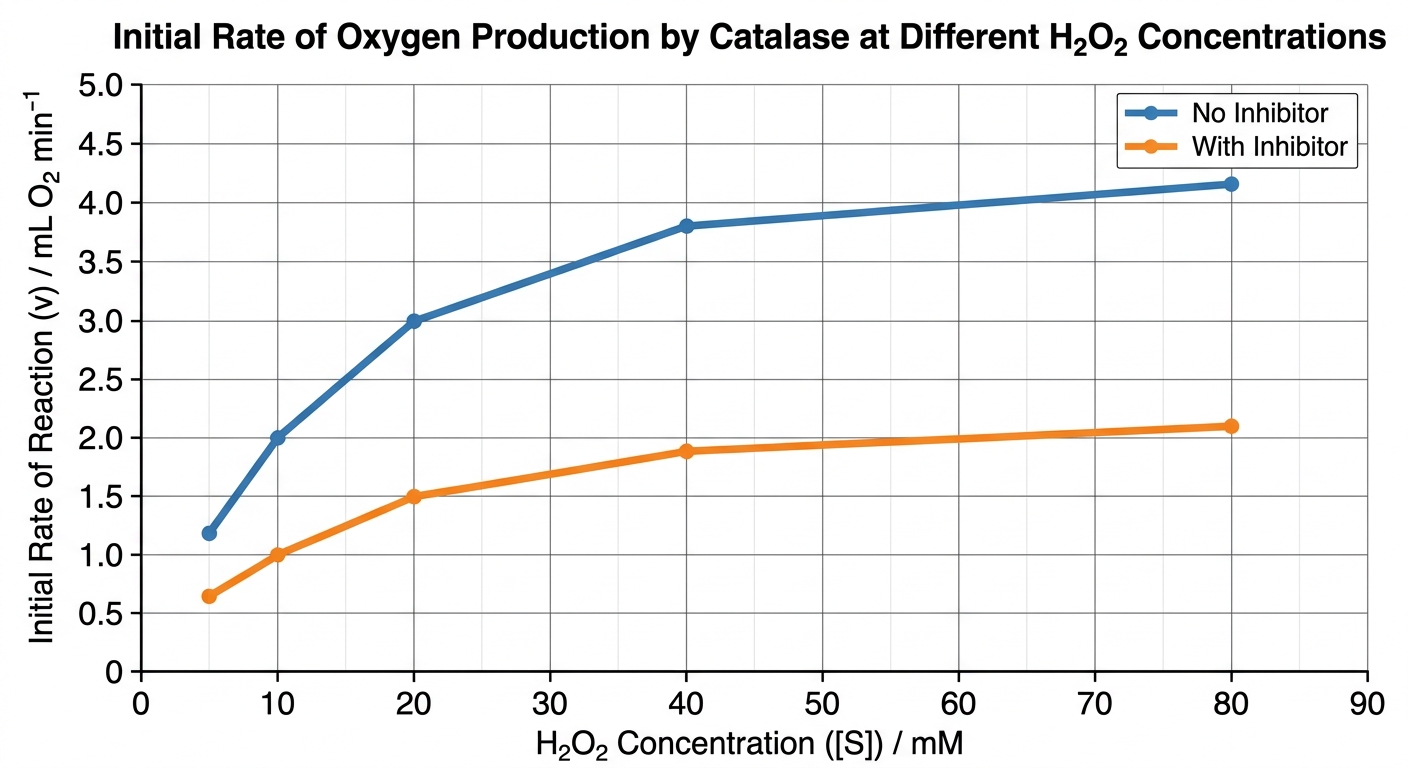
A student investigates the effect of an inhibitor on the enzyme catalase, which breaks down hydrogen peroxide () into water and oxygen. The initial rate of oxygen production is measured at different concentrations. The results are shown in the table below.
/ mM — Rate without inhibitor / — Rate with inhibitor /
5 — 1.2 — 0.6
10 — 2.0 — 1.0
20 — 3.8 — 1.5
40 — 4.2 — 1.9
80 — 4.5 — 2.1
The Michaelis–Menten equation is:
(a)
The student plots a graph of rate () against for both conditions.
(i) State the value of for catalase in the absence of the inhibitor, as indicated by the data. [1]
(ii) Determine whether the inhibitor is competitive or non-competitive, using evidence from the data table. [2 marks]
(ii) Determine whether the inhibitor is competitive or non-competitive, using evidence from the data table. [2 marks]
(b)
Explain the molecular mechanism by which a competitive inhibitor reduces the rate of an enzyme-catalysed reaction. [2 marks]
(c)
Evaluate the biological significance of enzyme inhibition in the regulation of a named metabolic pathway, referring to the type of inhibition identified in (a)(ii). [2 marks]
Solutions
That's every free question here — 3 of 57.
+54 more questions, plus Mock Papers & Worksheets, are waiting in Premium.