Neural Signaling · Paper 2 — Free Biology SL Practice Questions
Free questions
Open in full, with answers, mark scheme and examiner insights.
Structure of neurons
The diagrams show a sensory neuron from rat skin and a motor neuron from the rat spinal cord.
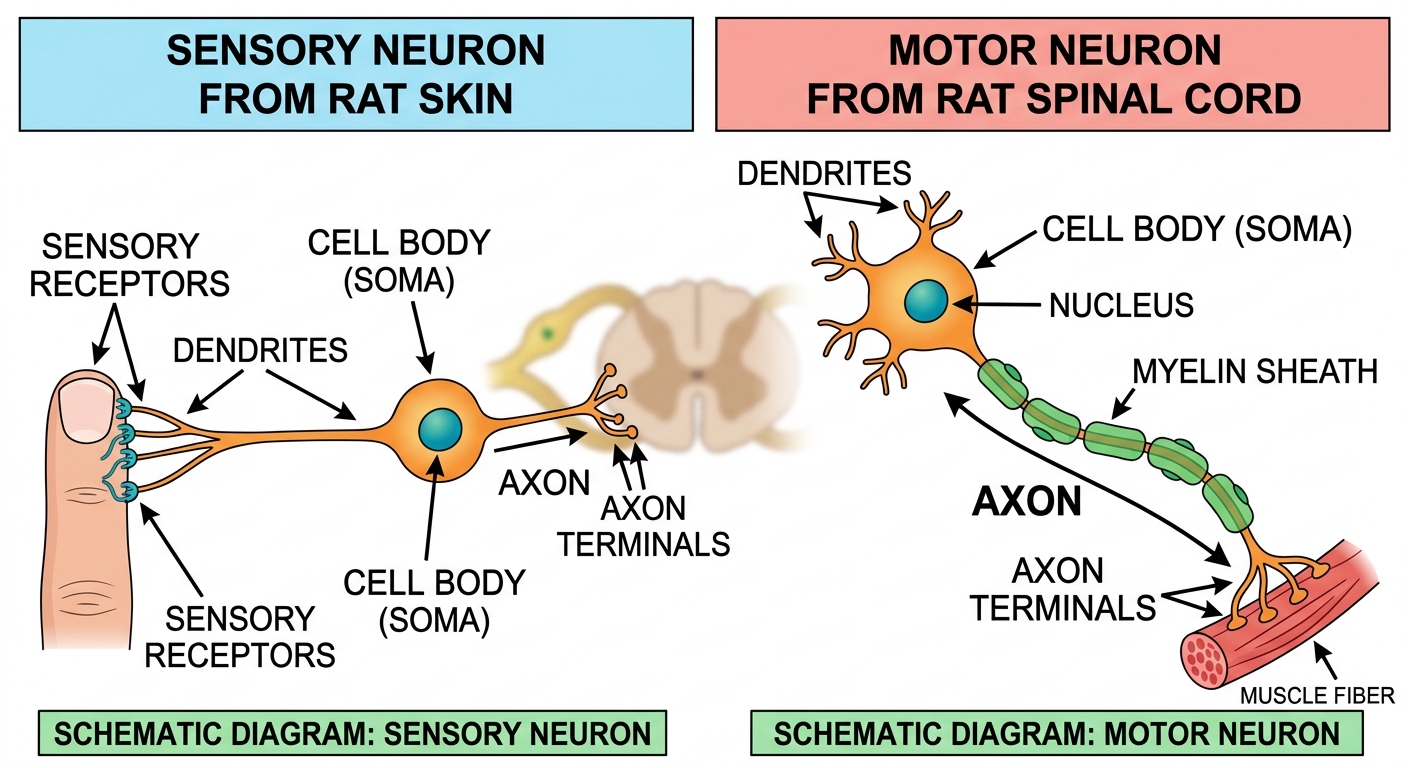
State one structural difference between the two neurons shown in the diagrams.
Outline the function of each neuron.
The motor neuron's axon is long and conducts impulses at . Calculate the time taken for an impulse to travel the length of the axon. Give your answer in ms.
Suggest one advantage to the rat of the myelin sheath on the motor neuron.
revisionprep.com
Summary Answer
Not available for this question.
Model Answer
Not available for this question.
Marking Scheme
Not available for this question.
Examiner Insights
Not available for this question.
Nervous system coordination and reflex arcs
This question is about the pain withdrawal reflex.
Draw a labelled diagram of a pain withdrawal reflex arc, from receptor to effector.
Outline the role of each type of neuron in the pain withdrawal reflex arc.
Describe the events in the pain withdrawal reflex when a finger touches a sharp object, and explain why it is an advantage for this response to be involuntary.
revisionprep.com
Summary Answer
Not available for this question.
Model Answer
Not available for this question.
Marking Scheme
Not available for this question.
Examiner Insights
Not available for this question.
Structure of neurons
The diagrams compare a squid giant axon (diameter , unmyelinated) with a human myelinated axon (diameter ). The squid axon conducts at and the human axon at .
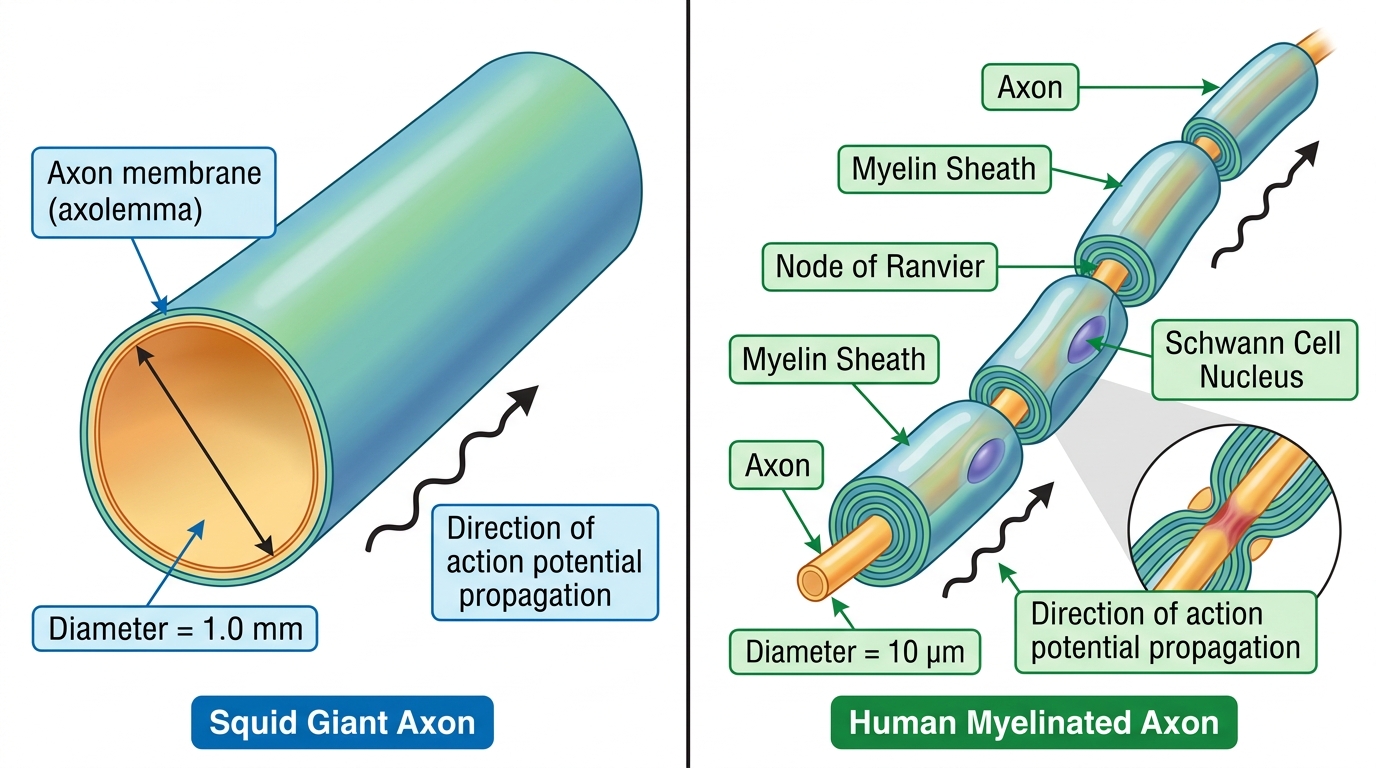
State the feature of the squid giant axon that increases its conduction speed.
Calculate how many times wider the squid axon is than the human axon.
Calculate how many times faster the human axon conducts than the squid axon.
Using your answers to (b) and (c), evaluate which is the more effective way to increase conduction speed.
revisionprep.com
Summary Answer
Not available for this question.
Model Answer
Not available for this question.
Marking Scheme
Not available for this question.
Examiner Insights
Not available for this question.
Action potential and neurotransmission
The table shows ion concentrations inside and outside a squid giant axon at rest.
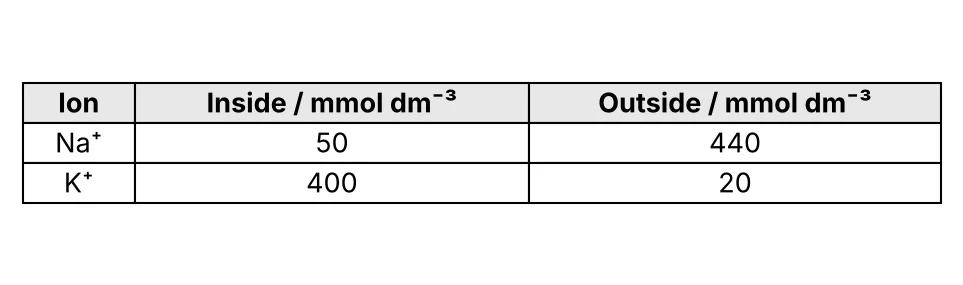
Determine how many times greater the K⁺ concentration is inside the axon than outside.
Explain how these concentration differences are maintained.
Deduce the direction in which Na⁺ moves when channels in the membrane open during an impulse. Give a reason.
Explain why a nerve impulse is described as an electrical signal.
Predict the direction in which K⁺ moves when K⁺ channels open after Na⁺ has entered, and the effect on the membrane potential.
revisionprep.com
Summary Answer
Not available for this question.
Model Answer
Not available for this question.
Marking Scheme
Not available for this question.
Examiner Insights
Not available for this question.
Action potential and neurotransmission
Nerve impulse speeds were measured in comparable nerves of three animals. The table shows the results.
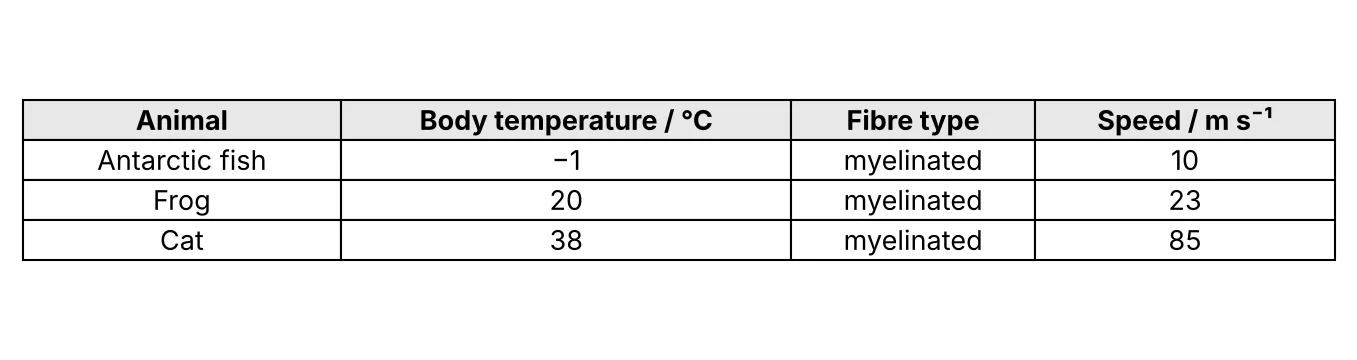
Calculate how many times faster the cat nerve conducts than the Antarctic fish nerve.
Describe the relationship between body temperature and speed.
Explain this relationship.
Suggest why this comparison may not be fully valid.
Suggest one advantage to the cat of fast nerve impulses.
revisionprep.com
Summary Answer
Not available for this question.
Model Answer
Not available for this question.
Marking Scheme
Not available for this question.
Examiner Insights
Not available for this question.
Synaptic transmission
The mean synaptic delay was measured at synapses in the spinal cord of a frog kept at different temperatures. The table shows the results.
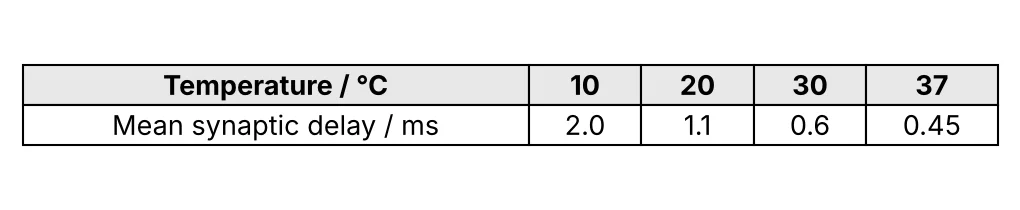
Describe the effect of temperature on the synaptic delay.
Calculate the percentage decrease in synaptic delay between 10 °C and 37 °C.
Explain why the synaptic delay is shorter at higher temperatures.
A reflex pathway contains 3 synapses. Calculate how much longer the total synaptic delay is at 10 °C than at 30 °C.
Suggest why the result at 37 °C may not be valid for a frog.
revisionprep.com
Summary Answer
Not available for this question.
Model Answer
Not available for this question.
Marking Scheme
Not available for this question.
Examiner Insights
Not available for this question.
That's every free question here — 6 of 107.
+101 more questions, plus Mock Papers & Worksheets, are waiting in Premium.