You're viewing 3 free preview questions for Biology SL — subscribe to unlock 61 more, plus the Full Question Bank, Mock Papers & Worksheets.Upgrade
Photosynthesis · Paper 2 — Free Biology SL Practice Questions
1MasterySAQ-SThe light-dependent and light-independent reactions6 marksPaper 2~9 min

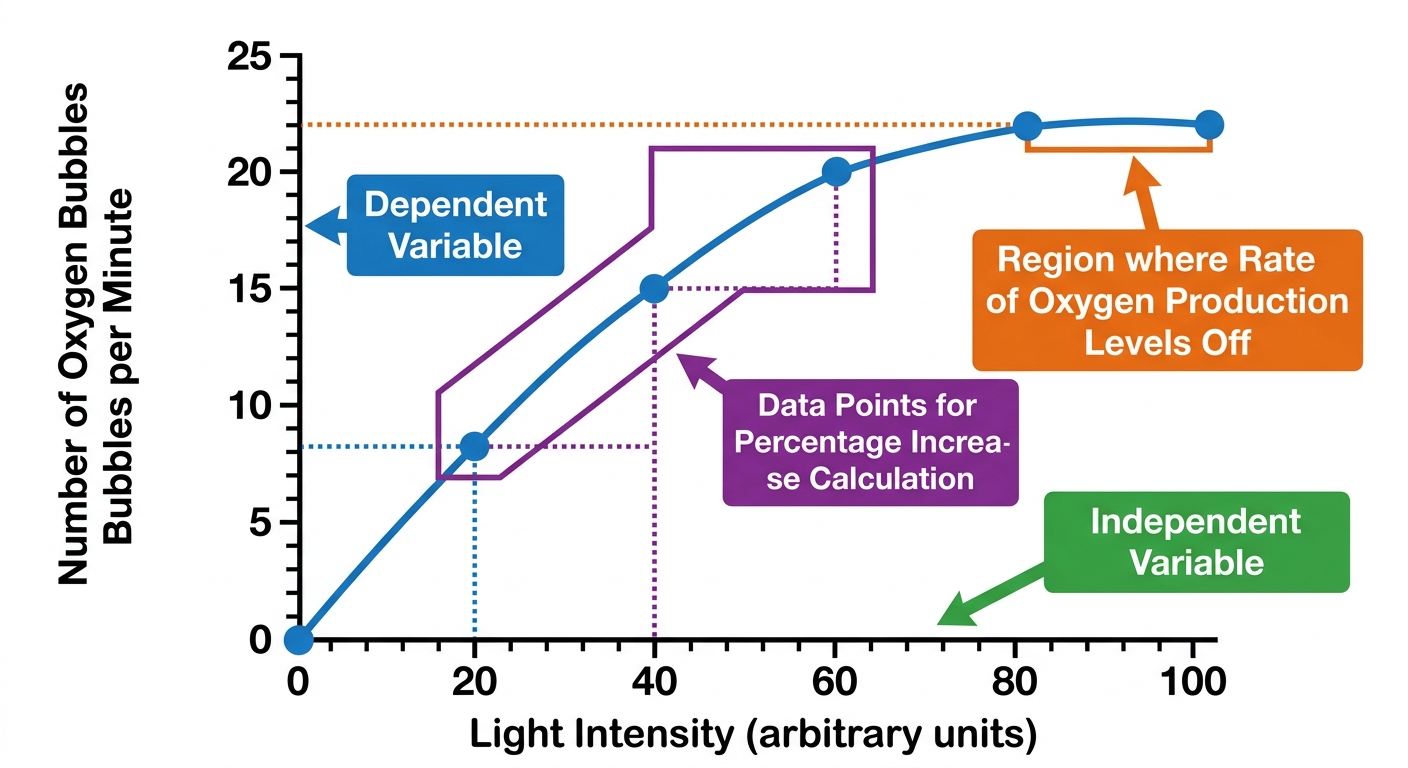
A student investigated the rate of photosynthesis in pondweed (Elodea) by counting the number of oxygen bubbles produced per minute at different light intensities. The results are shown below.
Light intensity (arbitrary units) — 0 — 20 — 40 — 60 — 80 — 100
Oxygen bubbles per minute — 0 — 8 — 15 — 20 — 22 — 23
(a)
State the independent variable in this investigation. [1 mark]
(b)
Calculate the percentage increase in oxygen bubble production when light intensity increases from to arbitrary units. [2 marks]
(c)
Explain why the rate of oxygen production levels off at higher light intensities, referring to both the light-dependent and light-independent reactions. [3 marks]

Solutions
2MasterySAQ-SThe light-dependent and light-independent reactions5 marksPaper 2~8 min
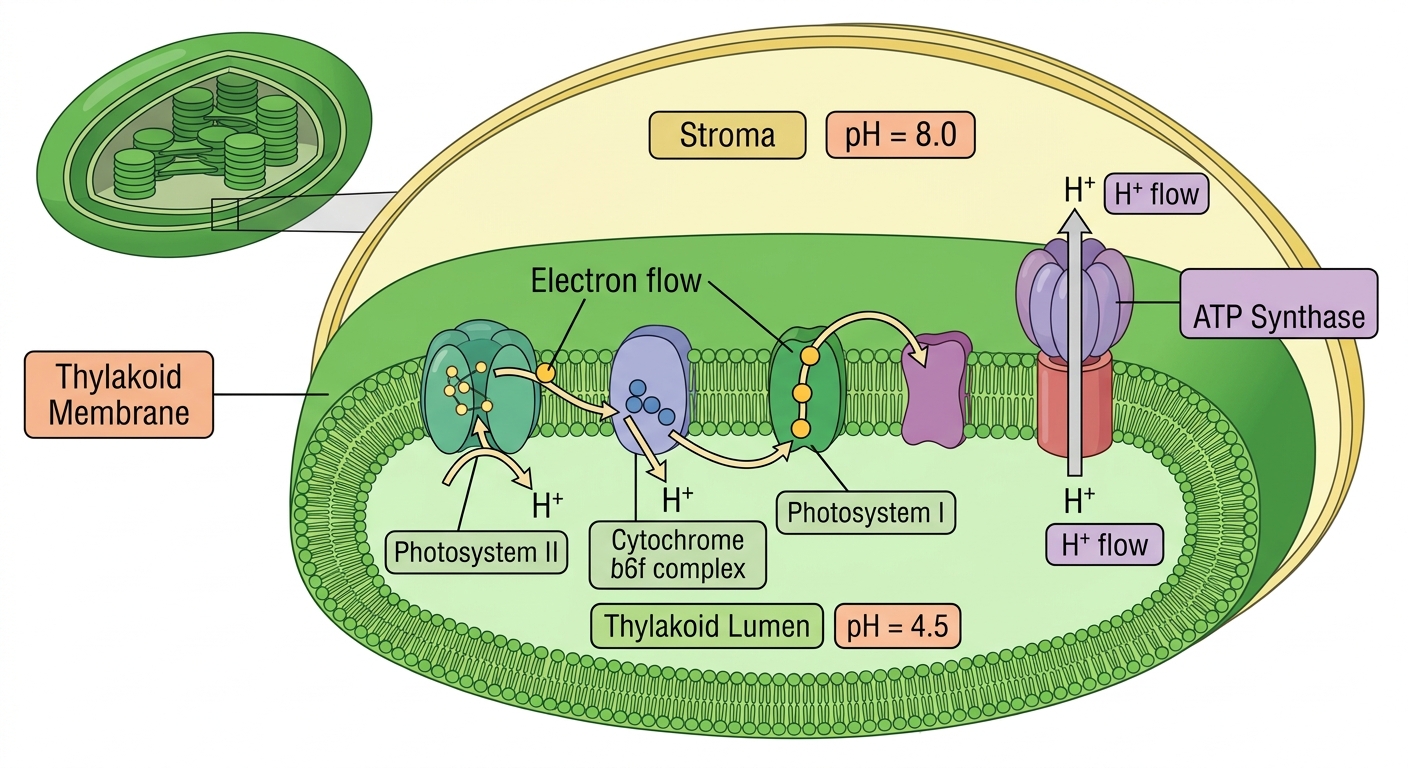
In the light-dependent reactions of photosynthesis, electrons pass along an electron transport chain embedded in the thylakoid membrane. This generates a proton gradient across the membrane, which drives ATP synthesis.
During active photosynthesis:
- pH of the thylakoid lumen
- pH of the stroma
(a)
State the process that directly supplies protons to the thylakoid lumen. [1 mark]
(b)
Using , calculate the difference in hydrogen ion concentration between the thylakoid lumen and the stroma. Give your answer in . [2 marks]
(c)
Explain how the proton gradient across the thylakoid membrane is used to synthesise ATP. [2 marks]
Solutions
3ChallengeSAQ-LThe light-dependent and light-independent reactions8 marksPaper 2~12 min
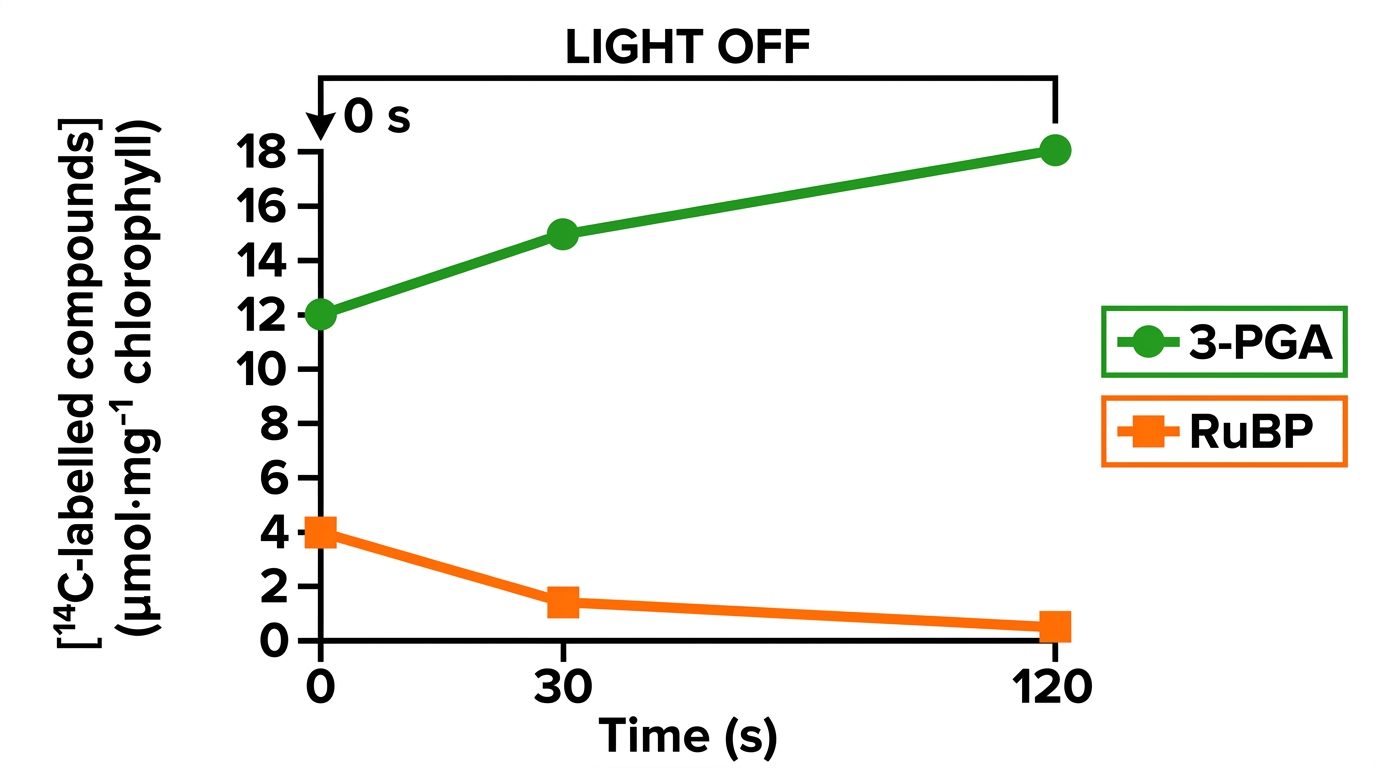
Isolated chloroplasts from spinach (Spinacia oleracea) were illuminated with saturating white light in the presence of -labelled carbon dioxide (). The light was then switched off, and the concentrations of -labelled 3-phosphoglycerate (3-PGA) and ribulose-1,5-bisphosphate (RuBP) were measured over the following 120 seconds.
Time after light off — chlorophyll — chlorophyll
— —
— —
— —
(a)
Calculate the percentage change in the concentration of RuBP from to . [2 marks]
(b)
Explain the changes in the concentrations of 3-PGA and RuBP observed in the first 30 seconds of darkness, with reference to the light-dependent reactions and the Calvin cycle. [3 marks]
(c)
Evaluate the hypothesis that the Calvin cycle operates independently of light, using the data provided and your knowledge of photosynthesis. [3 marks]
Solutions
That's every free question here — 3 of 64.
+61 more questions, plus Mock Papers & Worksheets, are waiting in Premium.