You're viewing 3 free preview questions for Biology SL — subscribe to unlock 44 more, plus the Full Question Bank, Mock Papers & Worksheets.Upgrade
Populations and Communities · Paper 2 — Free Biology SL Practice Questions
1MasterySAQ-SPopulation dynamics: Growth models, carrying capacity5 marksPaper 2~8 min

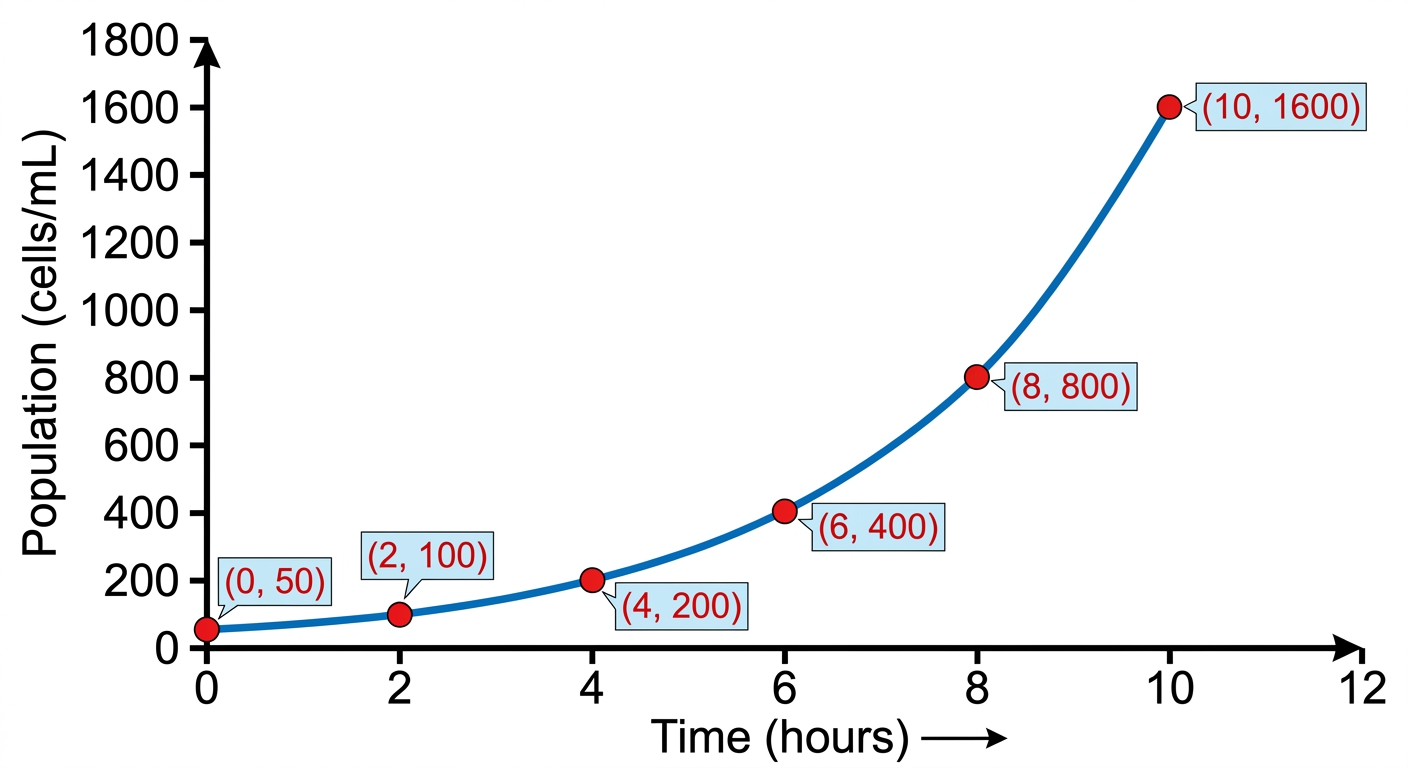
A researcher cultures yeast (Saccharomyces cerevisiae) in a chemostat and records the following data.
Time / hours — Population / cells
0 — 50
2 — 100
4 — 200
6 — 400
| 800 |
10 — 1600
The exponential growth equation is , where is the intrinsic rate of increase and is time in hours. The doubling time is given by .
(a)
State the type of population growth shown by these data. [1 mark]
(b)
Using the data at and , calculate the intrinsic rate of increase and hence determine the doubling time of the yeast population. [2 marks]
(c)
Explain why this growth pattern cannot continue indefinitely in a natural ecosystem. [2 marks]

Solutions
2MasterySAQ-SPopulation dynamics: Growth models, carrying capacity5 marksPaper 2~8 min
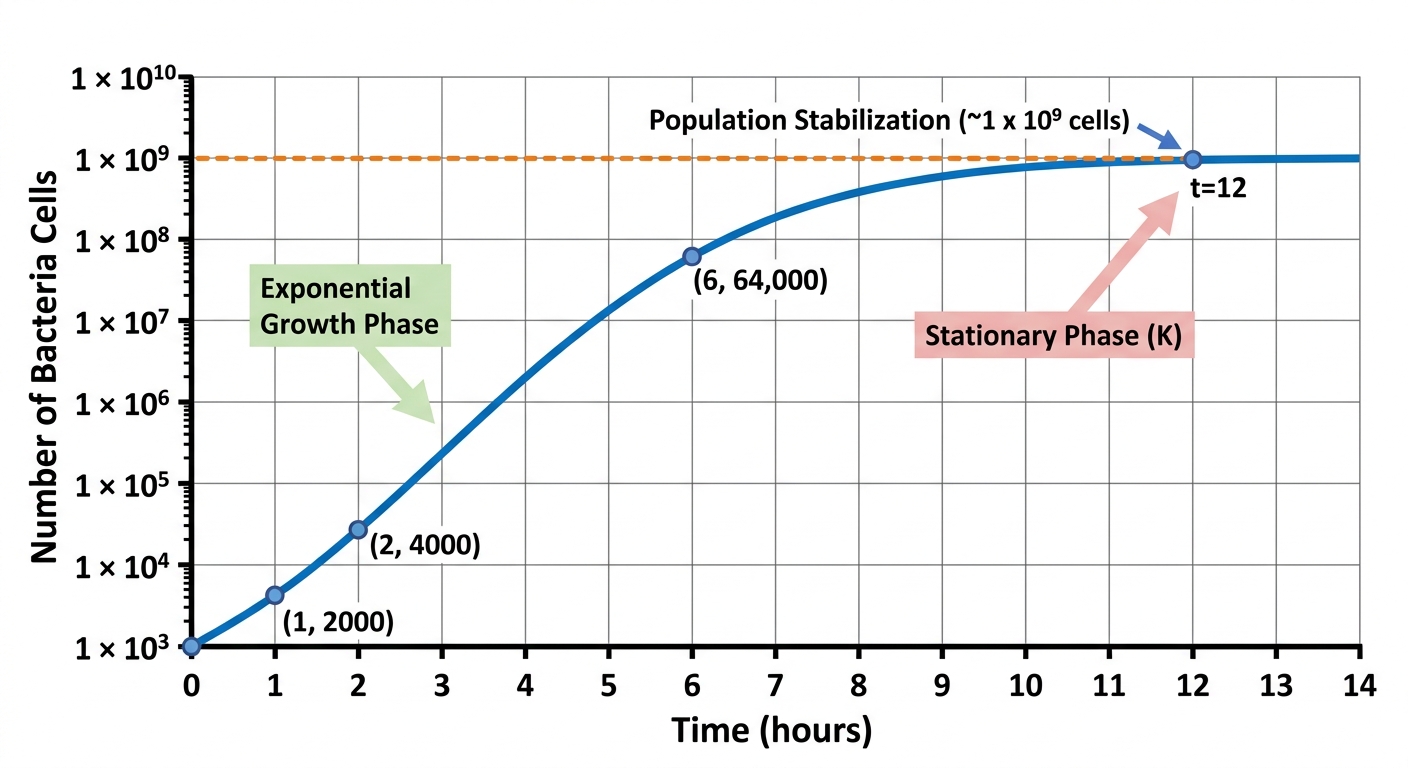
A population of Escherichia coli is grown in a nutrient-rich broth in a closed flask. The initial population is cells. The population doubles every hour during the first hours, reaching cells at . After hours the population stabilises at approximately cells.
(a)
Determine the per capita growth rate, , of the population during the first hours. [1 mark]
(b)
Determine the time at which the population would reach cells, assuming exponential growth continues. Show all working. [2 marks]
(c)
Explain why the population stops growing after hours, referring to the logistic growth model. [2 marks]
Solutions
3ChallengeSAQ-LPopulation dynamics: Growth models, carrying capacity7 marksPaper 2~11 min
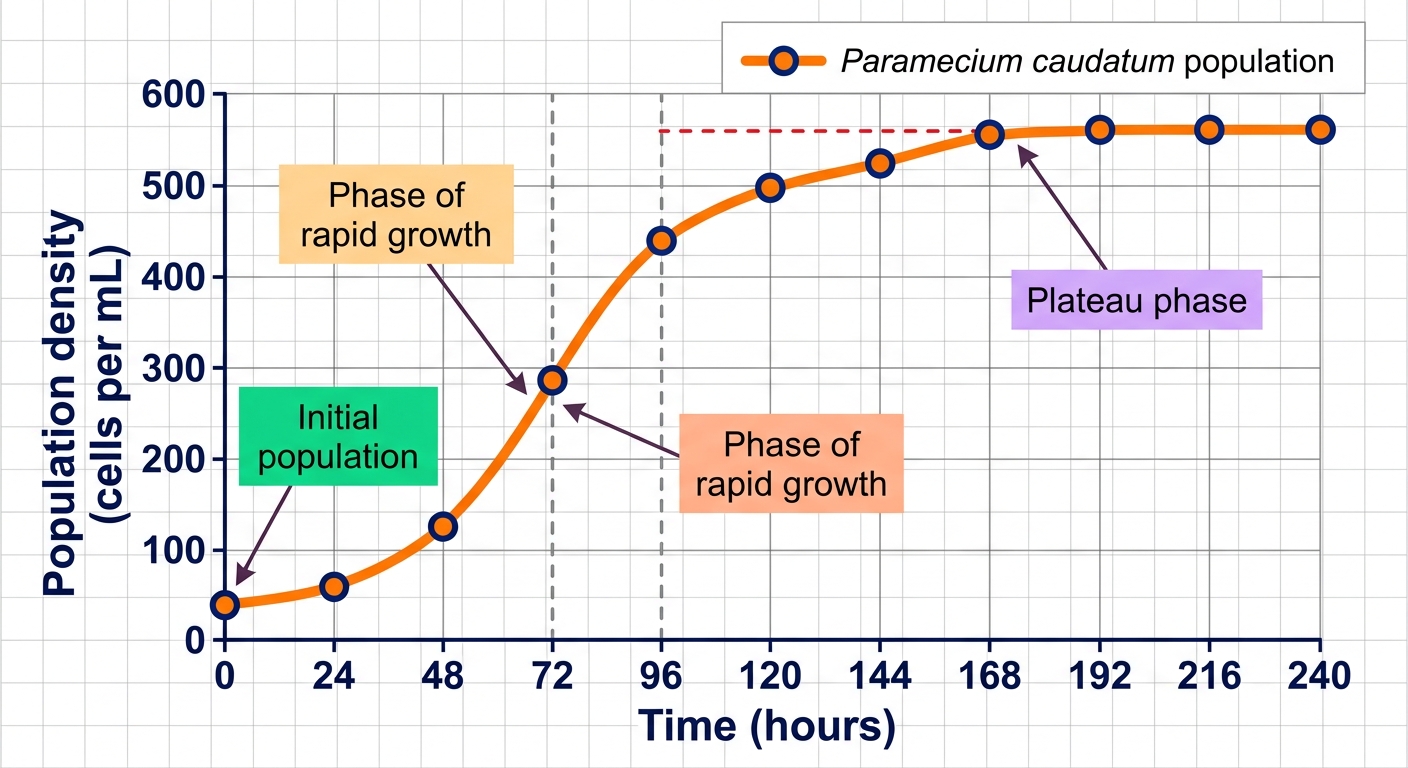
A population of Paramecium caudatum was cultured in a closed flask with a constant volume of nutrient medium. The population size was recorded every 24 hours. The culture medium was not replenished and waste products accumulated over time.
Time (hours) — 0 — 24 — 48 — 72 — 96 — 120 — 144 — 168 — 192 — 216 — 240
Population (cells ) — 10 — 20 — 40 — 80 — 155 — 280 — 420 — 510 — 550 — 560
The following equations are provided:
(a)
Calculate the per capita growth rate during the exponential phase of this population, using data from to hours. Show your working. [2 marks]
(b)
Explain why population growth deviates from the exponential model after 96 hours, referring to carrying capacity . [3 marks]
(c)
This closed-flask system differs from natural habitats because waste products accumulate irreversibly and cannot be removed. Evaluate whether the logistic growth model adequately represents the population dynamics observed in this specific context. [2 marks]
Solutions
That's every free question here — 3 of 47.
+44 more questions, plus Mock Papers & Worksheets, are waiting in Premium.