You're viewing 3 free preview questions for Biology SL — subscribe to unlock 45 more, plus the Full Question Bank, Mock Papers & Worksheets.Upgrade
Transfer of Energy and Matter · Paper 2 — Free Biology SL Practice Questions
1MasterySAQ-SEnergy flow in ecosystems: Trophic levels and food webs5 marksPaper 2~8 min

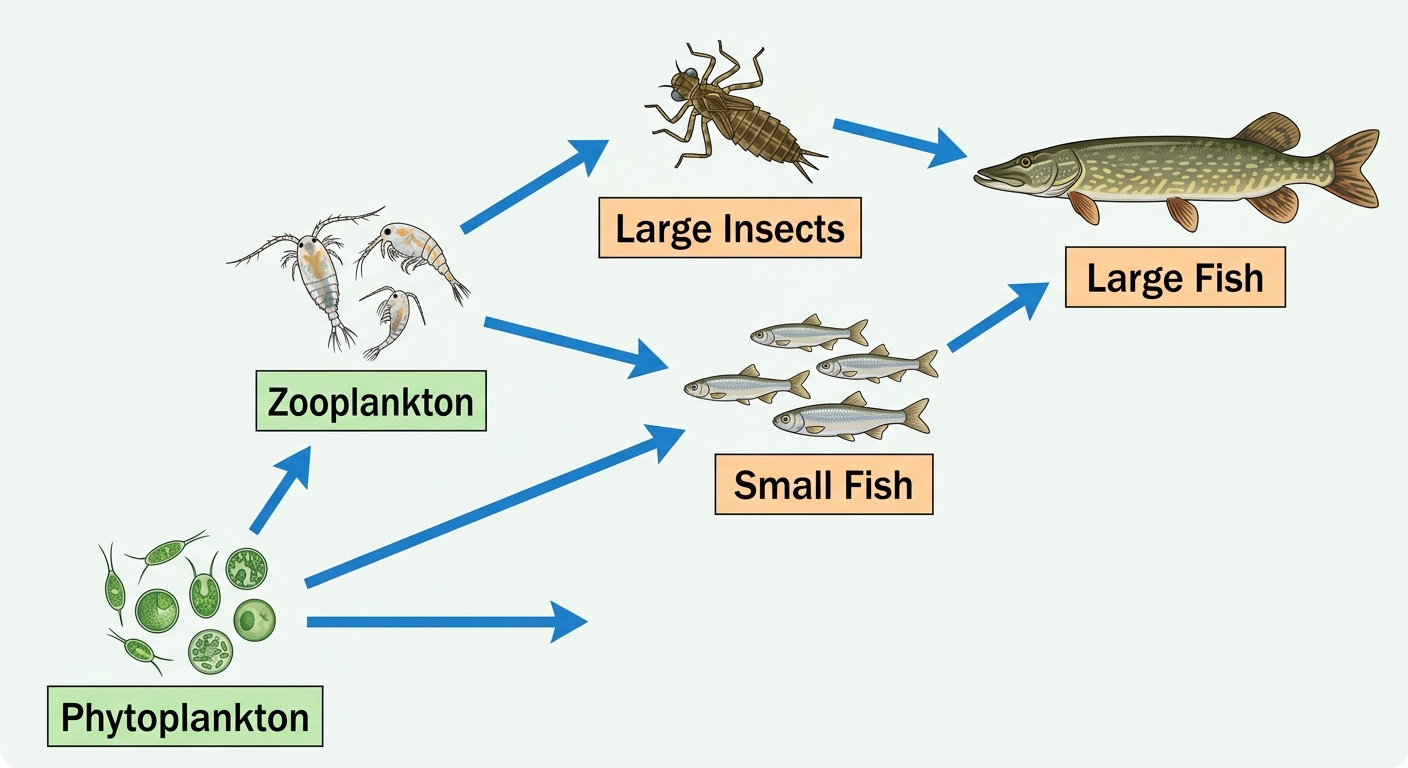
A simplified food web from a lake ecosystem in Sweden is shown below.
(a)
State what is meant by the term trophic level. [1 mark]
(b)
At the secondary consumer level, the secondary consumers assimilate and lose through respiration. Calculate the percentage of assimilated energy lost as heat this level. [2 marks]
(c)
The zooplankton population collapses due to pollution. Evaluate the relative impact of this collapse on the large fish population compared with the small fish population. [2 marks]

Solutions
2MasterySAQ-SEnergy flow in ecosystems: Trophic levels and food webs5 marksPaper 2~8 min
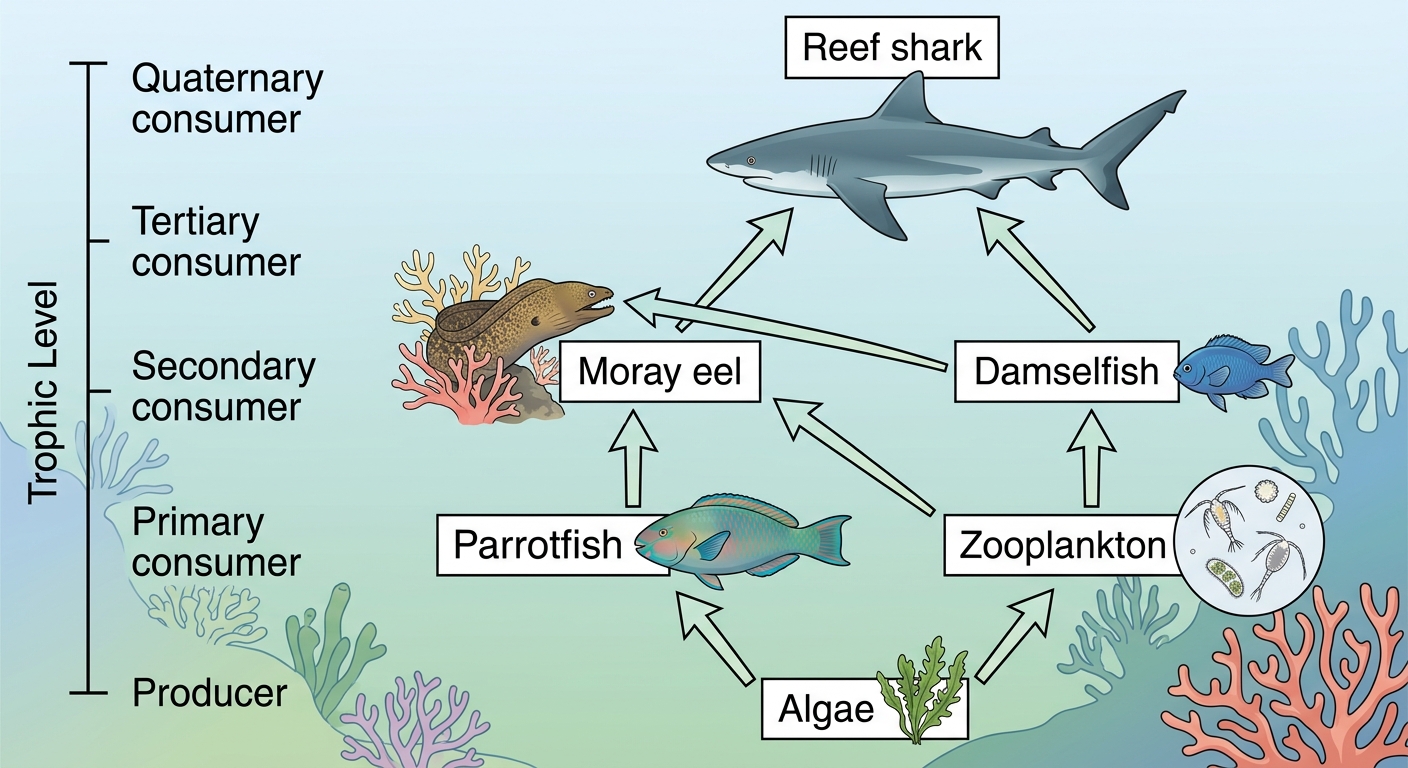
A coral reef ecosystem contains the following food web:
- Algae Parrotfish Moray eel Reef shark
- Algae Zooplankton Damselfish Moray eel Reef shark
The moray eel assimilates from damselfish and from parrotfish. The reef shark assimilates of the moray eel's total assimilated energy.
(a)
State the two food chains that supply energy to the reef shark. [1 mark]
(b)
Calculate the energy assimilated by the reef shark. [2 marks]
(c)
Explain why the removal of parrotfish from this ecosystem could have consequences for the reef shark beyond a simple reduction in energy supply. [2 marks]
Solutions
3ChallengeSAQ-LEnergy flow in ecosystems: Trophic levels and food webs9 marksPaper 2~14 min
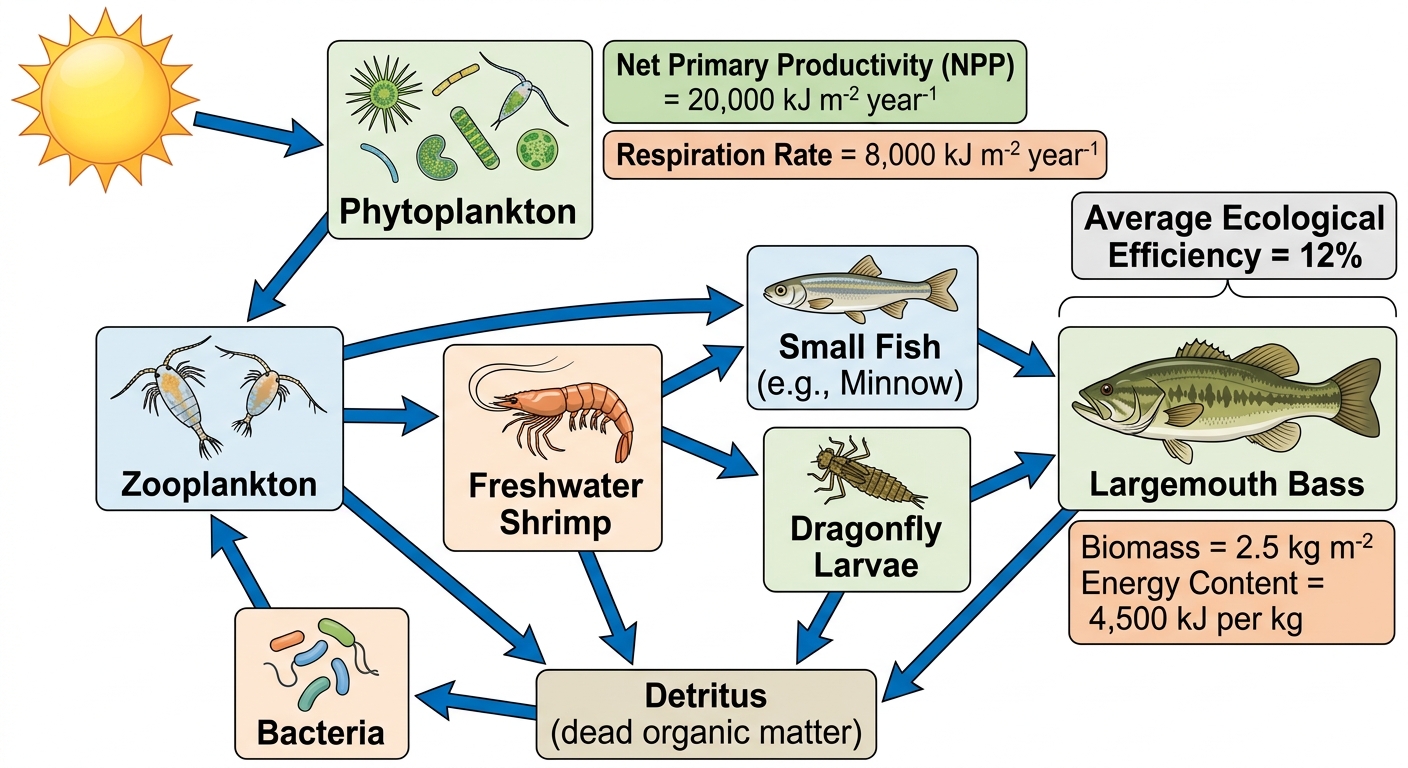
A simplified food web for a freshwater lake ecosystem in temperate North America is shown below. Arrows indicate the direction of energy flow.
The following data apply to this ecosystem:
- Net primary productivity (NPP) of phytoplankton:
- Respiration rate of phytoplankton:
- Mean ecological efficiency between each trophic level:
- Biomass of Largemouth Bass: ; energy content:
(a)
State the gross primary productivity (GPP) of the phytoplankton. [1 mark]
(b)
Calculate the total energy available to the Largemouth Bass from this food web, in . Assume bass feed exclusively on Small Fish and Dragonfly Larvae, and that each of these two prey groups receives equal energy from the trophic level below. Show all working. [4 marks]
(c)
Explain why the low ecological efficiency of limits the number of trophic levels that can be supported in this ecosystem. [2 marks]
(d)
Discuss the usefulness of a food web model, compared to a simple food chain, for predicting the impact of removing Freshwater Shrimp from this ecosystem. [2 marks]
Solutions
That's every free question here — 3 of 48.
+45 more questions, plus Mock Papers & Worksheets, are waiting in Premium.