Energy from Fuels · Paper 1 — Free Chemistry HL Practice Questions
Free questions
Open in full, with answers, mark scheme and examiner insights.
Combustion reactions and energy release
A student burned ethanol, , in a spirit burner to heat of water in a copper can. Table 1 shows the results of three trials. The balance reads to and the thermometer to . ; .
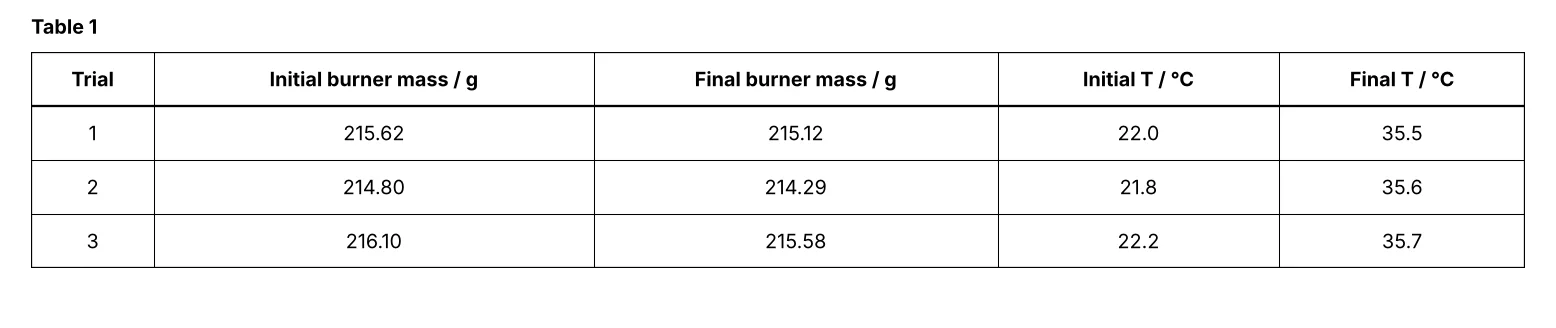
Calculate the mean mass of ethanol burned and the mean temperature rise of the water.
Determine the experimental enthalpy change of combustion of ethanol, in .
The literature value is . Identify the main systematic error that explains the difference and suggest one improvement to the method.
revisionprep.com
Summary Answer
Not available for this question.
Model Answer
Not available for this question.
Marking Scheme
Not available for this question.
Examiner Insights
Not available for this question.
Fuels and their efficiency
Ethanol was burned completely in a bomb calorimeter surrounded by of water. The heat capacity of the bomb itself may be ignored. Table 1 shows the results of three trials. ; ; the literature value of is .
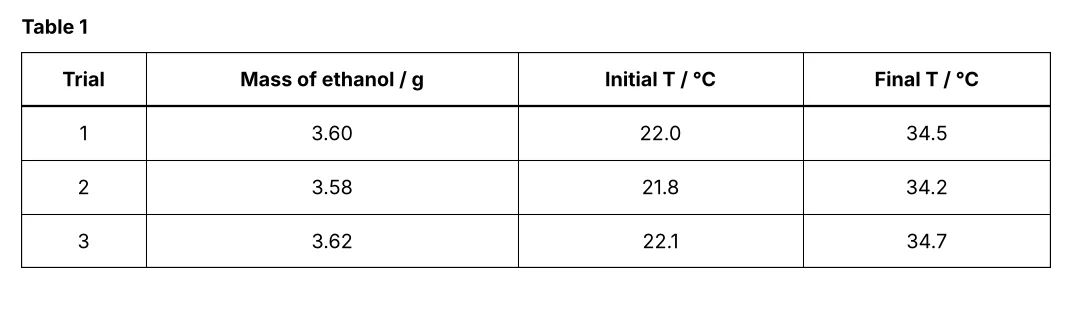
Calculate the energy absorbed by the water in trial 1.
Determine the experimental enthalpy change of combustion of ethanol from trial 1.
Calculate the percentage difference between your answer to (b) and the literature value.
Explain why this method is more accurate than a spirit burner heating an open can, and identify one remaining systematic error.
revisionprep.com
Summary Answer
Not available for this question.
Model Answer
Not available for this question.
Marking Scheme
Not available for this question.
Examiner Insights
Not available for this question.
Combustion reactions and energy release
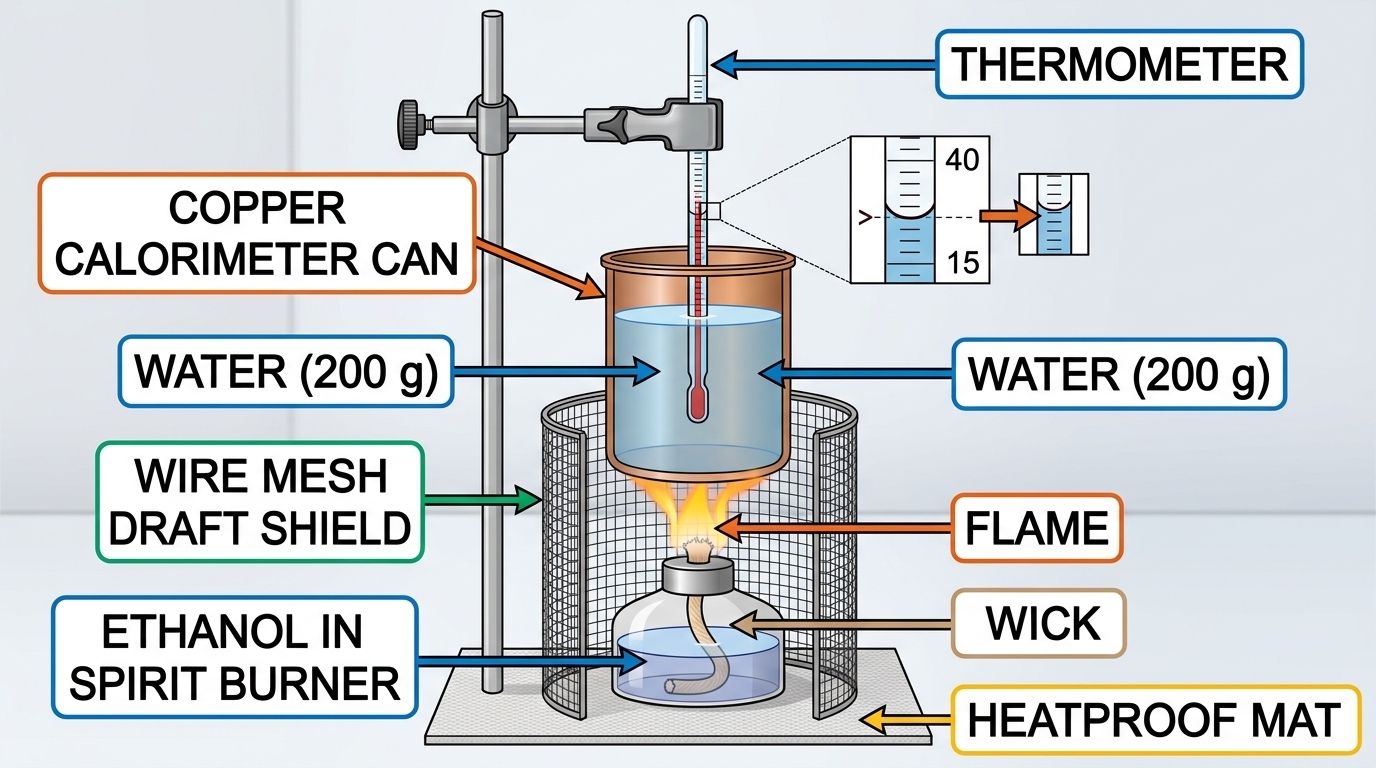
A student burns ethanol () in a spirit burner to heat 200 g of water, recording a temperature rise of 15.0 °C. The energy transferred to the water is calculated as 12.5 kJ, while theoretical enthalpy of combustion of ethanol is . The student consumed 0.0200 mol of ethanol, giving a theoretical energy release of 27.3 kJ. Which statement is the most significant explanation for the discrepancy between the measured and theoretical values?
revisionprep.com
Summary Answer
Not available for this question.
Model Answer
Not available for this question.
Marking Scheme
Not available for this question.
Examiner Insights
Not available for this question.
Fuels and their efficiency
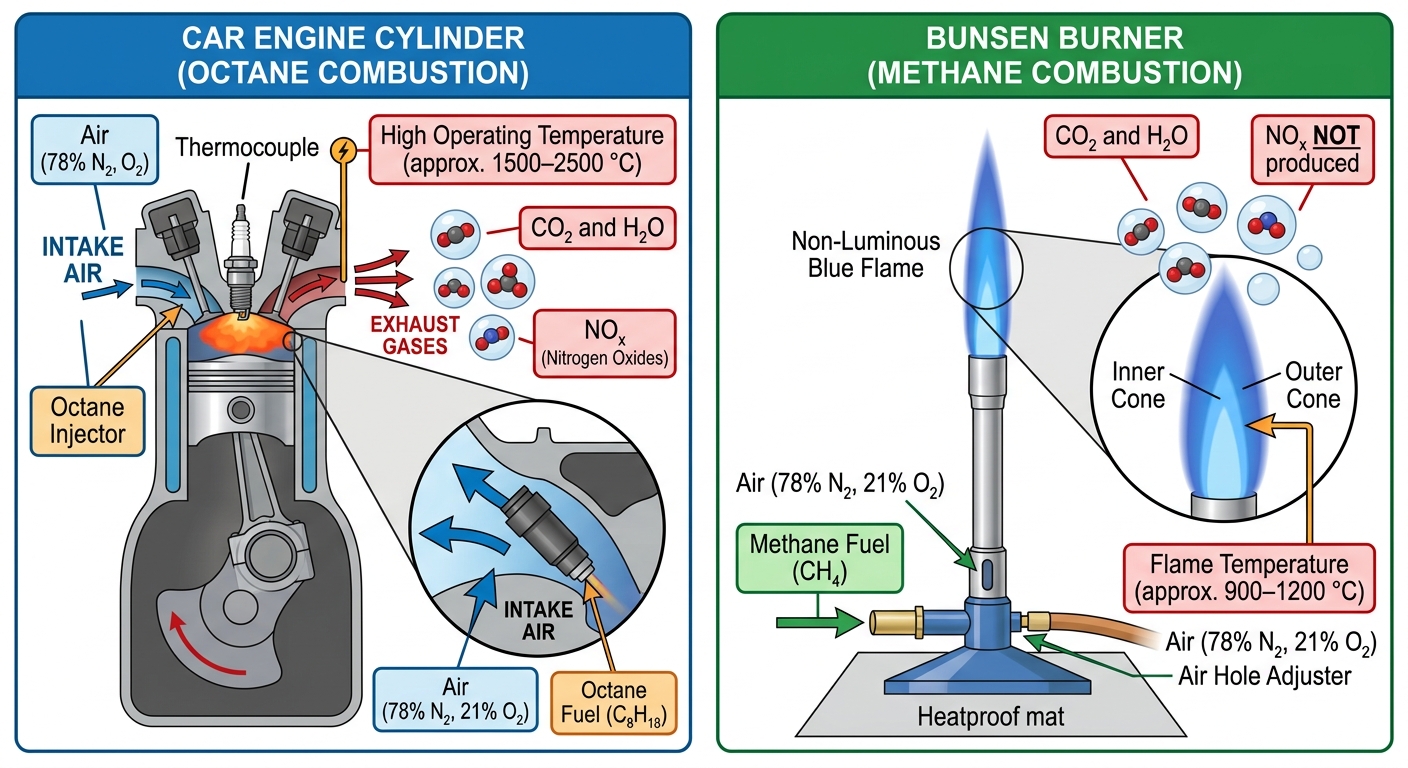
A car engine burning octane, , produces significant amounts of nitrogen oxides, , whereas a Bunsen burner burning methane produces almost none. Neither fuel contains nitrogen.
What is the main reason forms in the engine?
revisionprep.com
Summary Answer
Not available for this question.
Model Answer
Not available for this question.
Marking Scheme
Not available for this question.
Examiner Insights
Not available for this question.
Combustion reactions and energy release
An engineer tests a natural-gas boiler, varying the air supplied as a percentage of the amount needed for complete combustion. The dry exhaust gas is analysed and the heating efficiency is measured. Table 1 shows the results.
;
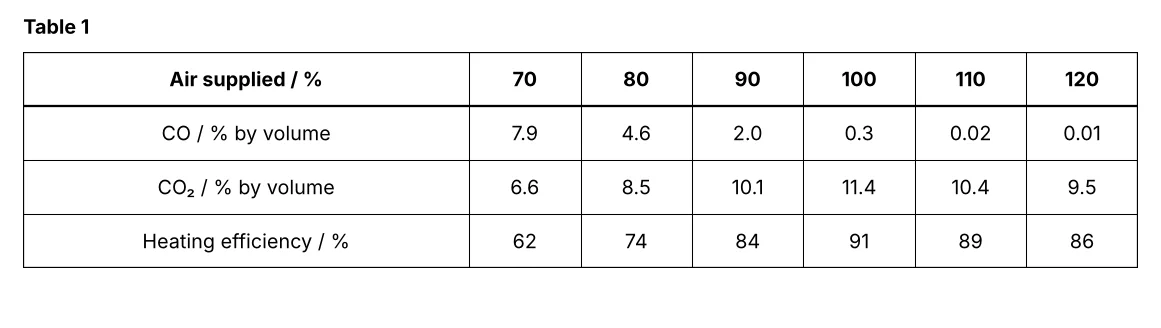
Write an equation for the incomplete combustion of methane to form carbon monoxide and water.
State the trend in the percentage of CO as the air supply increases from 70% to 100%.
Explain why the percentage of falls above 100% air, even though combustion is complete.
Determine, at 80% air, the fraction of the carbon that leaves as CO and hence the percentage of the energy of complete combustion that is not released.
Suggest why the heating efficiency falls when the air supply is above 110%.
Justify the recommendation that boilers are set to run at 105% to 110% air.
revisionprep.com
Summary Answer
Not available for this question.
Model Answer
Not available for this question.
Marking Scheme
Not available for this question.
Examiner Insights
Not available for this question.
Fuels and their efficiency
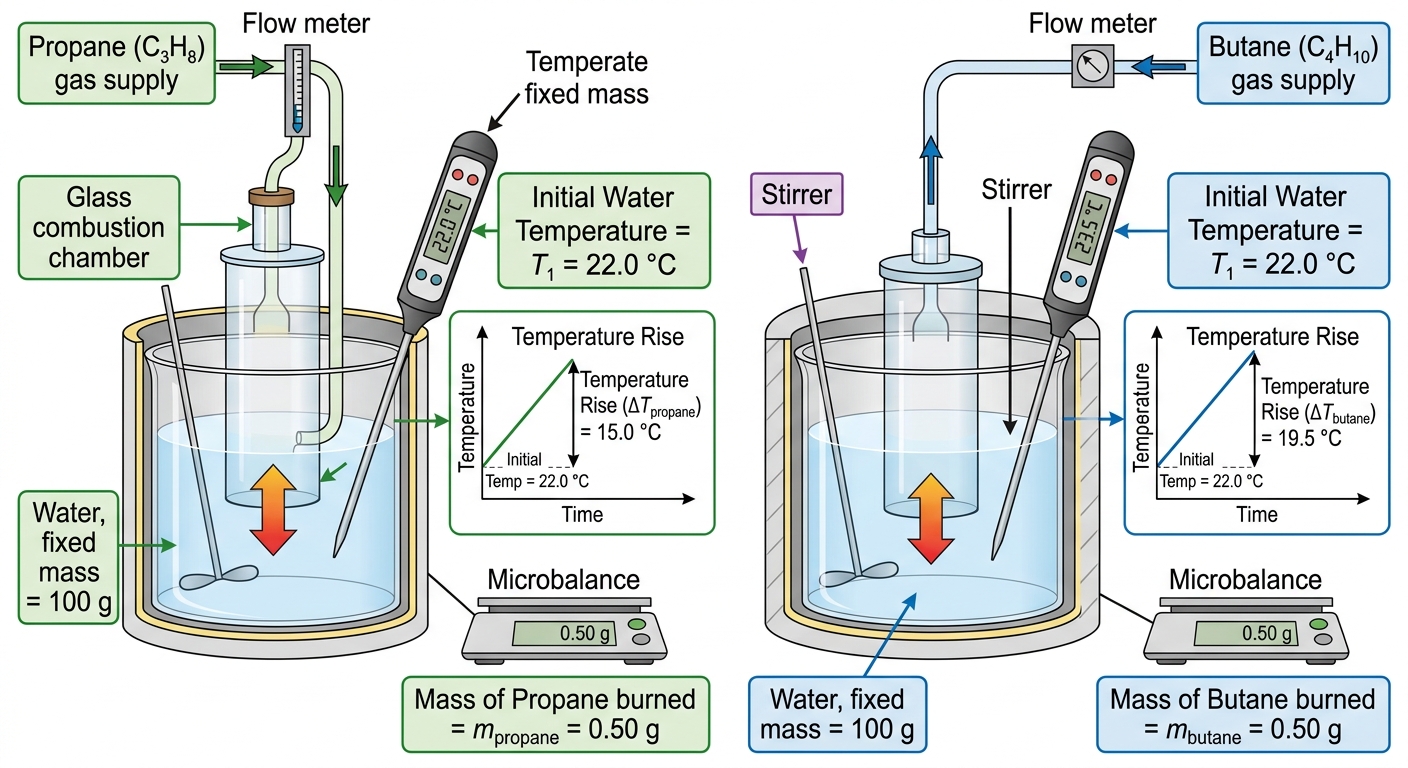
In the experiments shown, of propane and of butane are burned in turn under the same calorimeter, each heating of water. The temperature rises are for propane and for butane.
The specific energies of propane and butane are and .
Which conclusion is best supported by these results?
revisionprep.com
Summary Answer
Not available for this question.
Model Answer
Not available for this question.
Marking Scheme
Not available for this question.
Examiner Insights
Not available for this question.
That's every free question here — 6 of 121.
+115 more questions, plus Mock Papers & Worksheets, are waiting in Premium.