Entropy and Spontaneity · Paper 1 — Free Chemistry HL Practice Questions
Free questions
Open in full, with answers, mark scheme and examiner insights.
Entropy and the second law of thermodynamics
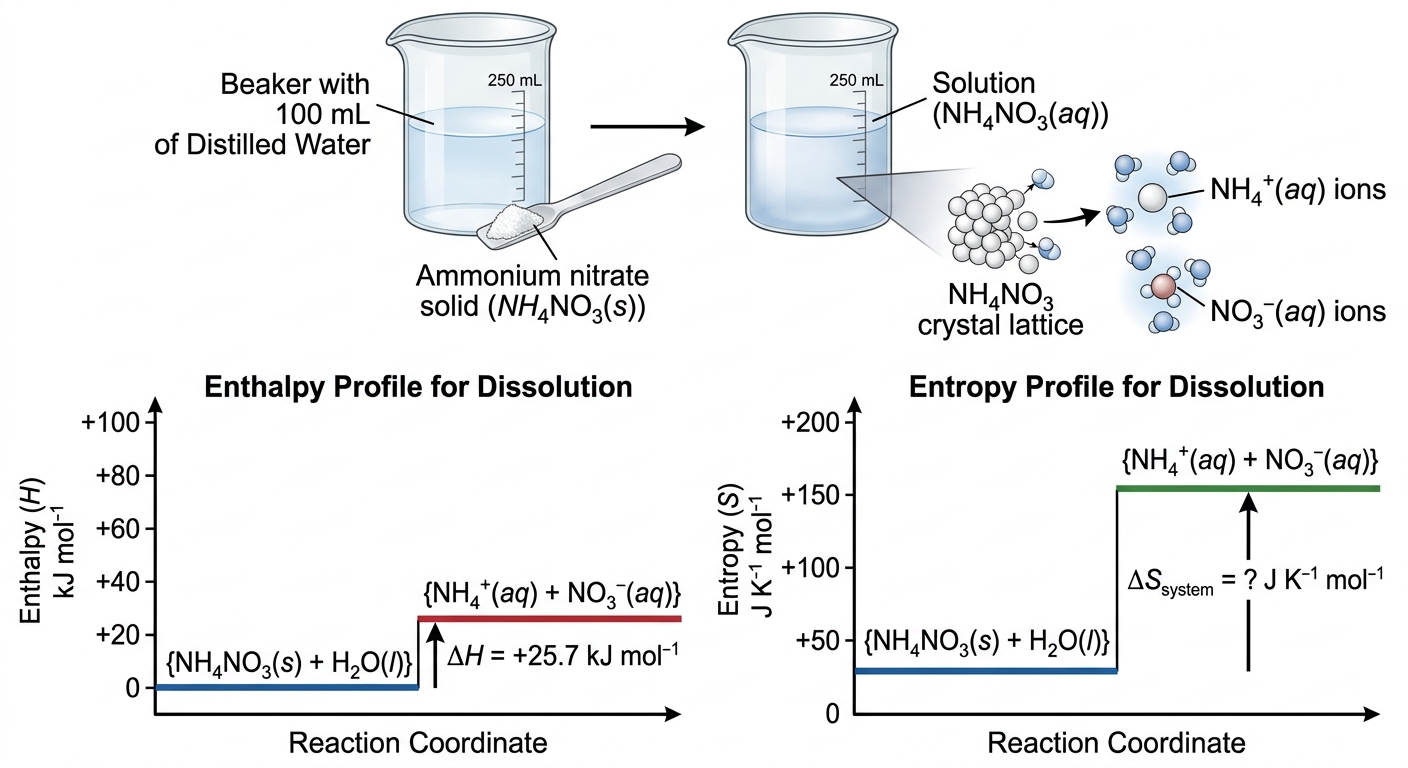
The shows ammonium nitrate dissolving in water at , with its enthalpy and entropy profiles.
The solid dissolves spontaneously. Which statement explains why this endothermic process is spontaneous?
revisionprep.com
Summary Answer
Not available for this question.
Model Answer
Not available for this question.
Marking Scheme
Not available for this question.
Examiner Insights
Not available for this question.
Spontaneous vs non-spontaneous processes
Which combination of signs gives a reaction that is not spontaneous at any temperature?
revisionprep.com
Summary Answer
Not available for this question.
Model Answer
Not available for this question.
Marking Scheme
Not available for this question.
Examiner Insights
Not available for this question.
Entropy and the second law of thermodynamics
The data in Table 1 give boiling points and enthalpies of vaporisation, at , for five liquids. The entropy of vaporisation of two of the liquids is left for you to calculate.
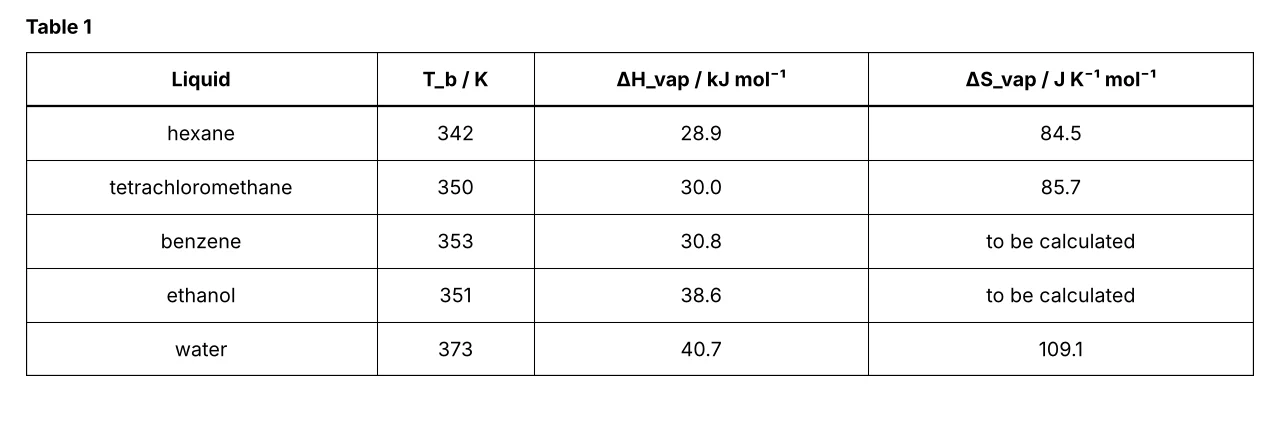
Show that, at the boiling point, .
Calculate for benzene and for ethanol, in .
Suggest why for ethanol and water is much larger than for the other three liquids.
Cyclohexane is non-polar and boils at . Determine an estimate of its enthalpy of vaporisation, using the data for the non-polar liquids.
The boiling point of benzene was measured with an uncertainty of and its enthalpy of vaporisation has an uncertainty of . Determine the percentage uncertainty in for benzene from the data in Table 1.
revisionprep.com
Summary Answer
Not available for this question.
Model Answer
Not available for this question.
Marking Scheme
Not available for this question.
Examiner Insights
Not available for this question.
Spontaneous vs non-spontaneous processes
A student dissolves ammonium nitrate in water in an insulated cup, as shown in the diagram. The box labelled "Calculated values" gives data-book values at .
Take the specific heat capacity of the solution as and use only the mass of water.
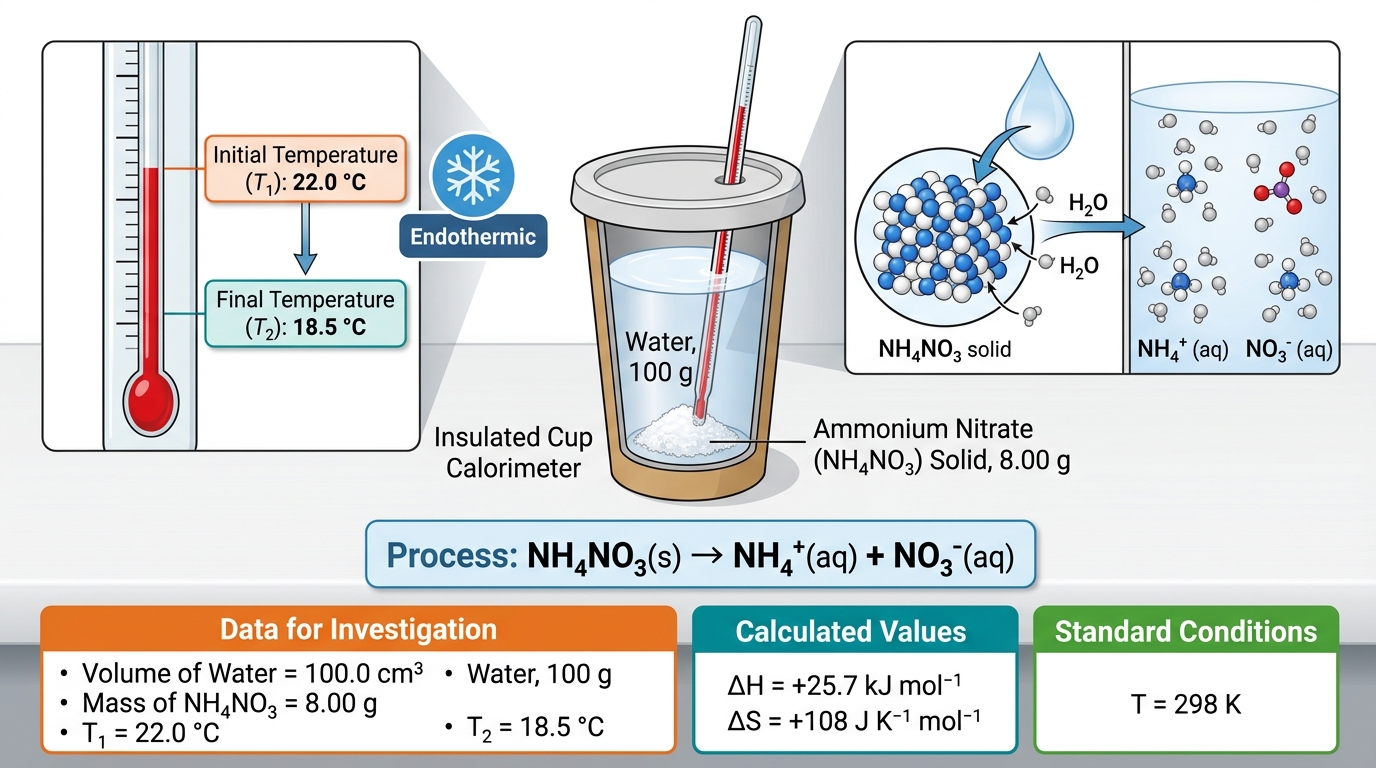
Calculate the enthalpy change of solution, in , from the student's results.
Determine the percentage error in the student's value compared with the data-book value.
Suggest one reason why the student's value is lower than the data-book value, and one improvement to the method.
Using the data-book values, calculate at and deduce whether the dissolution is spontaneous.
revisionprep.com
Summary Answer
Not available for this question.
Model Answer
Not available for this question.
Marking Scheme
Not available for this question.
Examiner Insights
Not available for this question.
Spontaneous vs non-spontaneous processes
Two reactions, A and B, are being compared for use in an industrial process. Figure 1 shows for each reaction between and . Assume and are constant.
Figure 1: against temperature for reactions A (solid line) and B (dashed line).
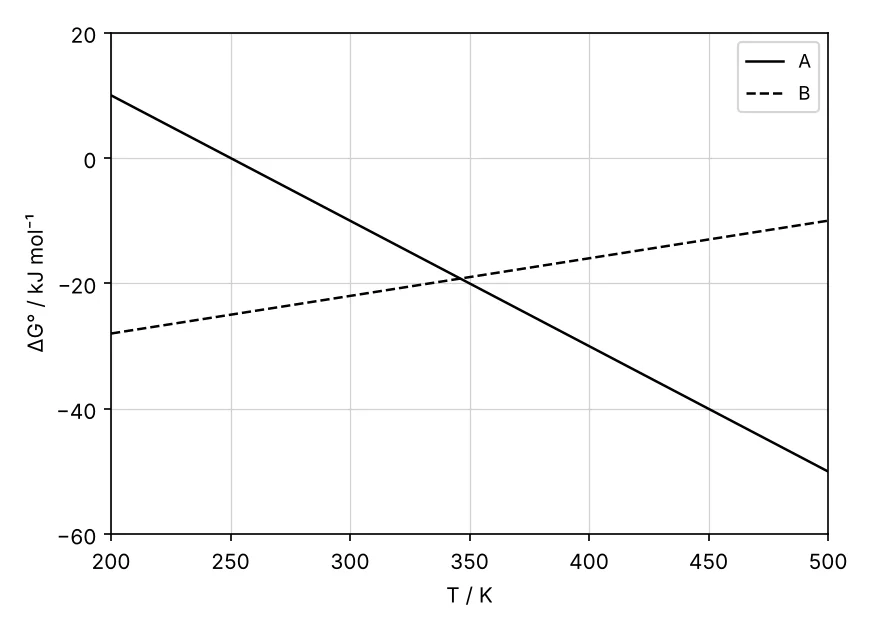
Determine and for reaction A, using the intercept and gradient of its line.
Calculate the temperature, in K, above which reaction A is spontaneous.
Estimate from Figure 1 the temperature at which the two reactions have the same .
Determine and for reaction B.
Deduce which reaction is more favoured (has the more negative ) at and at , and explain the change.
revisionprep.com
Summary Answer
Not available for this question.
Model Answer
Not available for this question.
Marking Scheme
Not available for this question.
Examiner Insights
Not available for this question.
Gibbs free energy and its application to chemical reactions
A student claims that every exothermic reaction is spontaneous. For , and . Assume both values are constant. Which row gives at and the correct evaluation of the claim?
revisionprep.com
Summary Answer
Not available for this question.
Model Answer
Not available for this question.
Marking Scheme
Not available for this question.
Examiner Insights
Not available for this question.
That's every free question here — 6 of 105.
+99 more questions, plus Mock Papers & Worksheets, are waiting in Premium.