Energy Cycles in Reactions · Paper 2 — Free Chemistry HL Practice Questions
Free questions
Open in full, with answers, mark scheme and examiner insights.
Thermochemistry and enthalpy diagrams
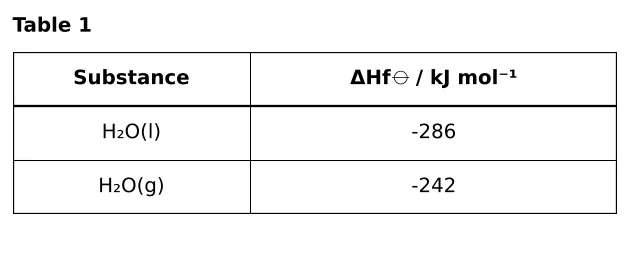
Methane is the main component of natural gas. Its standard enthalpy of combustion is when liquid water is formed.
.
Write an equation, including state symbols, for the complete combustion of methane to form liquid water.
Sketch an enthalpy level diagram for this reaction. Label the reactants, the products and , and show its value.
Calculate the energy, in kJ, released when of methane burns completely.
Calculate the enthalpy change, in , for the combustion of methane when the water is formed as a gas.
Deduce, with a reason, whether the product level for lies above or below the product level drawn in (b).
revisionprep.com
Summary Answer
Not available for this question.
Model Answer
Not available for this question.
Marking Scheme
Not available for this question.
Examiner Insights
Not available for this question.
Hess's law and enthalpy cycles
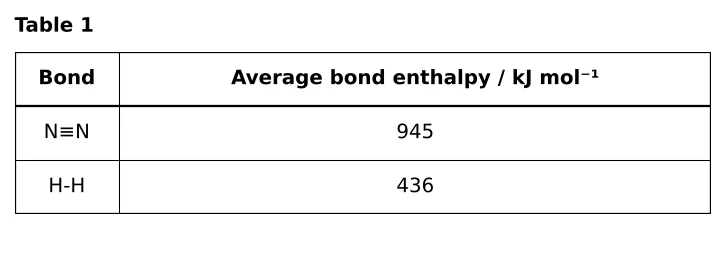
Ammonia is made industrially from nitrogen and hydrogen:
Let be the average bond enthalpy of the N-H bond.
State the condition that all species must satisfy for bond enthalpy calculations to be valid, and why this reaction meets it.
Determine the value of , in .
Suggest why the value of obtained this way could differ slightly from a tabulated average N-H bond enthalpy.
revisionprep.com
Summary Answer
Not available for this question.
Model Answer
Not available for this question.
Marking Scheme
Not available for this question.
Examiner Insights
Not available for this question.
Thermochemistry and enthalpy diagrams
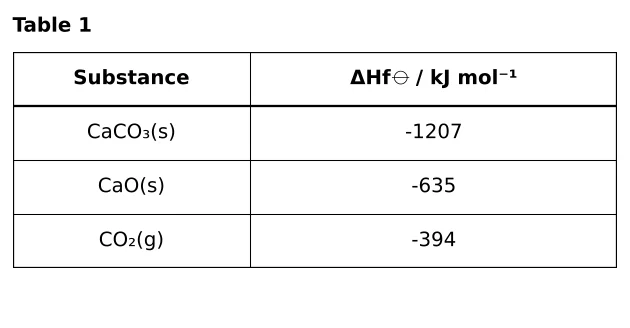
Calcium oxide (lime) is made by heating calcium carbonate in a kiln: .
Define the term standard enthalpy of formation, .
Write an equation, including state symbols, for the reaction whose enthalpy change is of ethanol, .
Write an equation, including state symbols, for the reaction whose enthalpy change is of calcium carbonate, .
Outline why of is zero.
Calculate the standard enthalpy change, in , for the decomposition of calcium carbonate.
Identify the reaction as exothermic or endothermic and describe how this is shown on an enthalpy level diagram.
Explain, in terms of enthalpy levels and the energy changes of bond breaking and bond forming, why the reverse reaction is exothermic, and state its enthalpy change.
revisionprep.com
Summary Answer
Not available for this question.
Model Answer
Not available for this question.
Marking Scheme
Not available for this question.
Examiner Insights
Not available for this question.
Born-Haber cycle and lattice enthalpy
Magnesium chloride is used to de-ice roads and to control dust. Data in kJ mol for MgCl2: lattice enthalpy +2522; enthalpy of hydration of Mg -1920; enthalpy of hydration of Cl -364.
Draw a labelled enthalpy cycle that links the enthalpy of solution of magnesium chloride () to its lattice enthalpy and the enthalpies of hydration of its ions.
Calculate the enthalpy change of solution of MgCl2 using its lattice enthalpy of +2522 kJ mol and the enthalpies of hydration: Mg, -1920 kJ mol; Cl, -364 kJ mol.
Using the signs of the lattice enthalpy and the enthalpies of hydration, explain why the dissolving of MgCl2 is exothermic.
The lattice enthalpy of CaCl2 is +2253 kJ mol and the enthalpies of hydration are Ca -1650 and Cl -364 kJ mol. Calculate the enthalpy of solution of CaCl2.
Compare the enthalpies of solution of MgCl2 and CaCl2 and explain, using ionic charge and radius, which lattice or hydration term is mainly responsible for the difference.
A student measures a temperature change when MgCl2 dissolves. Explain why the measured enthalpy of solution is likely to differ from the value calculated from the data.
revisionprep.com
Summary Answer
Not available for this question.
Model Answer
Not available for this question.
Marking Scheme
Not available for this question.
Examiner Insights
Not available for this question.
Born-Haber cycle and lattice enthalpy
Barium oxide is used in the cathodes of some vacuum tubes. Data in kJ mol: ; enthalpy of atomisation of Ba: ; (Ba): ; (Ba): ; enthalpy of atomisation of oxygen (per mole of O atoms): ; (O): . The lattice enthalpy of BaO is +3102 kJ mol.
Draw a labelled Born-Haber cycle for barium oxide (BaO), with state symbols and the name of each enthalpy change on its arrow.
Explain why the first electron affinity of oxygen is exothermic but the second is endothermic.
The lattice enthalpy of barium oxide (BaO) is +3102 kJ mol. Calculate the second electron affinity of oxygen from this value and the other data.
The second electron affinity of oxygen is endothermic, yet the enthalpy of formation of BaO is -548 kJ mol. Explain how the formation is exothermic.
The lattice enthalpy of BaO is +3102 kJ mol and that of MgO is +3845 kJ mol. Explain the difference, using the ionic radii: Ba2+ 135 pm, O2- 140 pm, Mg2+ 72 pm, O2- 140 pm.
revisionprep.com
Summary Answer
Not available for this question.
Model Answer
Not available for this question.
Marking Scheme
Not available for this question.
Examiner Insights
Not available for this question.
Bond dissociation and bond formation energies
Ethene burns completely in oxygen.
Standard enthalpies of formation: , .
The standard enthalpy of combustion of ethene, , is .
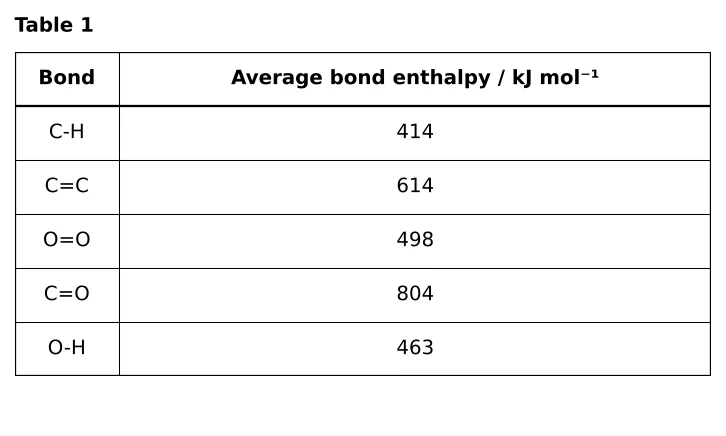
Calculate the enthalpy change for the reaction, in , using the average bond enthalpies.
Calculate the enthalpy change when of water vapour condenses to liquid water, and hence determine the value your answer to (a) predicts for of ethene.
Explain why the value obtained in (b) still differs from .
revisionprep.com
Summary Answer
Not available for this question.
Model Answer
Not available for this question.
Marking Scheme
Not available for this question.
Examiner Insights
Not available for this question.
That's every free question here — 6 of 200.
+194 more questions, plus Mock Papers & Worksheets, are waiting in Premium.