Entropy and Spontaneity · Paper 2 — Free Chemistry HL Practice Questions
Free questions
Open in full, with answers, mark scheme and examiner insights.
Entropy and the second law of thermodynamics
The table gives standard molar entropies at .
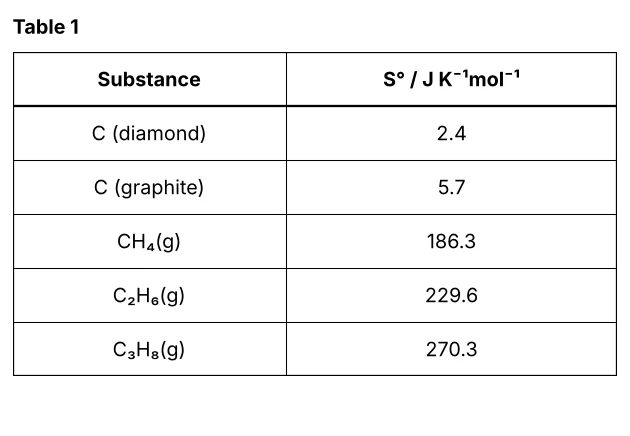
Suggest why graphite has a higher entropy than diamond.
Describe the trend in entropy from methane to propane and suggest a reason.
Predict whether the standard molar entropy of liquid propane is higher or lower than .
revisionprep.com
Summary Answer
Not available for this question.
Model Answer
Not available for this question.
Marking Scheme
Not available for this question.
Examiner Insights
Not available for this question.
Gibbs energy and the equilibrium constant
Silver chloride is only very slightly soluble in water. For the change at , .
Predict, with a reason, whether is greater than or less than for this change.
Calculate at . .
revisionprep.com
Summary Answer
Not available for this question.
Model Answer
Not available for this question.
Marking Scheme
Not available for this question.
Examiner Insights
Not available for this question.
Entropy and the second law of thermodynamics
Ethanol burns in oxygen: , .
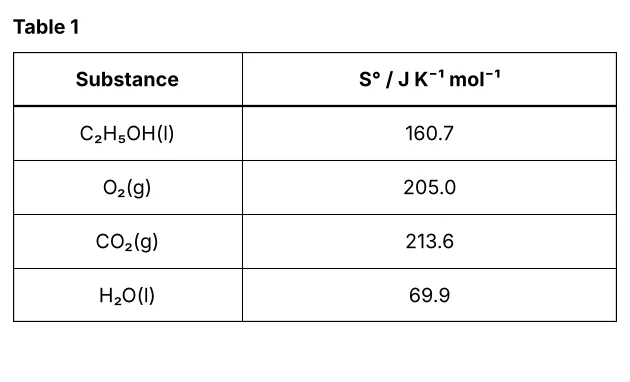
Calculate for the reaction.
Explain the sign of your answer to (a).
Calculate at 298 K, in .
State, with a reason, whether for this reaction is determined mainly by or by .
revisionprep.com
Summary Answer
Not available for this question.
Model Answer
Not available for this question.
Marking Scheme
Not available for this question.
Examiner Insights
Not available for this question.
Spontaneous vs non-spontaneous processes
The graph shows how the total Gibbs energy, , of a reaction mixture changes as a reaction proceeds at constant temperature and pressure. X, Y and Z are three compositions of the mixture.
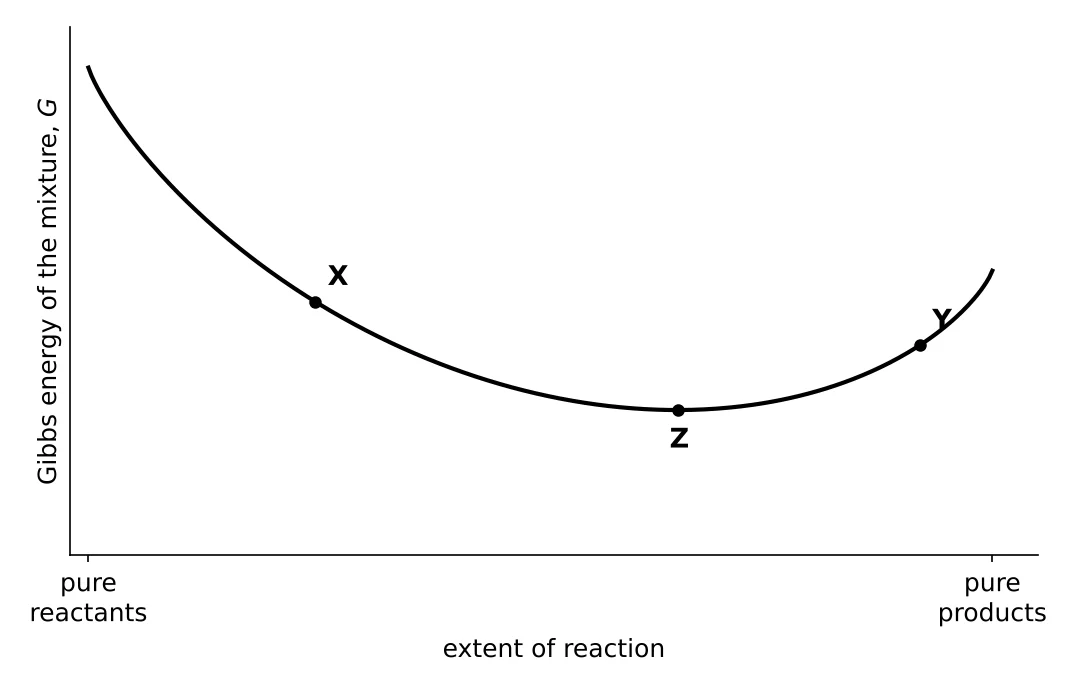
State the value of for the reaction when the mixture has composition Z.
Explain the direction in which the reaction proceeds from X and from Y.
State how the reaction quotient, , at X compares with the equilibrium constant, .
Deduce, with a reason, the sign of and whether is greater or less than 1.
A catalyst is added. State and explain its effect on the position of Z.
revisionprep.com
Summary Answer
Not available for this question.
Model Answer
Not available for this question.
Marking Scheme
Not available for this question.
Examiner Insights
Not available for this question.
Spontaneous vs non-spontaneous processes
Magnesium hydroxide is used as a flame retardant because it decomposes when heated and releases water vapour: . .
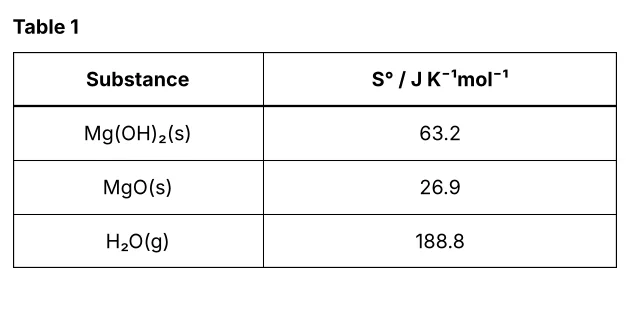
Calculate for the decomposition.
Explain why is positive, with reference to the states of matter in the equation.
Calculate at 298 K and state whether the decomposition is spontaneous at this temperature.
Determine the minimum temperature, in K, at which the decomposition is spontaneous, and state whether it is spontaneous at 600 K.
revisionprep.com
Summary Answer
Not available for this question.
Model Answer
Not available for this question.
Marking Scheme
Not available for this question.
Examiner Insights
Not available for this question.
Gibbs free energy and its application to chemical reactions
The thermite reaction between aluminium and iron(III) oxide is used to weld railway lines.
Standard molar entropies at in : Al(s) ; ; ; Fe(s) .
Assume that and do not change with temperature.
Calculate the standard entropy change, , for the reaction.
Calculate at , in .
Calculate at , in .
Deduce whether the reaction is spontaneous at all temperatures. Justify your answer using your answers to (b) and (c).
A mixture of aluminium and iron(III) oxide powder can be stored for years at , but it reacts violently once it is ignited. Explain this observation.
revisionprep.com
Summary Answer
Not available for this question.
Model Answer
Not available for this question.
Marking Scheme
Not available for this question.
Examiner Insights
Not available for this question.
That's every free question here — 6 of 106.
+100 more questions, plus Mock Papers & Worksheets, are waiting in Premium.