You're viewing 1 free preview question for Chemistry HL — subscribe to unlock 94 more, plus the Full Question Bank, Mock Papers & Worksheets.Upgrade
Measuring Enthalpy Change · Paper 2 — Free Chemistry HL Practice Questions
1ChallengeSAQ-LExothermic vs endothermic reactions9 marksPaper 2~14 min

Data
| Bond enthalpy / |
—
—
—
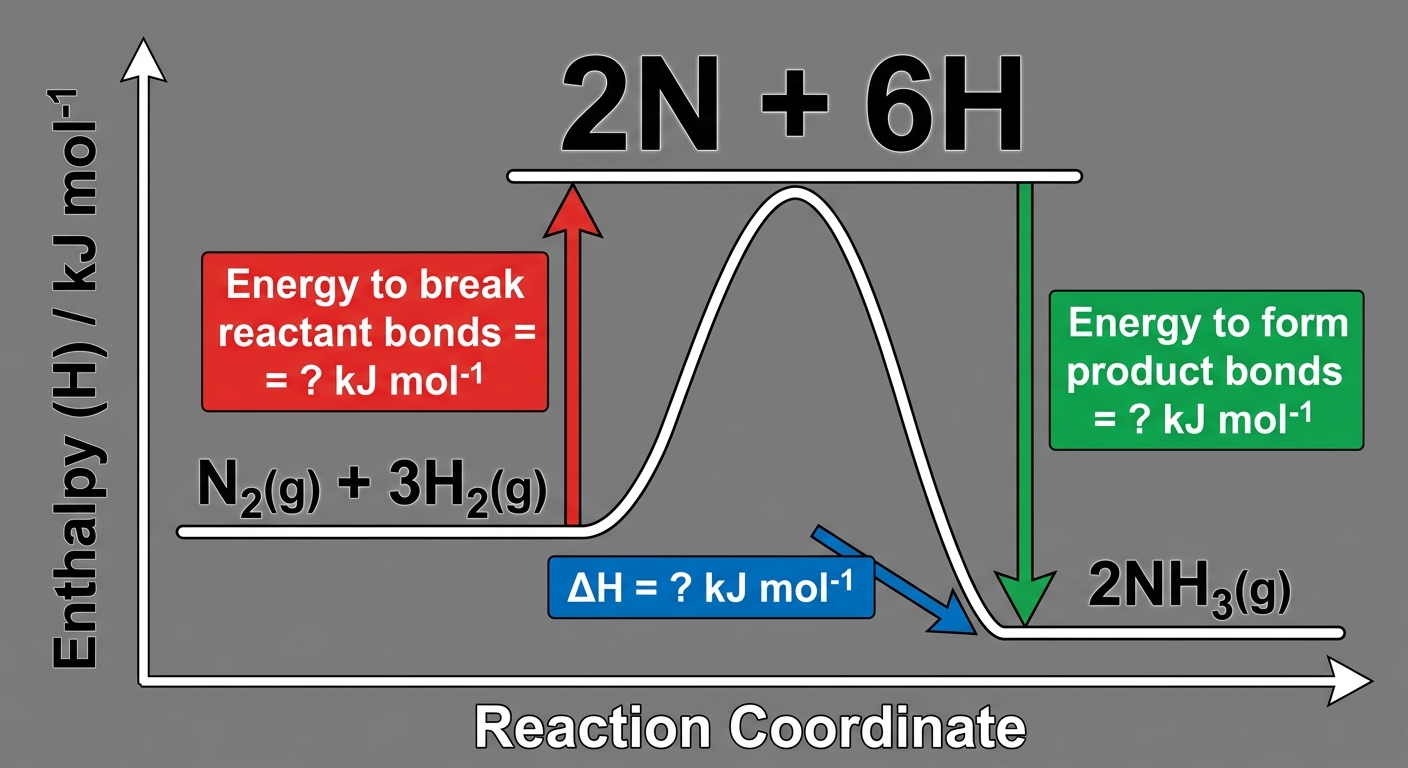
The Haber process produces ammonia: . The forward reaction is exothermic.
Bond enthalpy
(a)
State what is meant by the term average bond enthalpy. [1 mark]
(b)
Determine the enthalpy change, , for the forward reaction using the bond enthalpy data. State whether the reaction is exothermic or endothermic. [3 marks]
(c)
Explain why the value of calculated using bond enthalpies differs from the value measured experimentally. [2 marks]
(d)
The Haber process is operated at approximately and , using an iron catalyst. Evaluate the choice of , referring to reaction rate, equilibrium yield, and the sign of . [3 marks]

Solutions
That's every free question here — 1 of 95.
+94 more questions, plus Mock Papers & Worksheets, are waiting in Premium.