Energy from Fuels · Paper 1 — Free Chemistry SL Practice Questions
Free questions
Open in full, with answers, mark scheme and examiner insights.
Combustion reactions and energy release
A student burns ethanol in the apparatus shown and calculates an enthalpy of combustion of . The literature value is . What is the most likely main reason for the difference?
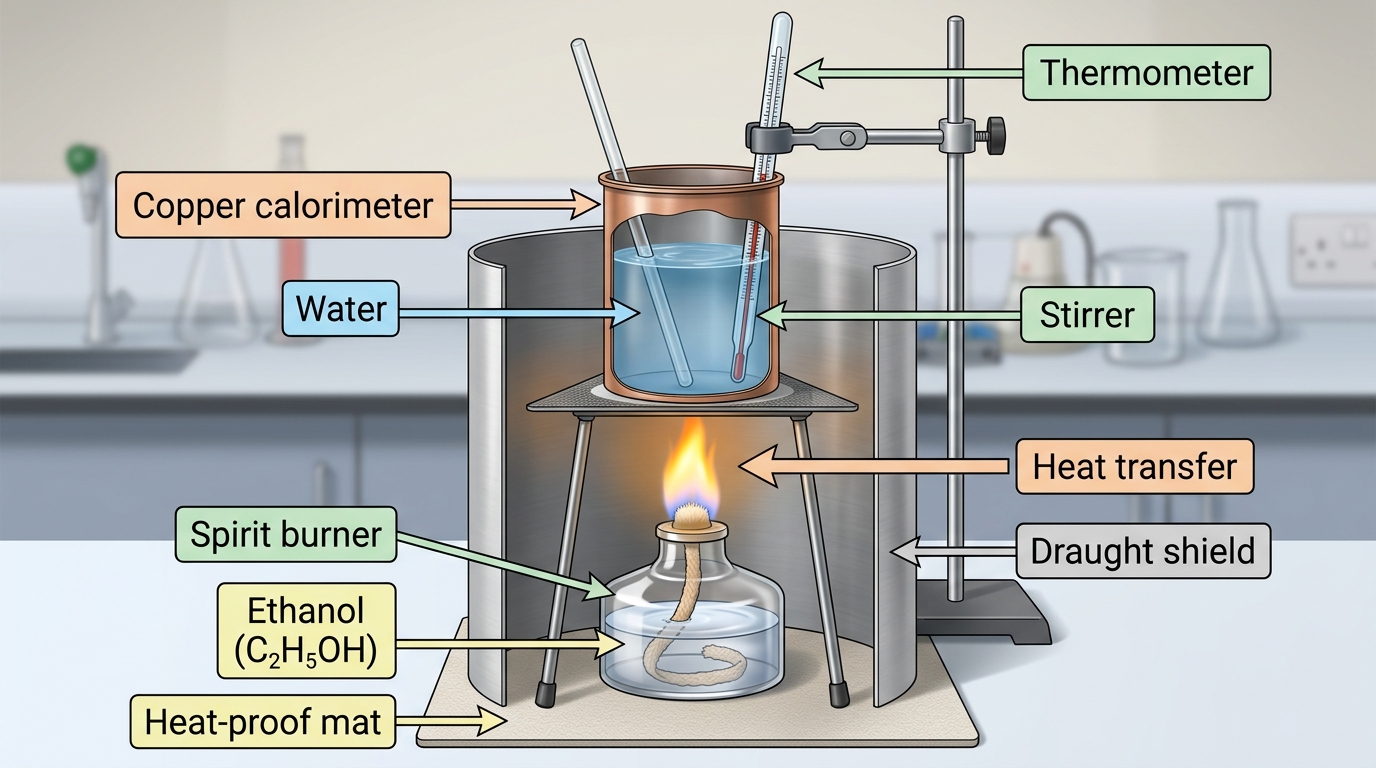
revisionprep.com
Summary Answer
Not available for this question.
Model Answer
Not available for this question.
Marking Scheme
Not available for this question.
Examiner Insights
Not available for this question.
Fuels and their efficiency
A student burns of methane, , and of ethanol, , separately, releasing and respectively as shown in the . Which fuel has the greater energy content per gram?
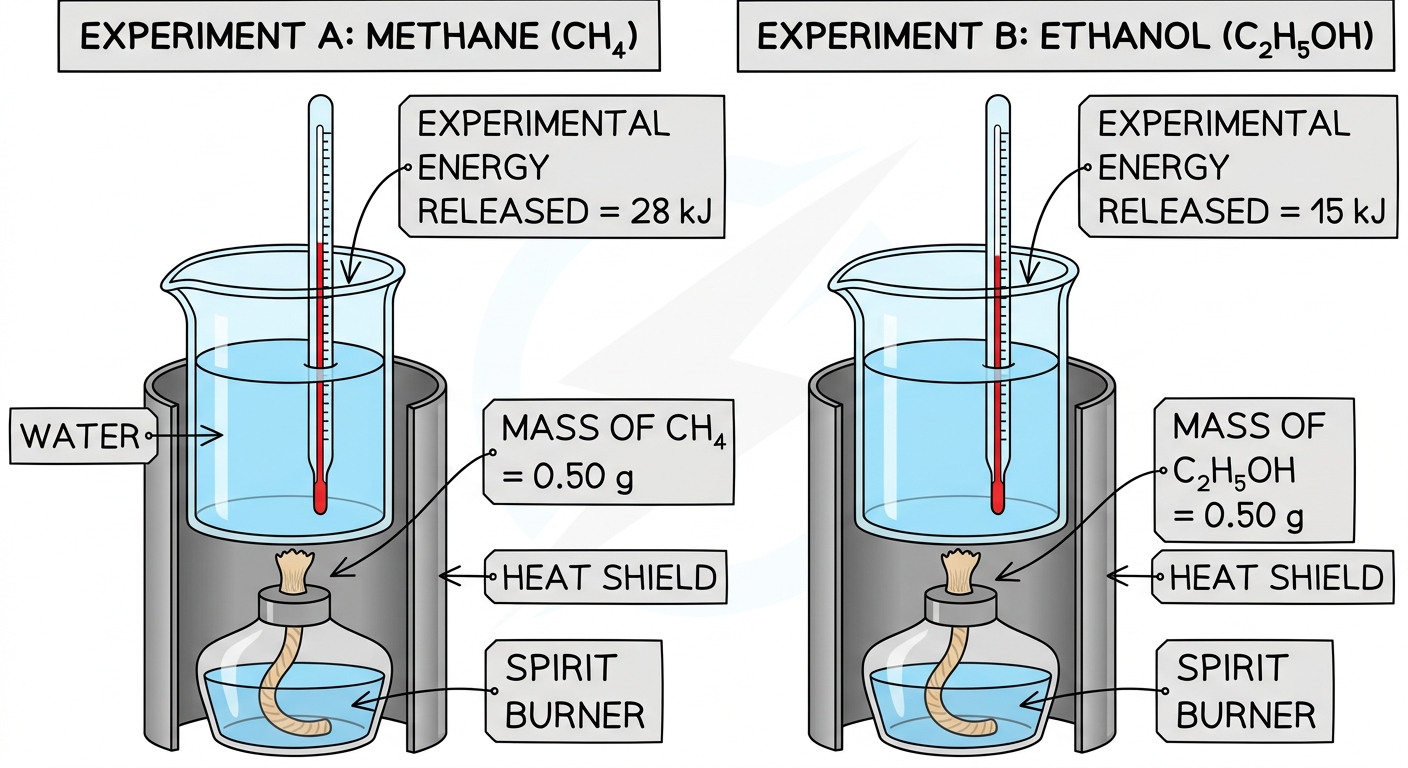
revisionprep.com
Summary Answer
Not available for this question.
Model Answer
Not available for this question.
Marking Scheme
Not available for this question.
Examiner Insights
Not available for this question.
Combustion reactions and energy release
A student burns ethanol, , under of water in four trials. Table 1 shows the mass of ethanol burnt and the temperature rise of the water in each trial. Use and .
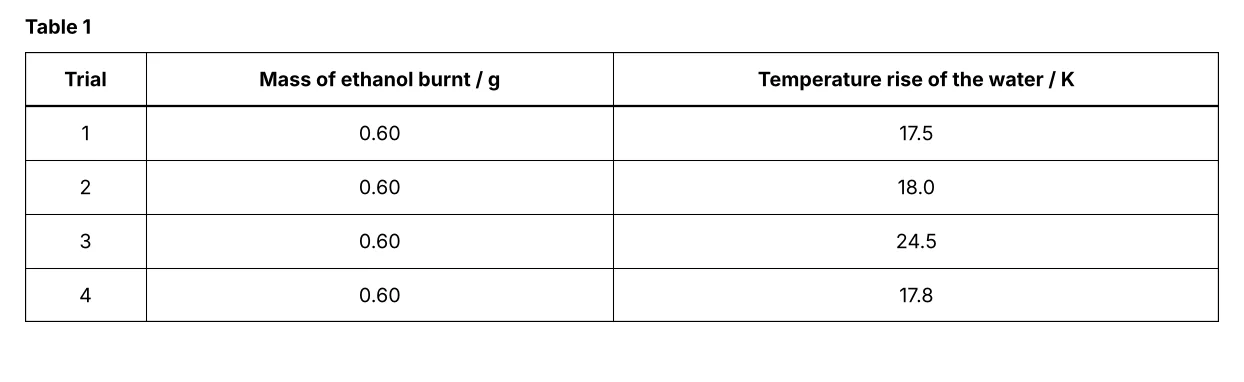
Identify the anomalous result in Table 1.
Calculate the mean temperature rise, excluding the anomalous result.
Calculate the experimental enthalpy of combustion of ethanol, in .
Suggest one improvement to the method that would reduce the systematic error, and explain its effect on the result.
revisionprep.com
Summary Answer
Not available for this question.
Model Answer
Not available for this question.
Marking Scheme
Not available for this question.
Examiner Insights
Not available for this question.
Fuels and their efficiency
A student burns samples of three fuels in a bomb calorimeter with a heat capacity of . Table 1 shows the temperature rise for each fuel, each measured with an uncertainty of . The data booklet value for octane, (), is .
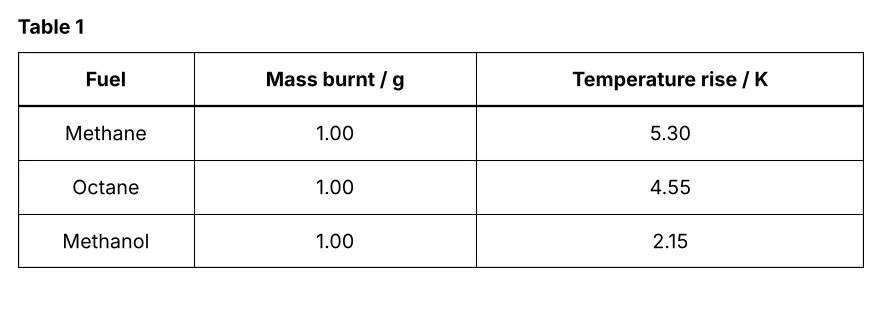
Calculate the energy released per gram of each fuel, in .
Calculate the energy released per mole of octane, in .
Calculate the percentage difference between your value in (b) and the data booklet value.
Determine the percentage uncertainty in the temperature rise for octane.
Evaluate whether the data justify ranking methane above octane for energy released per gram.
revisionprep.com
Summary Answer
Not available for this question.
Model Answer
Not available for this question.
Marking Scheme
Not available for this question.
Examiner Insights
Not available for this question.
Combustion reactions and energy release
A student burns ethanol, , in a spirit burner below a calorimeter. The measurements are in Table 1; each temperature reading has an uncertainty of . Use and . The data booklet value is .
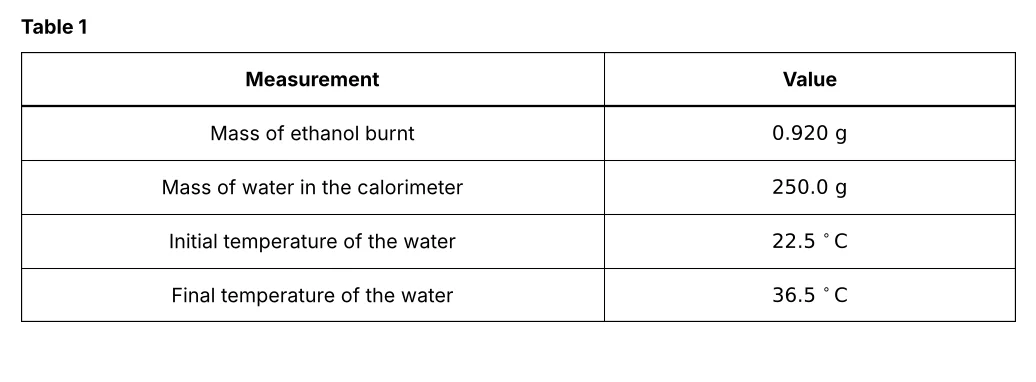
Calculate the experimental enthalpy of combustion of ethanol, in .
Calculate the percentage by which the experimental value is less exothermic than the data booklet value.
Evaluate the main sources of error in this experiment and suggest an improvement that would address the most significant one.
revisionprep.com
Summary Answer
Not available for this question.
Model Answer
Not available for this question.
Marking Scheme
Not available for this question.
Examiner Insights
Not available for this question.
Fuels and their efficiency
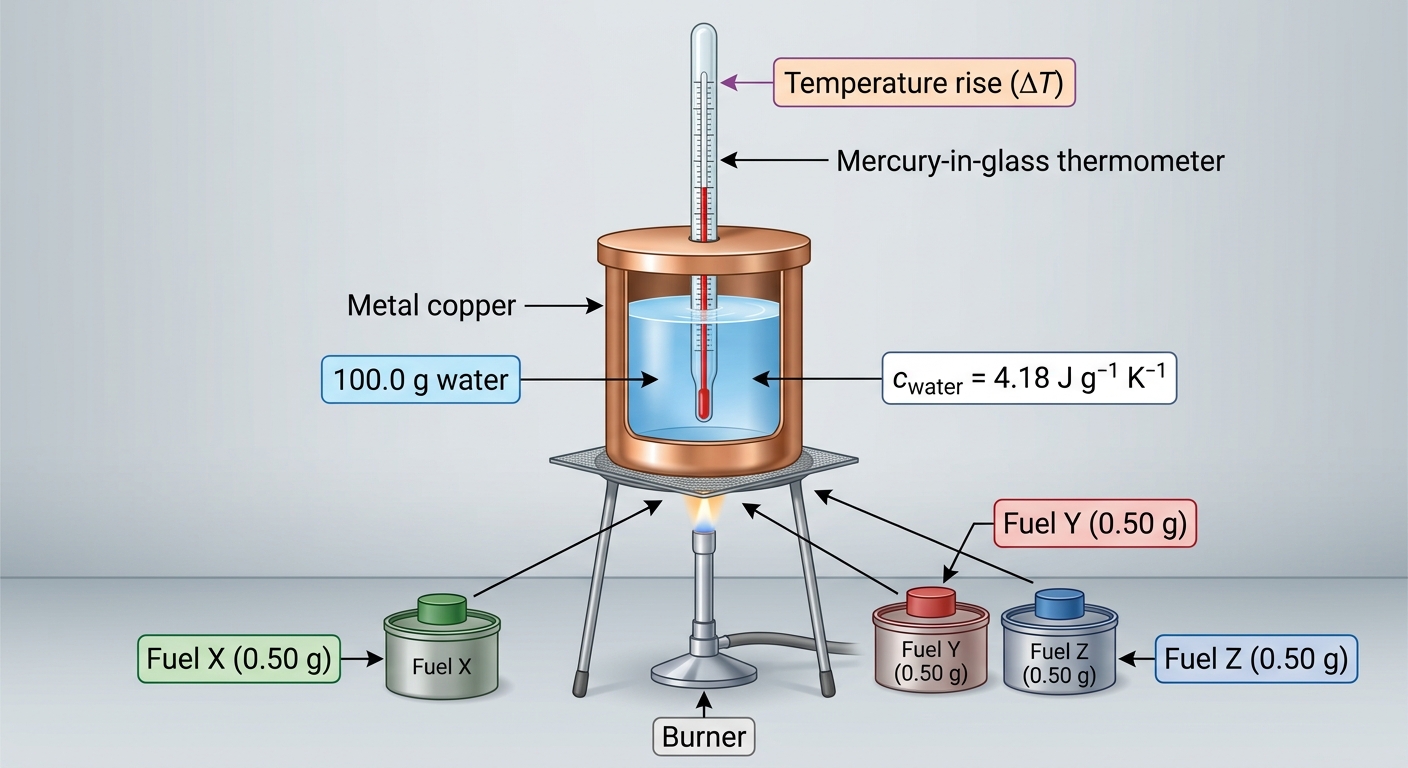
A student burns of each of three fuels, X, Y and Z, beneath a calorimeter containing of water (), as shown in the . The temperature rises are for X, for Y and for Z. The student concludes that fuel Y has the highest energy content per gram. Which statement best evaluates this conclusion?
revisionprep.com
Summary Answer
Not available for this question.
Model Answer
Not available for this question.
Marking Scheme
Not available for this question.
Examiner Insights
Not available for this question.
That's every free question here — 6 of 98.
+92 more questions, plus Mock Papers & Worksheets, are waiting in Premium.