You're viewing 1 free preview question for Chemistry SL — subscribe to unlock 95 more, plus the Full Question Bank, Mock Papers & Worksheets.Upgrade
Energy Cycles in Reactions · Paper 2 — Free Chemistry SL Practice Questions
1MasterySAQ-SThermochemistry and enthalpy diagrams5 marksPaper 2~8 min

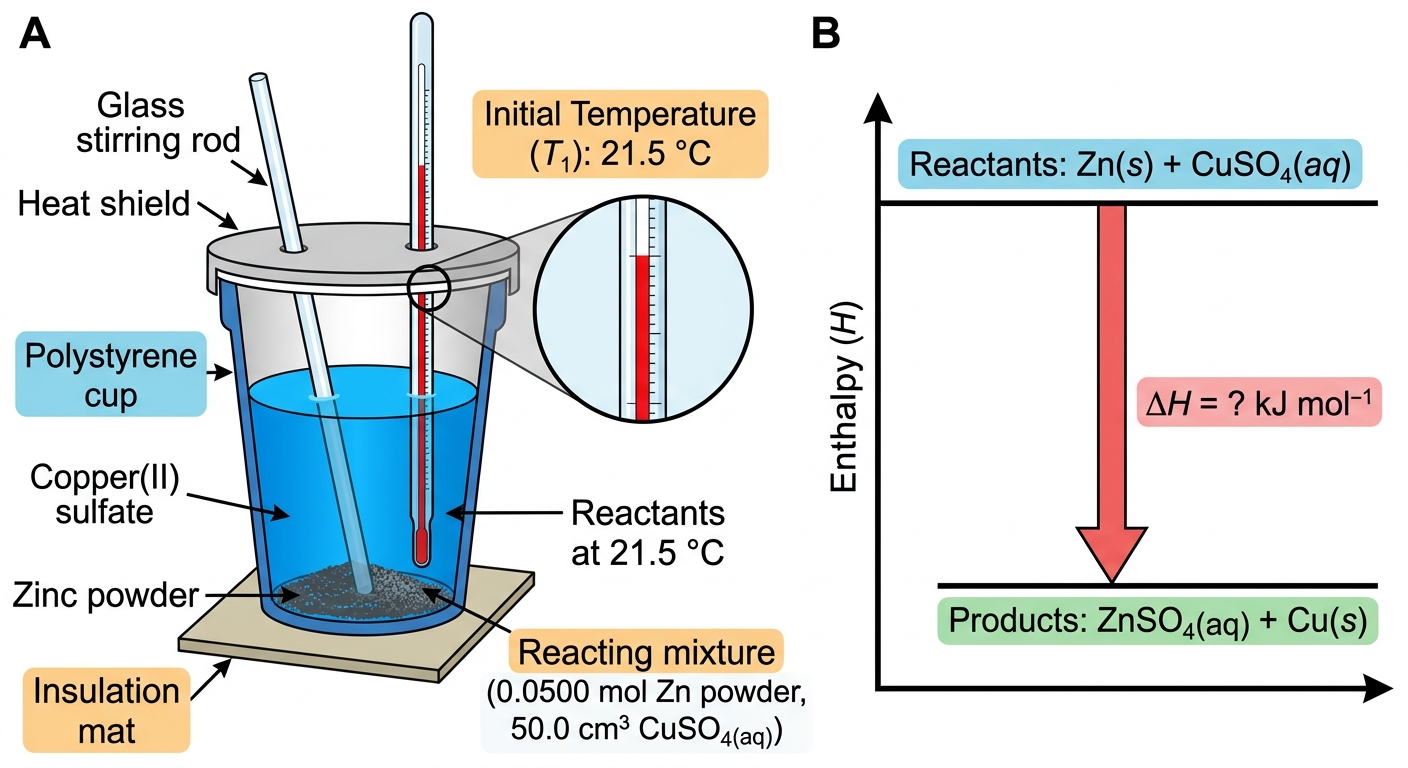
A student investigates the exothermic reaction between zinc powder and aqueous copper(II) sulfate:
The student adds of zinc powder to of aqueous copper(II) sulfate in a polystyrene cup. The initial temperature of both reactants is . After stirring, the maximum temperature reached is . Assume the specific heat capacity of the solution is and the density of the solution is .
(a)
State which species — reactants or products — has the higher enthalpy in this reaction. [1 mark]
(b)
Calculate the enthalpy change, , for this reaction in of zinc reacted. Give your answer to three significant figures. [2 marks]
(c)
The accepted standard enthalpy change for this reaction is . Explain two reasons why the student's experimental value differs from this accepted value. [2 marks]

Solutions
That's every free question here — 1 of 96.
+95 more questions, plus Mock Papers & Worksheets, are waiting in Premium.