You're viewing 1 free preview question for Chemistry SL — subscribe to unlock 71 more, plus the Full Question Bank, Mock Papers & Worksheets.Upgrade
Entropy and Spontaneity (Additional Higher Level) · Paper 2 — Free Chemistry SL Practice Questions
1ChallengeSAQ-LEntropy and the second law of thermodynamics7 marksPaper 2~11 min

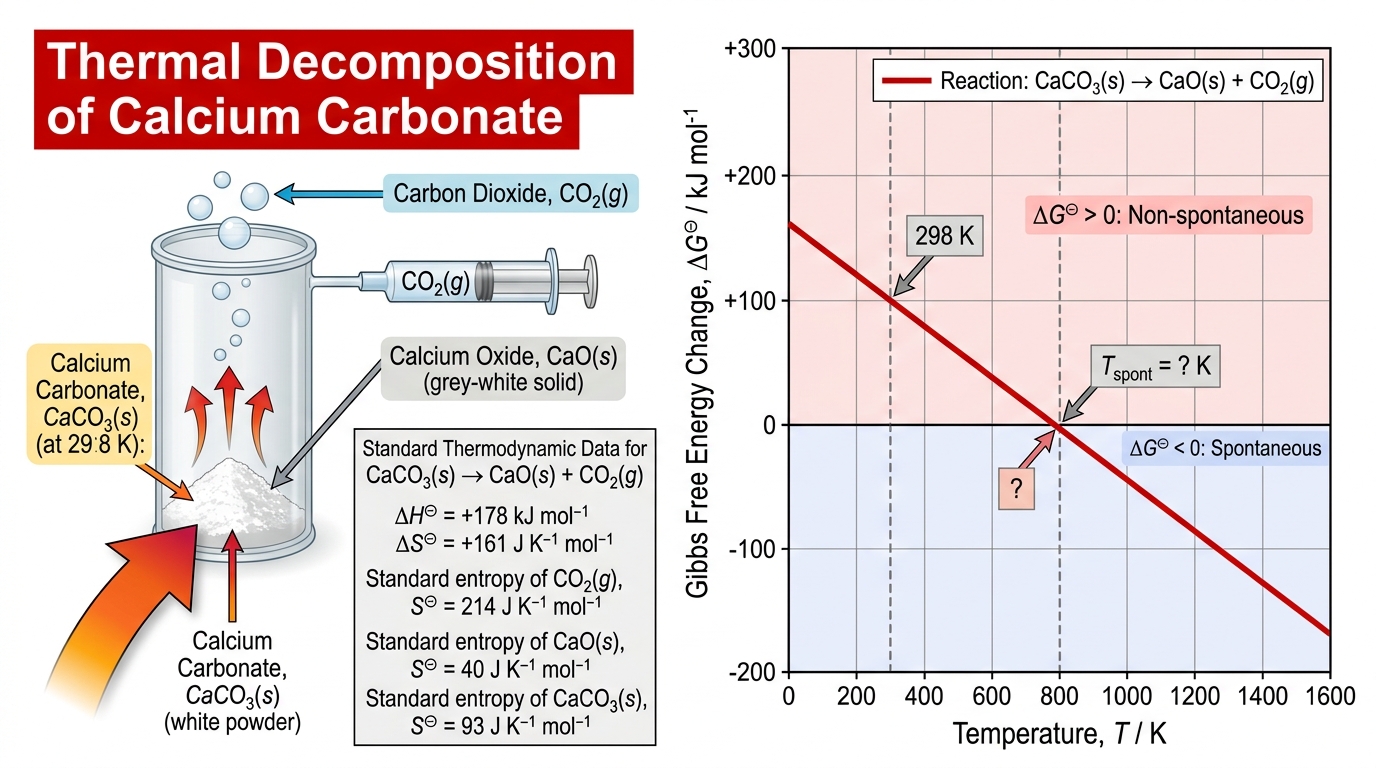
Data
-
-
Equations: ; ;
This question is about the spontaneity of thermal decomposition of calcium carbonate, a key reaction in the cement industry.
(a)
Calculate the temperature, in K, above which the decomposition of calcium carbonate becomes spontaneous. [3 marks]
(b)
Explain why is positive for this reaction. [2 marks]
(c)
Calculate the total entropy change of the universe, , at , and hence evaluate whether this consistent with the reaction being non-spontaneous at this temperature. [2 marks]

Solutions
That's every free question here — 1 of 72.
+71 more questions, plus Mock Papers & Worksheets, are waiting in Premium.