Measuring Enthalpy Change · Paper 2 — Free Chemistry SL Practice Questions
Free questions
Open in full, with answers, mark scheme and examiner insights.
Enthalpy of reaction, heat capacity, and calorimetry
In a calorimetry experiment, of magnesium reacts with excess hydrochloric acid: . The temperature of of solution rises from to . The specific heat capacity of the solution is .
State the temperature change.
Calculate the energy released, in kJ.
Calculate the enthalpy change per mole of magnesium, in .
Deduce the energy released when of magnesium reacts under the same conditions.
revisionprep.com
Summary Answer
Not available for this question.
Model Answer
Not available for this question.
Marking Scheme
Not available for this question.
Examiner Insights
Not available for this question.
Exothermic vs endothermic reactions
The enthalpy level diagram for a reaction is shown.
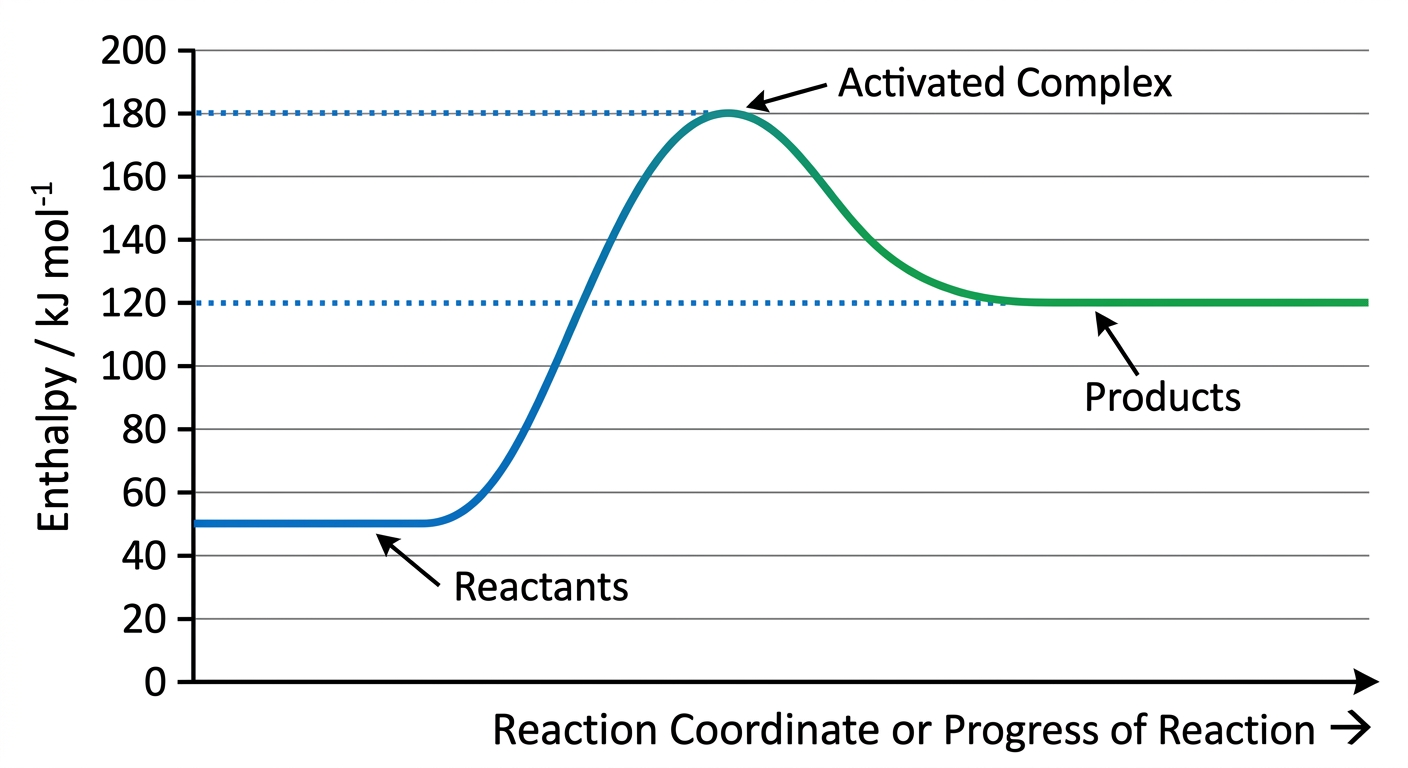
State whether the reaction is exothermic or endothermic, giving a reason, and determine for the forward reaction.
Determine the activation energy of the forward reaction.
Determine the activation energy of the reverse reaction.
State the value of for the reverse reaction.
revisionprep.com
Summary Answer
Not available for this question.
Model Answer
Not available for this question.
Marking Scheme
Not available for this question.
Examiner Insights
Not available for this question.
Enthalpy of reaction, heat capacity, and calorimetry
A student investigates the enthalpy of neutralisation of sodium hydroxide with hydrochloric acid in a calorimeter made from two nested polystyrene cups.
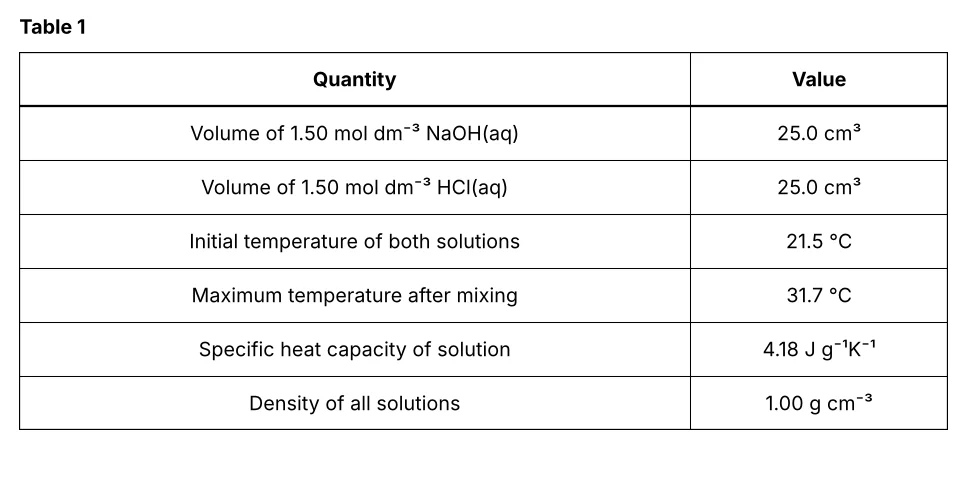
State whether the reaction is exothermic or endothermic.
Calculate the enthalpy change, in , for .
The experiment is repeated with in place of HCl(aq) and the temperature rise is smaller. Explain why, even though the same volume and concentration of acid are used.
State one limitation of this calorimeter.
Suggest one improvement that addresses the limitation in (d).
Each thermometer reading has an uncertainty of . Calculate the percentage uncertainty in the temperature change.
Discuss whether this uncertainty is large enough to explain why the value in (b) differs from the accepted value of .
revisionprep.com
Summary Answer
Not available for this question.
Model Answer
Not available for this question.
Marking Scheme
Not available for this question.
Examiner Insights
Not available for this question.
Exothermic vs endothermic reactions
A student uses average bond enthalpies to estimate the enthalpy change for the combustion of methane, with all species gaseous:
The experimental value of for methane, with liquid water as the product, is .
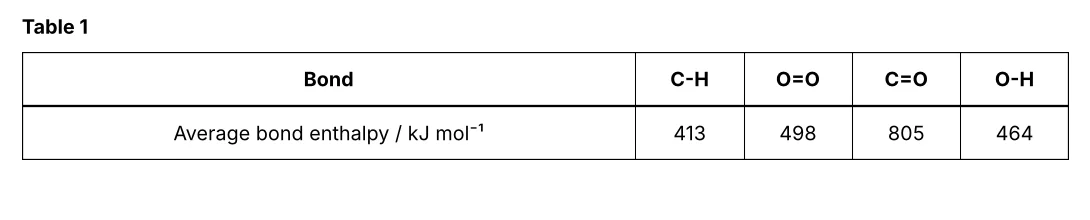
State whether the breaking of bonds is an exothermic or an endothermic process.
Calculate the enthalpy change for the reaction using the bond enthalpy data.
The value in (b) differs from . Identify two reasons for the difference.
revisionprep.com
Summary Answer
Not available for this question.
Model Answer
Not available for this question.
Marking Scheme
Not available for this question.
Examiner Insights
Not available for this question.
Enthalpy of reaction, heat capacity, and calorimetry
A student measures the enthalpy change for the reaction between magnesium powder and excess dilute sulfuric acid in an open polystyrene cup, recording the temperature every 30 seconds before and after adding the metal. The student calculates from the highest recorded temperature and writes in the conclusion: 'The only error worth correcting in this experiment is heat loss to the air, so adding a lid would make the result accurate.'
State why a polystyrene cup is used rather than a copper can.
Describe how the recorded temperatures should be used to obtain a temperature change corrected for cooling.
Evaluate the student's conclusion. Refer to the treatment of the results and to at least two assumptions made in the calculation, stating the direction of the error each one causes.
Suggest one change to the apparatus and one change to the procedure, each with a reason, that would improve the accuracy of the value of .
Explain why repeating the experiment and calculating a mean reduces the effect of random errors but not the systematic errors described in (c).
revisionprep.com
Summary Answer
Not available for this question.
Model Answer
Not available for this question.
Marking Scheme
Not available for this question.
Examiner Insights
Not available for this question.
Conservation of energy and standard enthalpy change
Yeast converts glucose to ethanol and carbon dioxide in a process called fermentation: . The standard enthalpy changes of formation, in , are: ; ; ; .
Calculate the standard enthalpy change of combustion of glucose, in , using the formation data.
Calculate the standard enthalpy change of combustion of ethanol, in .
Calculate the standard enthalpy change of the fermentation of one mole of glucose using the formation data.
Deduce the standard enthalpy change of fermentation from your answers to (a) and (b), without using the formation data.
Explain why your answers to (c) and (d) have the same value.
Calculate the energy released, in kJ, when of glucose ferments. .
Evaluate the statement that fermenting glucose to ethanol and then burning the ethanol releases less total energy than burning the glucose directly.
revisionprep.com
Summary Answer
Not available for this question.
Model Answer
Not available for this question.
Marking Scheme
Not available for this question.
Examiner Insights
Not available for this question.
That's every free question here — 6 of 53.
+47 more questions, plus Mock Papers & Worksheets, are waiting in Premium.