Fission · Paper 1 — Free Physics HL Practice Questions
Free questions
Open in full, with answers, mark scheme and examiner insights.
Spontaneous and neutron-induced fission; energy release
The fission of of uranium-235 releases about . What mass of uranium-235 must undergo fission to release ?
revisionprep.com
Summary Answer
Not available for this question.
Model Answer
Not available for this question.
Marking Scheme
Not available for this question.
Examiner Insights
Not available for this question.
Chain reactions and critical mass
Control rods made of boron are inserted deeper into the core of a reactor that was critical. What is the main effect on the chain reaction?
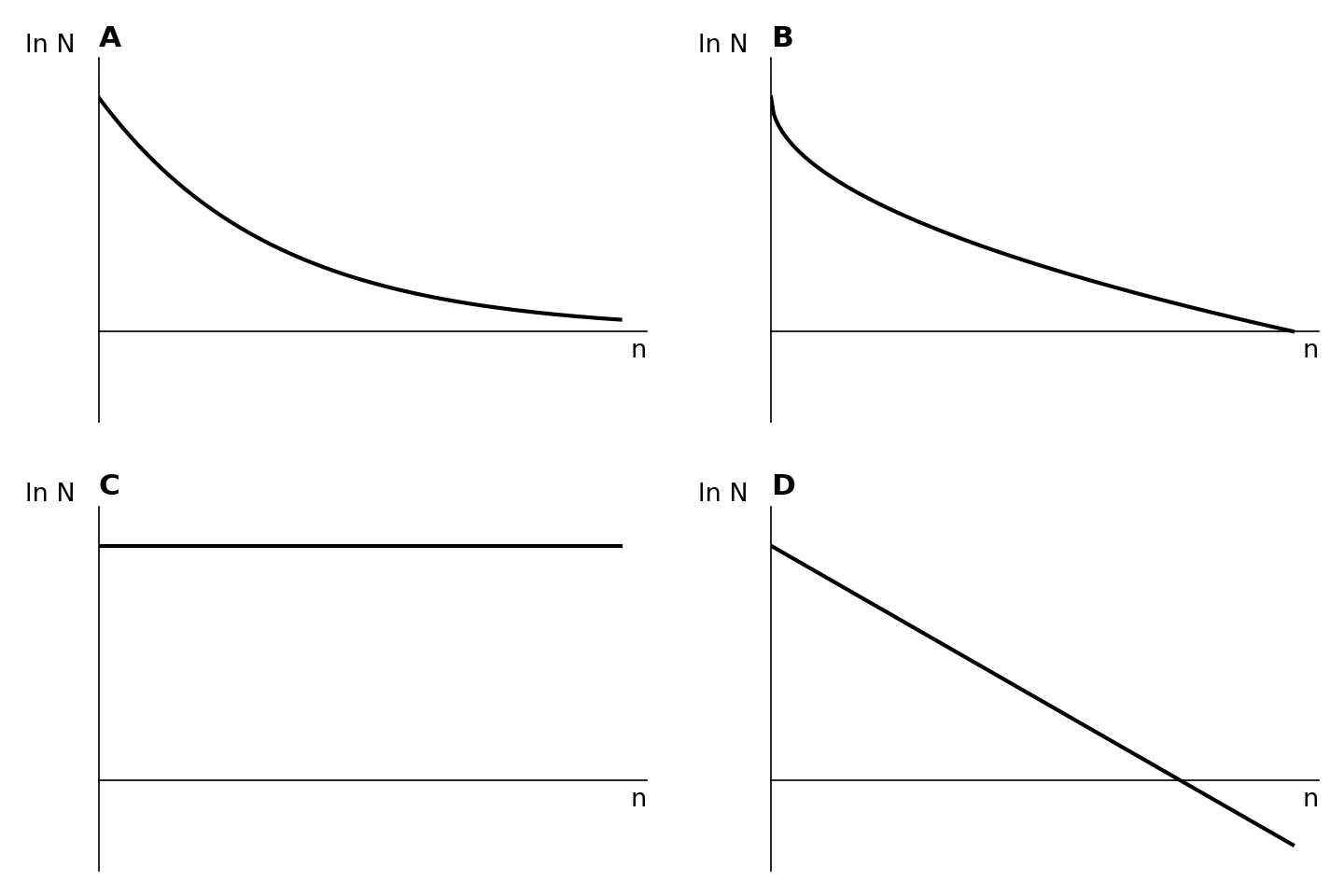
revisionprep.com
Summary Answer
Not available for this question.
Model Answer
Not available for this question.
Marking Scheme
Not available for this question.
Examiner Insights
Not available for this question.
Spontaneous and neutron-induced fission; energy release
Figure 1 shows, on logarithmic scales, how the probability that a neutron causes fission when it meets a uranium-235 nucleus depends on the neutron's kinetic energy (smoothed hypothetical data).
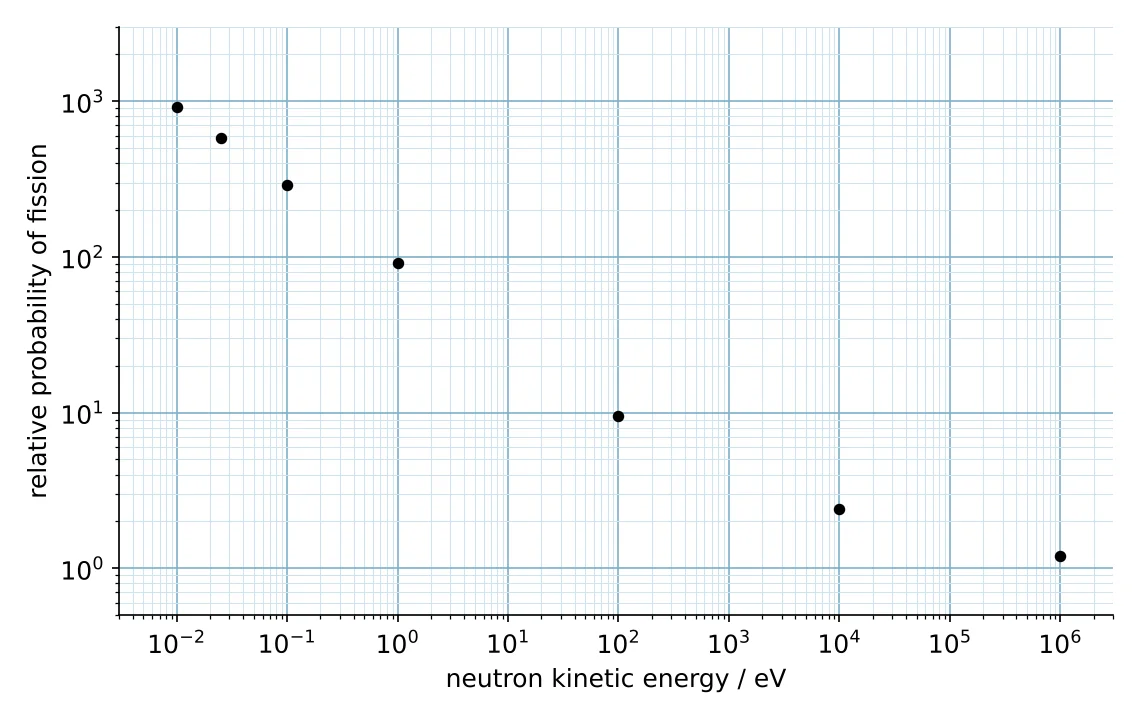
Determine the ratio of the probability of fission for a thermal neutron of energy to that for a fast neutron of energy .
Between and the points lie on a straight line. Determine the gradient of this line.
Outline how the data support the use of a moderator in a reactor.
revisionprep.com
Summary Answer
Not available for this question.
Model Answer
Not available for this question.
Marking Scheme
Not available for this question.
Examiner Insights
Not available for this question.
Chain reactions and critical mass
A computer model gives the critical mass of a sphere of highly enriched uranium surrounded by a neutron reflector of different thicknesses. Figure 1 shows the results; the error bars show the uncertainty of .
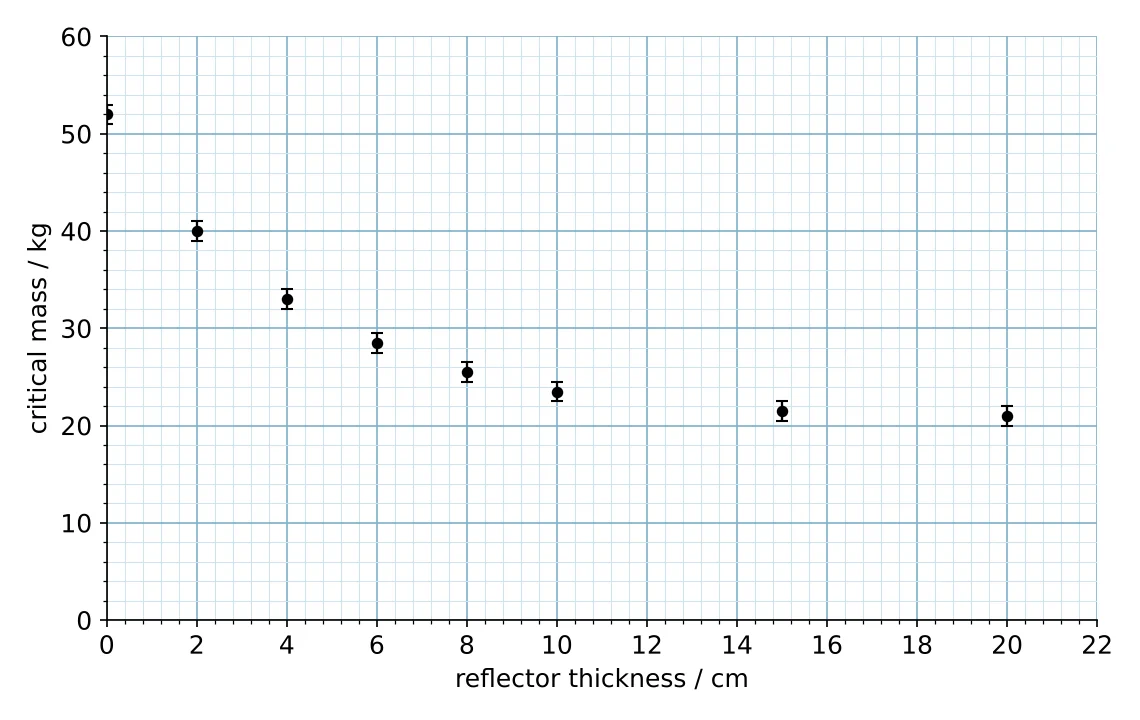
Determine the percentage reduction in the critical mass produced by a reflector thick.
Describe the trend shown and suggest why increasing the thickness beyond about has little effect.
Estimate the reflector thickness needed for a critical mass of .
revisionprep.com
Summary Answer
Not available for this question.
Model Answer
Not available for this question.
Marking Scheme
Not available for this question.
Examiner Insights
Not available for this question.
Spontaneous and neutron-induced fission; energy release
In an experiment, the kinetic energies of the light and heavy fragments from single fission events of uranium-236 are measured, together with their mass numbers and . Table 1 shows four events. Each kinetic energy has an uncertainty of . The fragments start from rest.
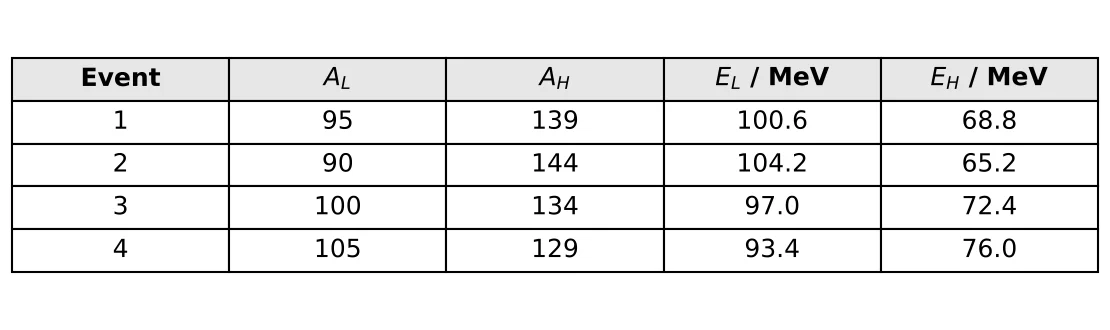
Explain why, if momentum is conserved, .
Determine for event 2, with its absolute uncertainty.
Deduce whether event 2 is consistent with the conservation of momentum.
revisionprep.com
Summary Answer
Not available for this question.
Model Answer
Not available for this question.
Marking Scheme
Not available for this question.
Examiner Insights
Not available for this question.
Chain reactions and critical mass
A new reactor core is loaded with fuel in steps. A neutron source in the core and a detector are used: as fuel is added, the count rate of the detector rises, and it would become very large if the core reached critical mass. Figure 1 shows plotted against the mass of fuel loaded. The error bars show an uncertainty of in each value.
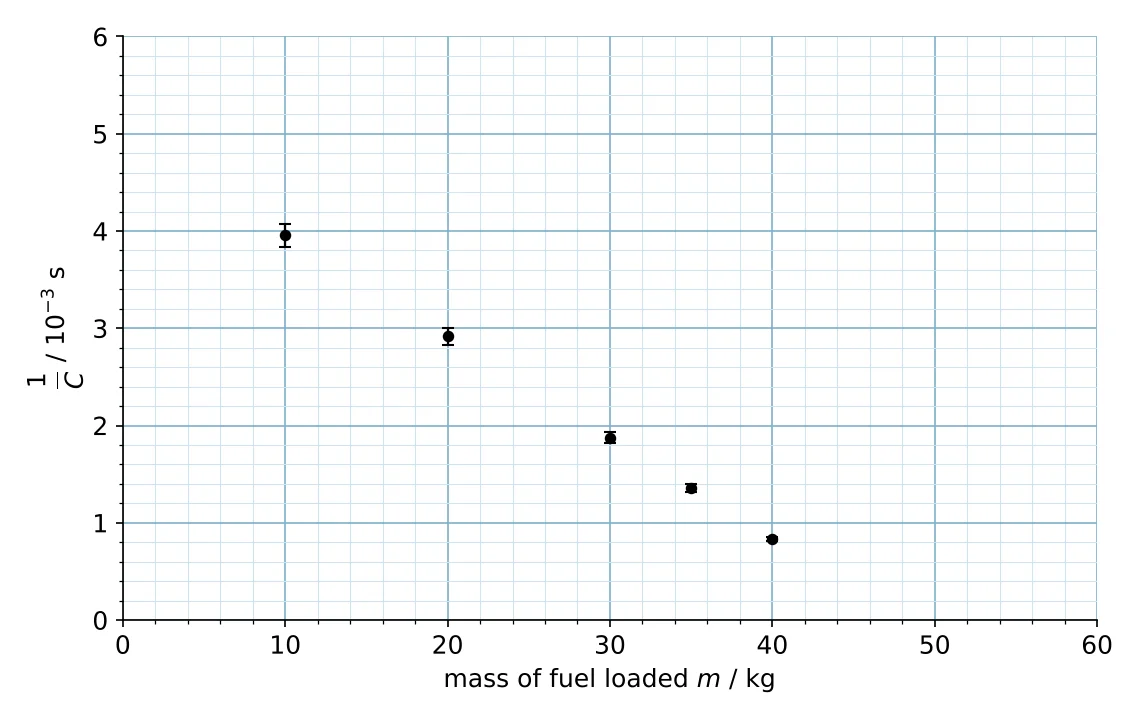
Explain why , rather than , is plotted against .
Draw a line of best fit and determine the critical mass of the core.
Determine the gradient of your line, with its unit.
Estimate the uncertainty in your value of the critical mass.
Suggest why the fuel is added in smaller steps as the count rate increases.
revisionprep.com
Summary Answer
Not available for this question.
Model Answer
Not available for this question.
Marking Scheme
Not available for this question.
Examiner Insights
Not available for this question.
That's every free question here — 6 of 127.
+121 more questions, plus Mock Papers & Worksheets, are waiting in Premium.