Fusion and Stars · Paper 1 — Free Physics HL Practice Questions
Free questions
Open in full, with answers, mark scheme and examiner insights.
Fusion in stars and stellar equilibrium
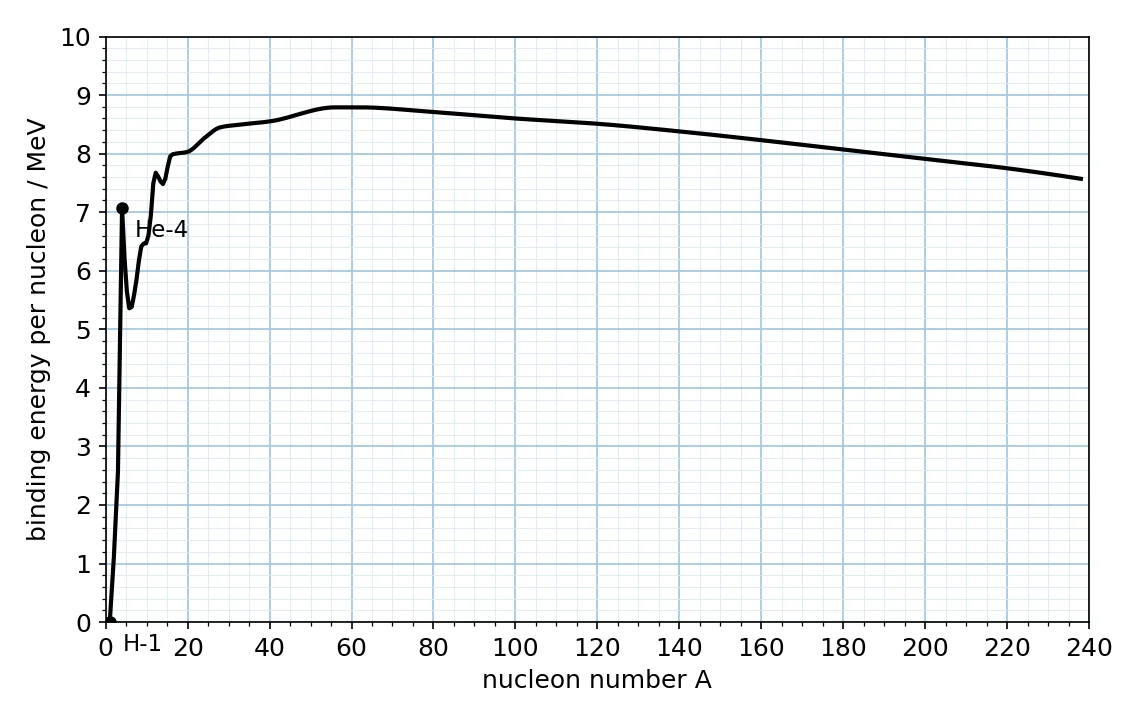
A binding energy per nucleon graph shows that hydrogen-1 has a binding energy per nucleon of approximately and helium-4 has a binding energy per nucleon of approximately . When four hydrogen nuclei fuse to form one helium-4 nucleus, which statement correctly explains why energy is released?
revisionprep.com
Summary Answer
Not available for this question.
Model Answer
Not available for this question.
Marking Scheme
Not available for this question.
Examiner Insights
Not available for this question.
Stellar nucleosynthesis
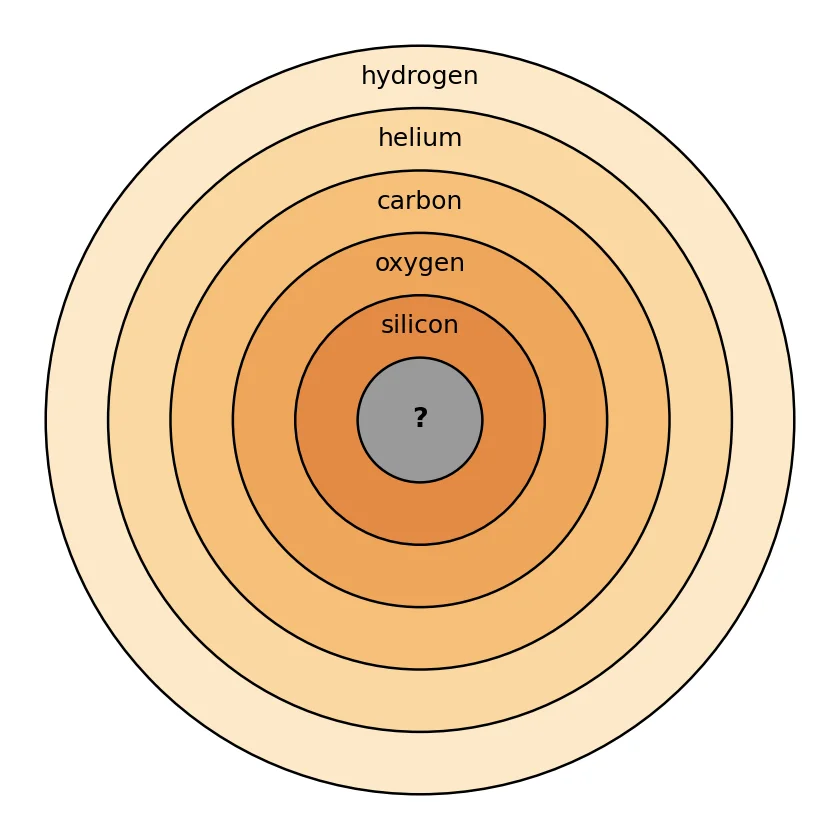
The shows the layered structure of a very massive star just before the end of its life. Each layer is labelled with the main element present.
Which element makes up most of the central core?
revisionprep.com
Summary Answer
Not available for this question.
Model Answer
Not available for this question.
Marking Scheme
Not available for this question.
Examiner Insights
Not available for this question.
Fusion in stars and stellar equilibrium
A student looks up the binding energy per nucleon of some light nuclei in a data book. The values are given with their uncertainties in Table 1.
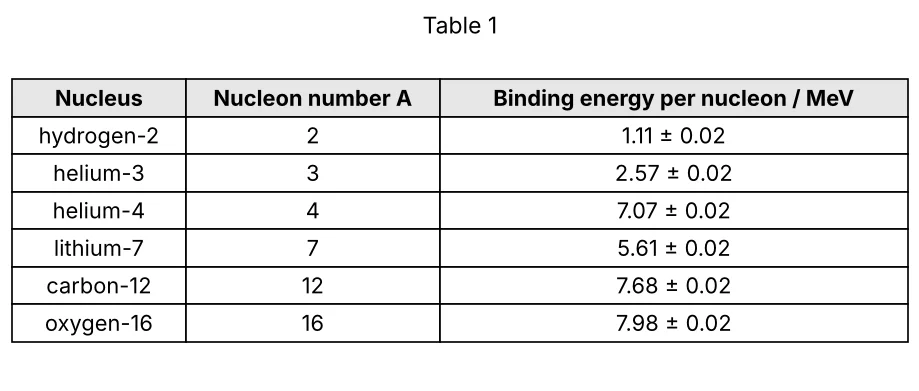
Calculate the energy released when two hydrogen-2 nuclei fuse to form one helium-4 nucleus.
Determine the absolute uncertainty in your answer to (a).
Three helium-4 nuclei can fuse to form carbon-12. Deduce, by comparing the energy released per nucleon, which of the two reactions releases more energy per nucleon.
revisionprep.com
Summary Answer
Not available for this question.
Model Answer
Not available for this question.
Marking Scheme
Not available for this question.
Examiner Insights
Not available for this question.
Stellar nucleosynthesis
A computer model of stars gives the highest core temperature that a star reaches during its life for different initial masses . Figure 1 shows against , with the uncertainty of each model value. The data are hypothetical.
Carbon fusion needs a core temperature of about K.
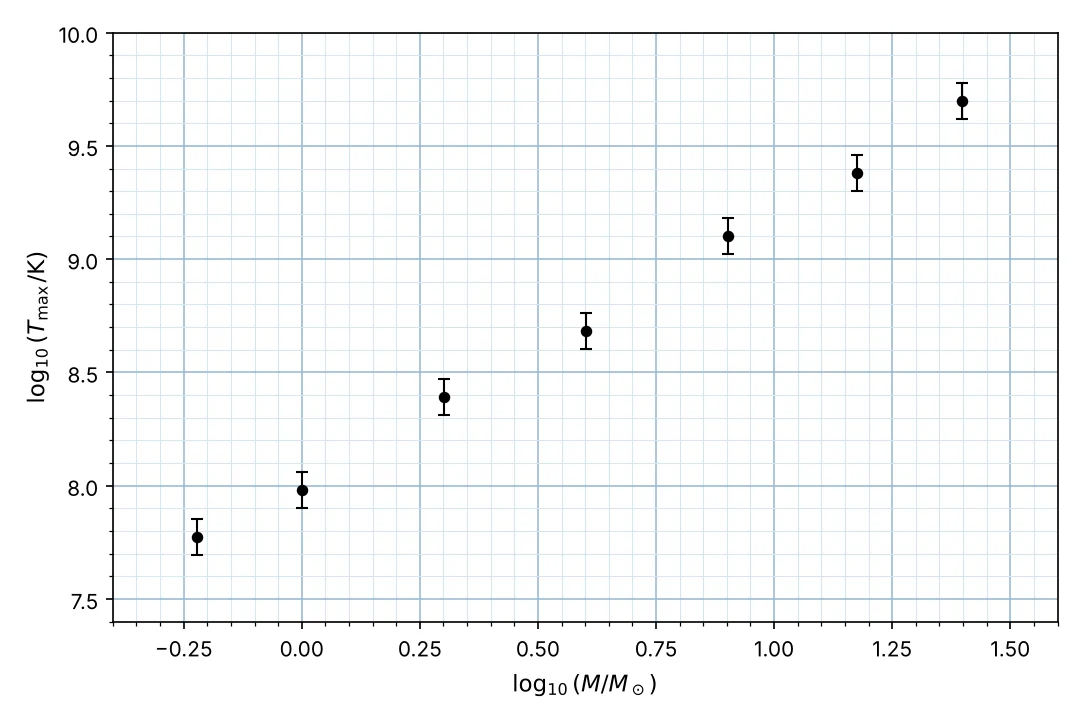
Use Figure 1 to determine for a star of 2 solar masses.
Determine the gradient of the line of best fit.
Deduce the smallest initial mass of a star that can fuse carbon.
Suggest why the model values in Figure 1 are shown with uncertainty bars.
revisionprep.com
Summary Answer
Not available for this question.
Model Answer
Not available for this question.
Marking Scheme
Not available for this question.
Examiner Insights
Not available for this question.
Fusion in stars and stellar equilibrium
A student uses a simple mass spectrometer to measure the masses of hydrogen-1 and helium-4 atoms. Four readings of each are shown in Table 1. .
The overall effect of hydrogen fusion is that four hydrogen-1 atoms become one helium-4 atom.
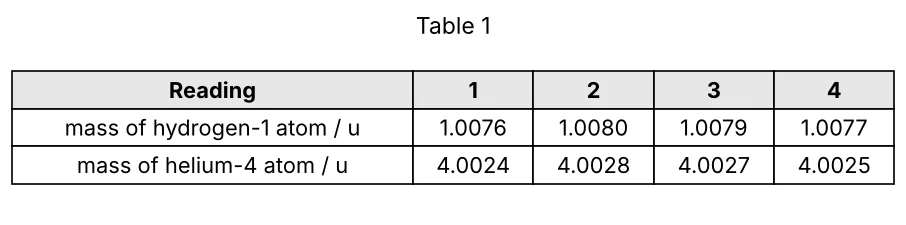
State the mean mass of each atom with its absolute uncertainty.
Calculate the mass defect for the formation of one helium-4 atom from four hydrogen-1 atoms.
Determine the absolute uncertainty in the mass defect.
Calculate the percentage uncertainty in the mass defect and compare it with the percentage uncertainty in the helium mass.
Determine the energy released, with its uncertainty, and comment on why fusion energies need very precise masses.
revisionprep.com
Summary Answer
Not available for this question.
Model Answer
Not available for this question.
Marking Scheme
Not available for this question.
Examiner Insights
Not available for this question.
Hertzsprung–Russell diagram, luminosity and main regions
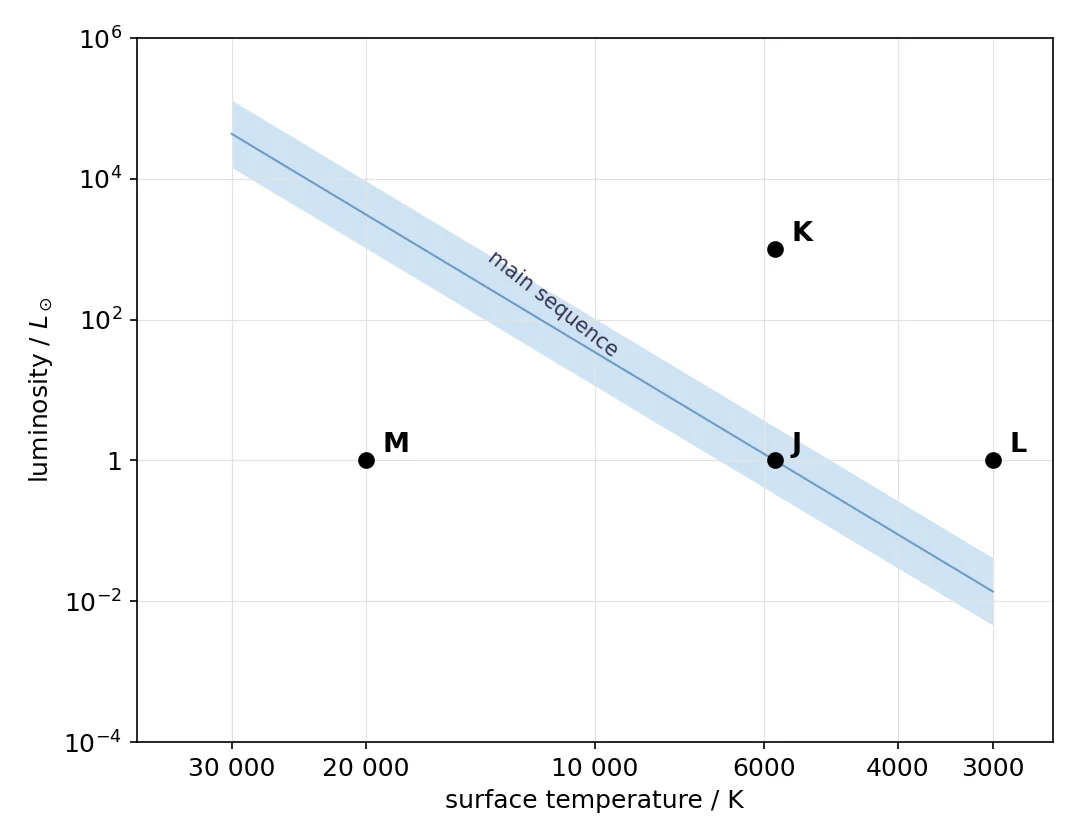
Four stars J, K, L and M are plotted on the HR .
Which star has the smallest radius?
revisionprep.com
Summary Answer
Not available for this question.
Model Answer
Not available for this question.
Marking Scheme
Not available for this question.
Examiner Insights
Not available for this question.
That's every free question here — 6 of 103.
+97 more questions, plus Mock Papers & Worksheets, are waiting in Premium.