Quantum Physics · Paper 1 — Free Physics HL Practice Questions
Free questions
Open in full, with answers, mark scheme and examiner insights.
Photoelectric effect: work function, threshold frequency and Einstein's equation
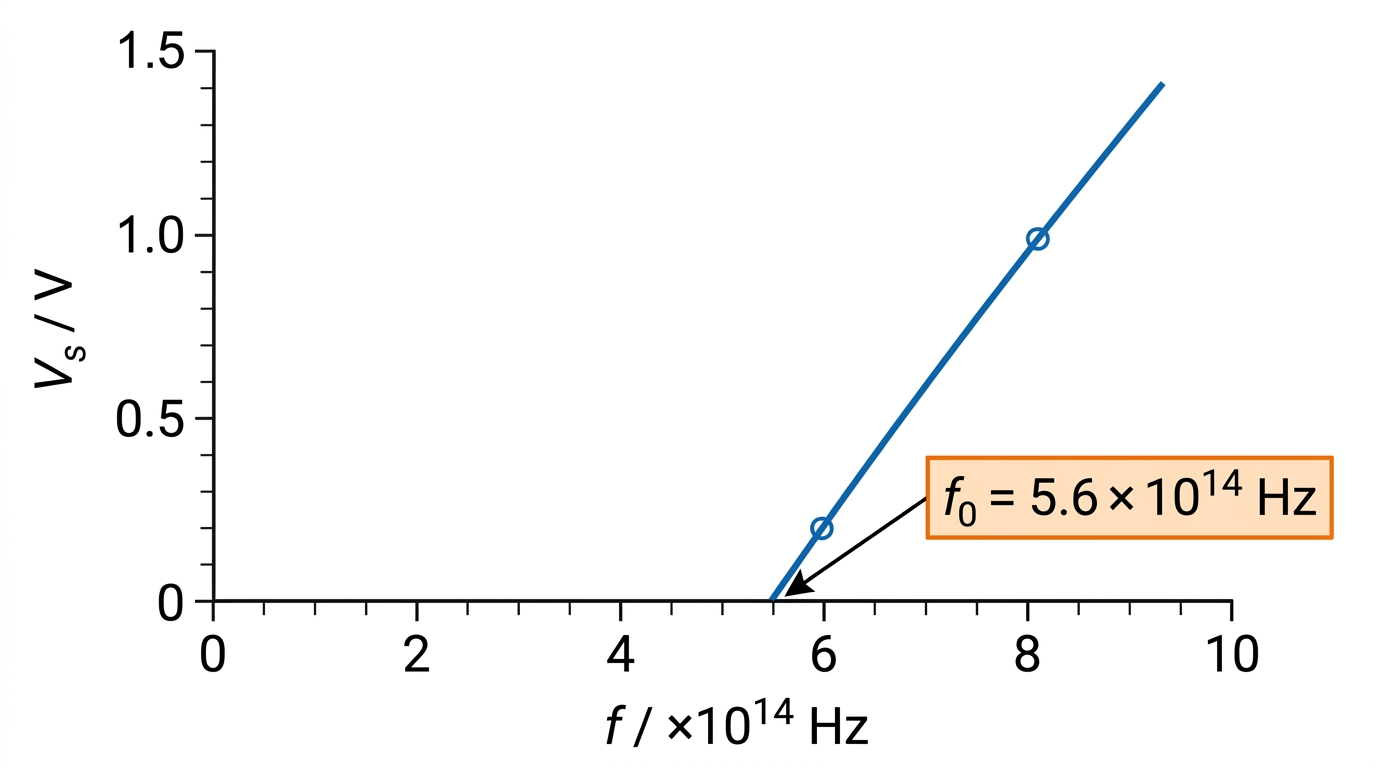
In a photoelectric effect experiment, light of varying frequency is incident on a potassium surface. The stopping potential varies linearly with , crossing the frequency axis at Hz. The gradient of the against graph is V s. What is the work function of potassium?
revisionprep.com
Summary Answer
Not available for this question.
Model Answer
Not available for this question.
Marking Scheme
Not available for this question.
Examiner Insights
Not available for this question.
Wave–particle duality, de Broglie wavelength and electron diffraction
An electron diffraction tube shows two rings on its screen. They are produced by two sets of rows of carbon atoms in graphite, with spacings and . Table 1 shows the measured diameters. For small angles, the diameter of a ring is inversely proportional to the spacing of the rows that produce it.
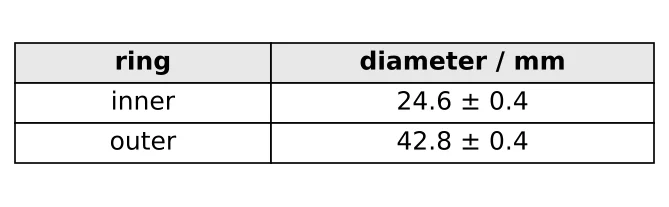
Calculate the ratio .
Determine the absolute uncertainty in this ratio.
Deduce whether the ratio is consistent with the two row spacings.
State which set of rows produces the outer ring.
revisionprep.com
Summary Answer
Not available for this question.
Model Answer
Not available for this question.
Marking Scheme
Not available for this question.
Examiner Insights
Not available for this question.
Photoelectric effect: work function, threshold frequency and Einstein's equation
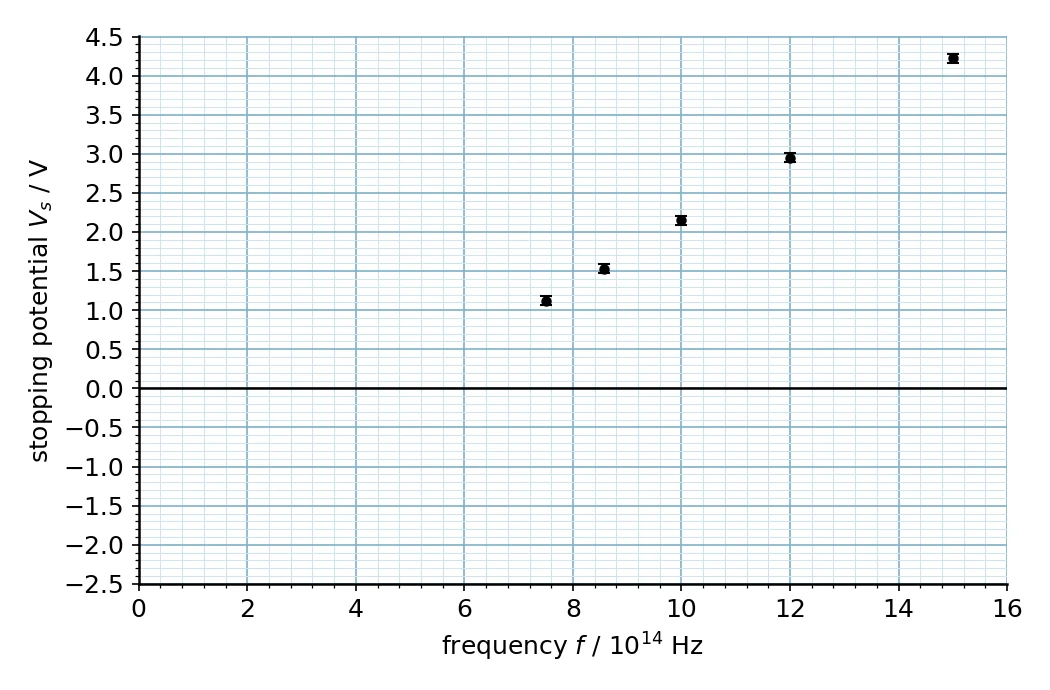
In a repeat of Millikan's experiment, the stopping potential is measured for light of five frequencies falling on a sodium surface. The graph shows the results. Take C.
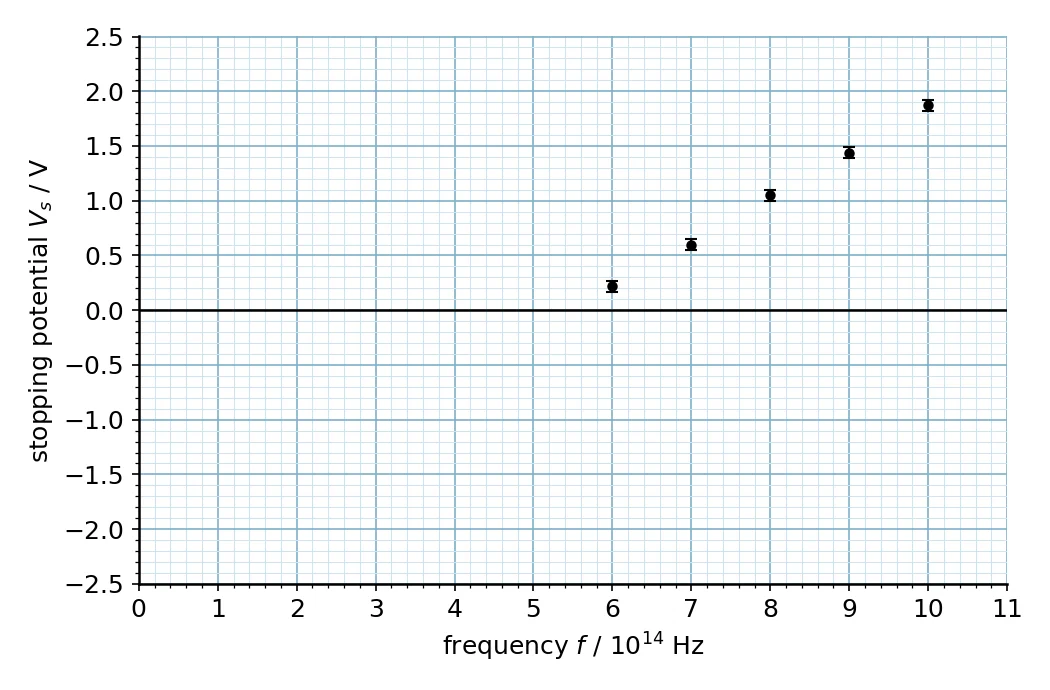
Explain why the stopping potential is a measure of the maximum kinetic energy of the photoelectrons.
Draw the line of best fit. Determine its gradient.
Hence determine the Planck constant.
Extend the line to determine the threshold frequency and the work function of sodium in eV.
State how the graph would change for a metal with a larger work function.
revisionprep.com
Summary Answer
Not available for this question.
Model Answer
Not available for this question.
Marking Scheme
Not available for this question.
Examiner Insights
Not available for this question.
Wave–particle duality, de Broglie wavelength and electron diffraction
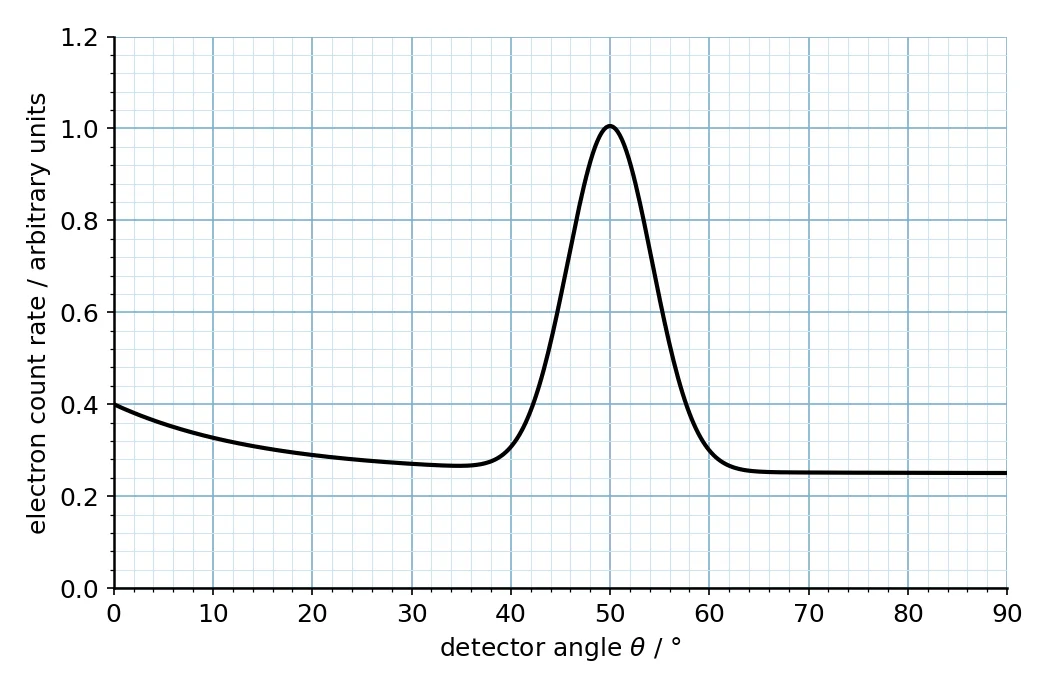
Electrons accelerated through strike a nickel crystal whose surface rows of atoms are apart. The graph shows the electron count rate against detector angle , measured from the incident beam. What wavelength does the graph give for the electrons?
revisionprep.com
Summary Answer
Not available for this question.
Model Answer
Not available for this question.
Marking Scheme
Not available for this question.
Examiner Insights
Not available for this question.
Photoelectric effect: work function, threshold frequency and Einstein's equation
A new photocathode material is tested with a tunable laser. The stopping potential is measured for five wavelengths : 200, 250, 300, 350 and 400 nm. The graph shows against the frequency of the light. Take m s and C.
Show that the frequency of light of wavelength is .
Draw a line of best fit and determine its gradient.
Hence determine the Planck constant.
Determine the work function of the material in eV, explaining your method.
Calculate the threshold wavelength of the material.
Explain why the classical wave model does not predict a threshold wavelength.
When the laser intensity is doubled, each stopping potential is unchanged but each saturation current doubles. Explain these two observations.
revisionprep.com
Summary Answer
Not available for this question.
Model Answer
Not available for this question.
Marking Scheme
Not available for this question.
Examiner Insights
Not available for this question.
Wave–particle duality, de Broglie wavelength and electron diffraction
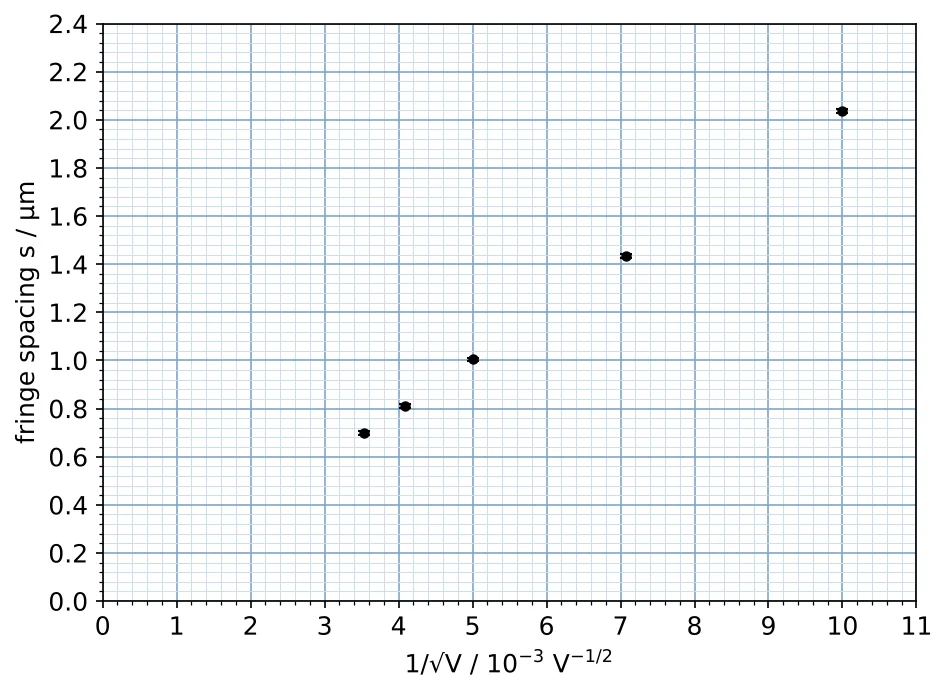
In an electron biprism experiment, electrons accelerated from rest through a potential difference behave as if they come from two coherent sources apart, and fringes form on a detector away. Figure 1 shows the fringe spacing plotted against for from to ; the error bars show . Take kg and C.
Explain why a non-relativistic model of the de Broglie wavelength of the electrons predicts that is proportional to .
Determine the gradient of the line through the origin that fits the three points at the lowest voltages (, and ).
Use your gradient to determine a value for the Planck constant.
The points at and lie below the line. Evaluate this observation.
revisionprep.com
Summary Answer
Not available for this question.
Model Answer
Not available for this question.
Marking Scheme
Not available for this question.
Examiner Insights
Not available for this question.
That's every free question here — 6 of 162.
+156 more questions, plus Mock Papers & Worksheets, are waiting in Premium.