You're viewing 4 free preview questions for Physics HL — subscribe to unlock 162 more, plus the Full Question Bank, Mock Papers & Worksheets.Upgrade
Fission · Paper 2 — Free Physics HL Practice Questions
1FoundationSAQ-LNuclear fission process7 marksPaper 2~11 min

Data
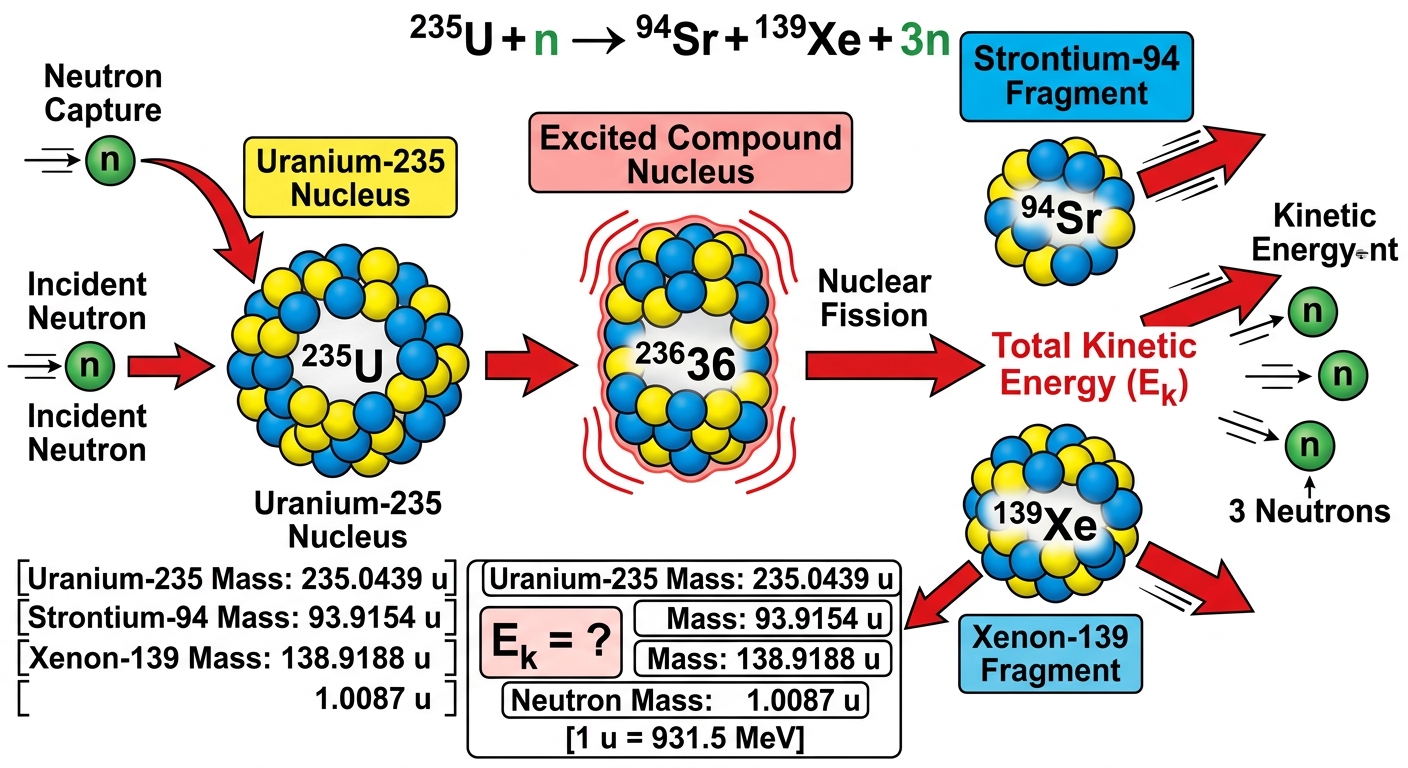
A uranium-235 nucleus undergoes asymmetric fission, producing strontium-94 and xenon-139 fragments along with neutrons. The complete reaction is:
Atomic masses: , , , neutron .
(a)
Determine the mass defect, in u, for this reaction. [1 mark]
(b)
Calculate the total energy released, in MeV, by this fission reaction. [2 marks]
(c)
Explain why the fission fragments have high ionizing power as they travel through matter. [2 marks]
(d)
The total energy released in part (b) is approximately 179 MeV. In a reactor, the measured kinetic energy of the fission fragments and prompt neutrons accounts for about 168 MeV. Evaluate whether the assumption that all released energy becomes kinetic energy of the products is valid, identifying the physical processes responsible for the remaining energy. [2 marks]

Solutions
2FoundationSAQ-SNuclear fission process7 marksPaper 2~11 min
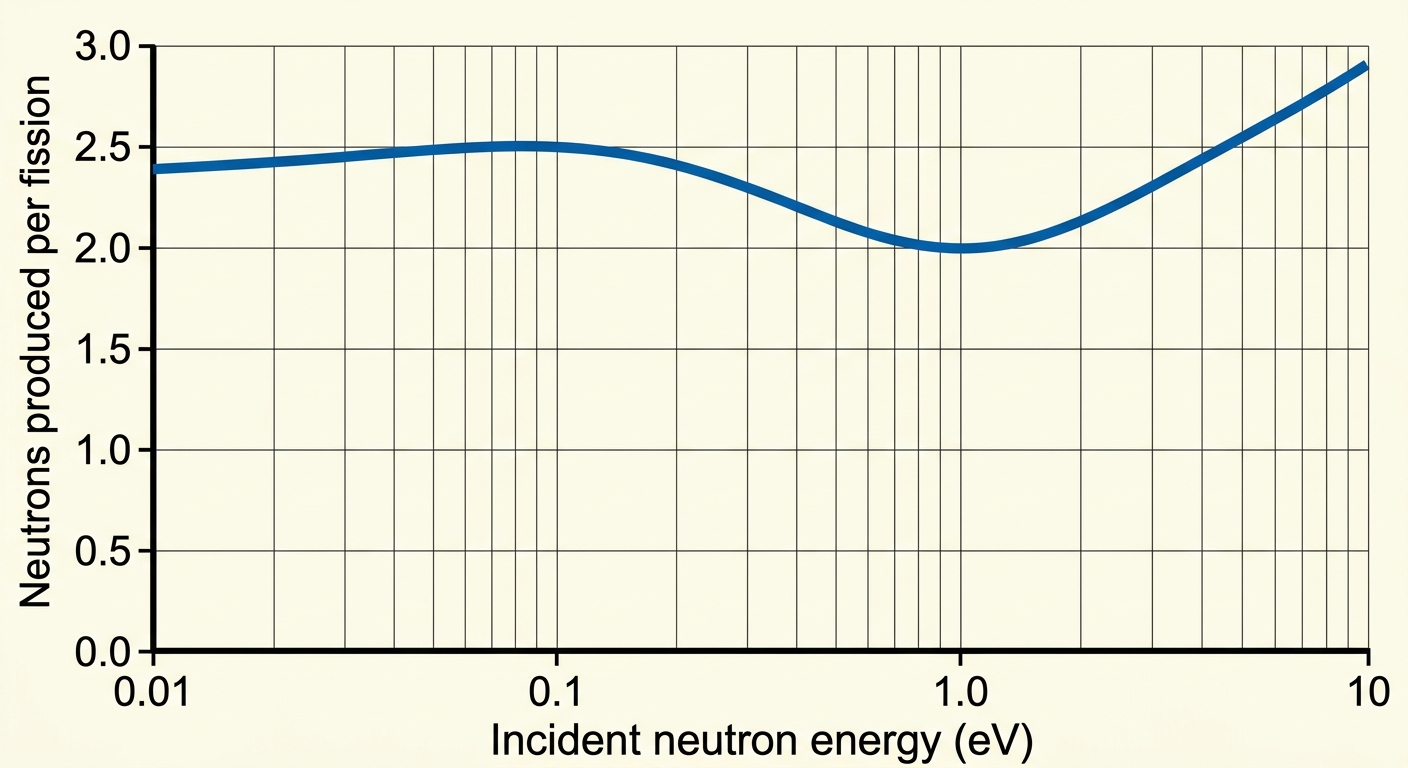
A fission reactor uses enriched uranium fuel rods. The graph below shows the number of neutrons produced per fission as a function of the energy of the incident neutron for uranium-235.
(a)
Describe how the number of neutrons produced per fission varies with the energy of the incident neutron, as shown in the graph. [2 marks]
(b)
For a reactor to be critical, exactly one neutron from each fission must cause a further fission. The average number of neutrons produced per fission is 2.4.
Calculate the fraction of neutrons produced per fission that must successfully cause fission to maintain a critical chain reaction. [2 marks]
(c)
Control rods absorb neutrons. A reactor operating at criticality has its control rods partially inserted further, increasing the fraction of neutrons absorbed.
Deduce and explain the effect this has on the reactor power output. [3 marks]
Solutions
3FoundationSAQ-SChain reaction and critical mass5 marksPaper 2~8 min
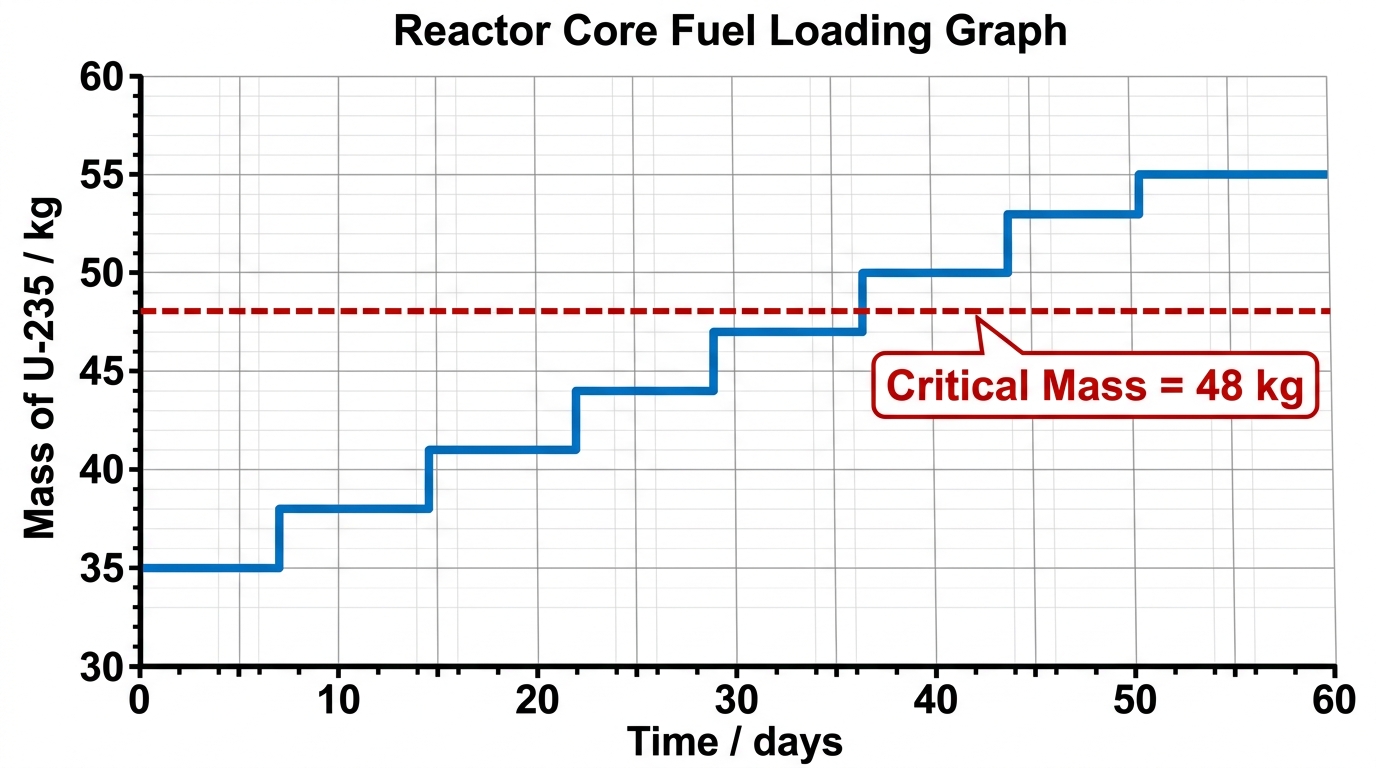
The shows the mass of uranium-235 in a reactor core as fuel is gradually added. The critical mass for this reactor geometry is 48 kg.
(a)
State what is meant by critical mass and explain why it depends on the geometry of the reactor core. [2 marks]
(b)
Using the graph, determine the additional mass of uranium-235 that must be added when the core contains 42 kg in order to reach criticality. [1 mark]
(c)
The core is loaded to a total mass of 55 kg of uranium-235. Deduce whether the core is subcritical, critical, or supercritical, and explain the consequence for the neutron population over time. [2 marks]
Solutions
4ChallengeSAQ-LNuclear fission process9 marksPaper 2~14 min
Data
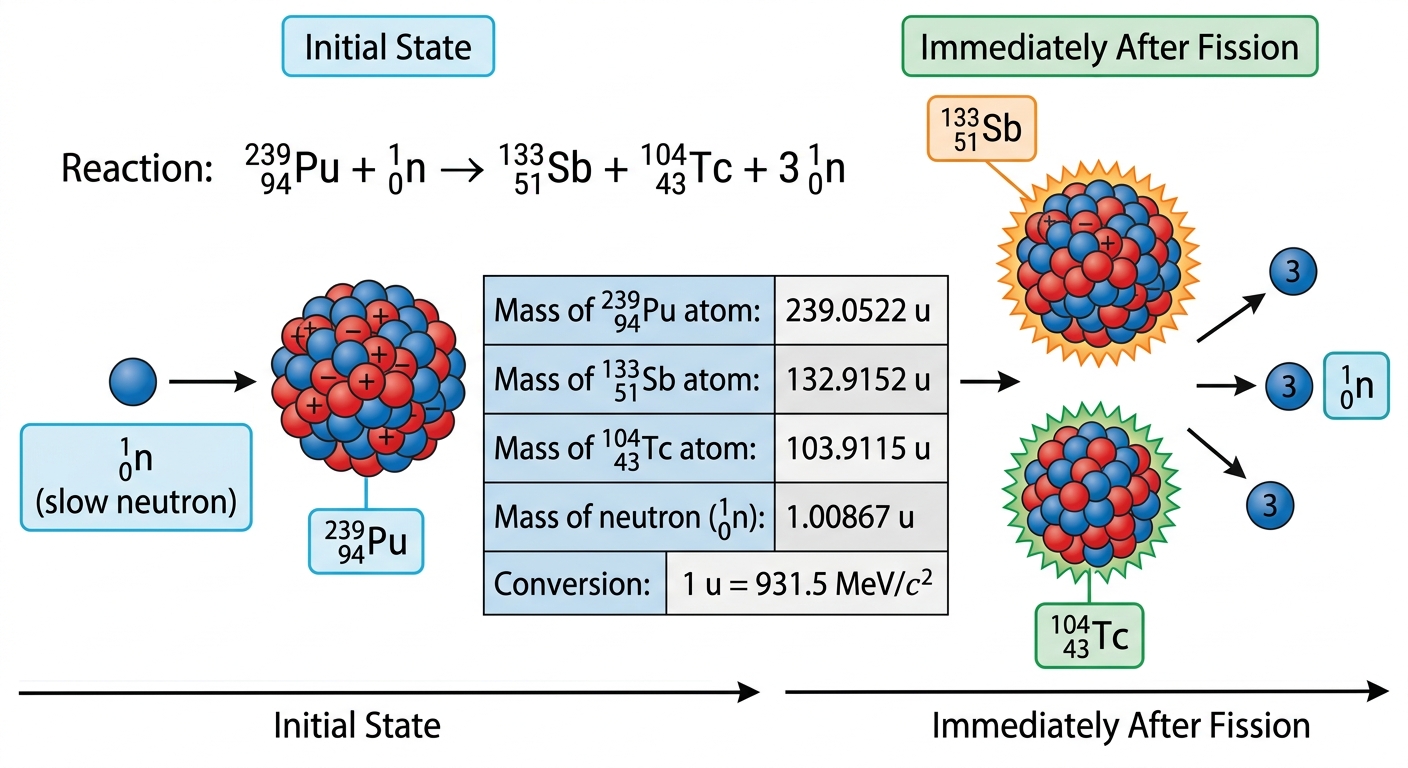
- Mass of atom
- Mass of atom
- Mass of atom
- Mass of neutron
-
In a research reactor, a sample of plutonium-239 undergoes fission after absorbing a slow neutron. One possible fission reaction is:
(a)
Calculate the energy released in this fission event. Give your answer in MeV. [3 marks]
(b)
Determine the neutron-to-proton ratio for each fission fragment immediately after fission. State, with a reason, which fragment is further from the valley of stability. [3 marks]
(c)
The fission fragments undergo beta-minus decay. Explain why the fragments are unstable immediately after fission and how beta-minus decay moves them towards stability. [3 marks]
Solutions
That's every free question here — 4 of 166.
+162 more questions, plus Mock Papers & Worksheets, are waiting in Premium.