You're viewing 4 free preview questions for Physics HL — subscribe to unlock 82 more, plus the Full Question Bank, Mock Papers & Worksheets.Upgrade
Fusion and Stars · Paper 2 — Free Physics HL Practice Questions
1MasterySAQ-SLife cycle of stars6 marksPaper 2~9 min

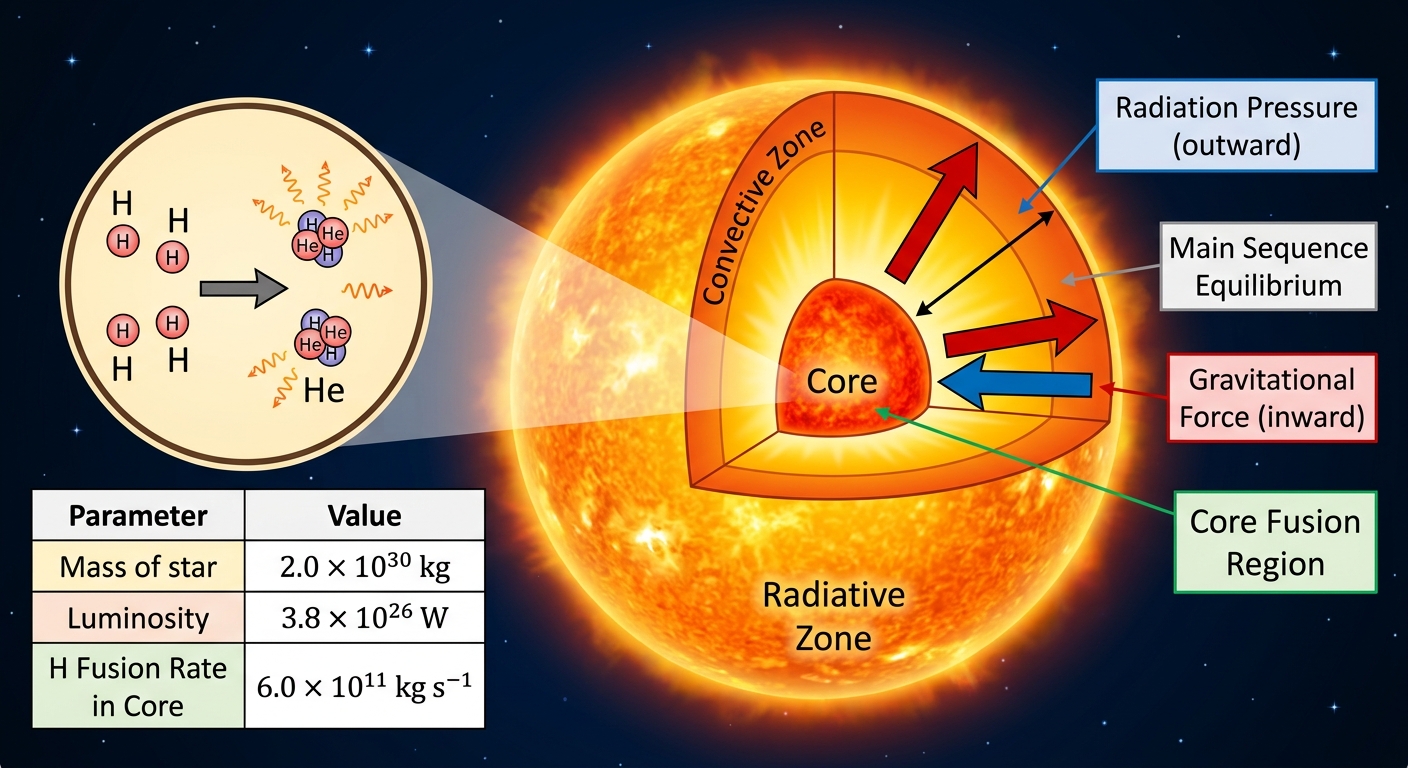
A main sequence star has a mass of and a luminosity of . During the main sequence phase, hydrogen is fused into helium at a rate of .
Speed of light:
(a)
State the two opposing forces that maintain hydrostatic equilibrium during the main sequence phase of a star. [1 mark]
(b)
Calculate the fraction of the mass consumed per second that is converted into energy. [3 marks]
(c)
Only approximately 10 percent of the star's total mass is available as hydrogen fuel in the core. Deduce the main sequence lifetime of this star in years. [2 marks]

Solutions
2MasterySAQ-SLife cycle of stars7 marksPaper 2~11 min
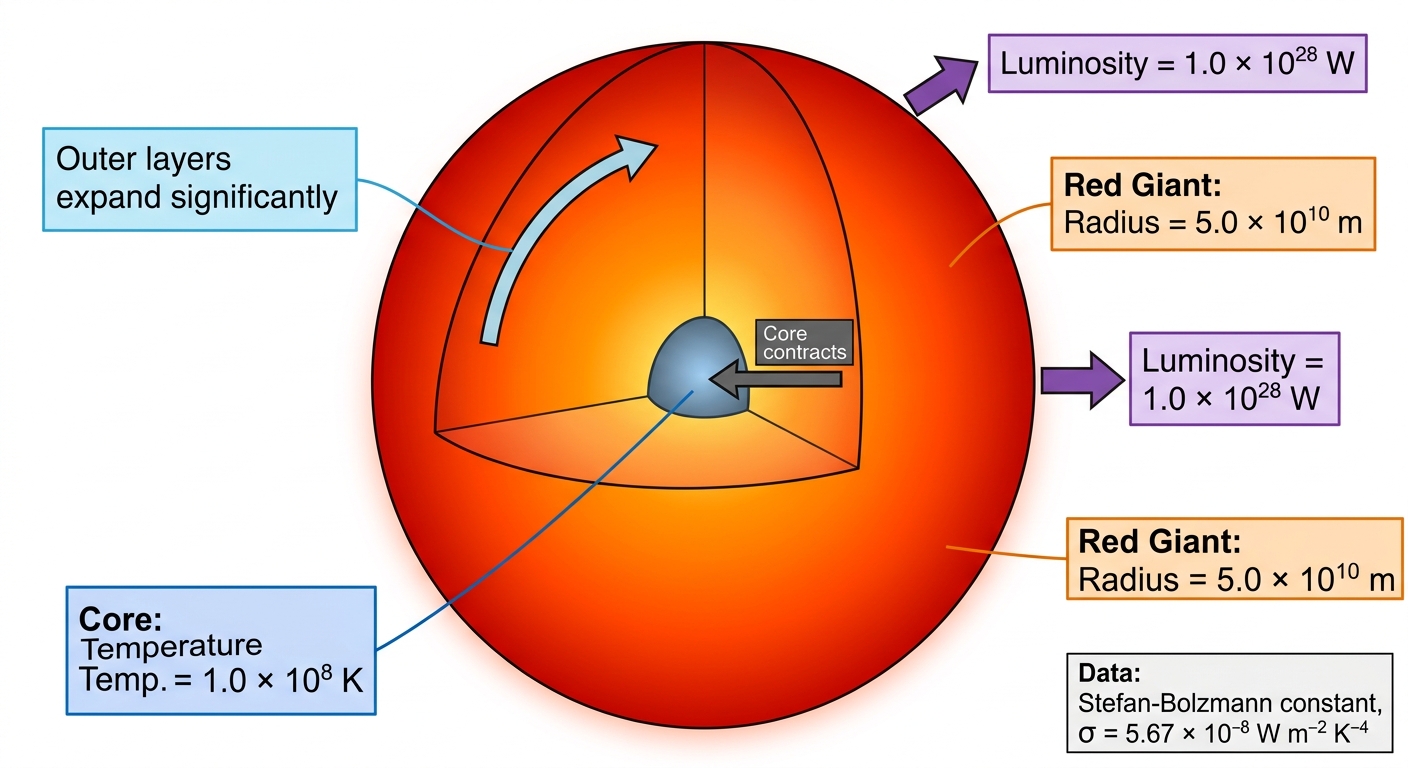
A red giant star has the following properties:
Quantity — Value
Radius —
Luminosity —
Stefan–Boltzmann constant —
(a)
State what happens to the core of a main-sequence star when its hydrogen fuel is exhausted. [1 mark]
(b)
Calculate the surface temperature of this red giant. [3 marks]
(c)
The peak wavelength of radiation emitted by the Sun is . Using your answer to (b) and Wien's displacement law (), deduce whether this red giant emits peak radiation at a longer or shorter wavelength than the Sun, and calculate the ratio . [3 marks]
Solutions
3MasterySAQ-SLife cycle of stars5 marksPaper 2~8 min
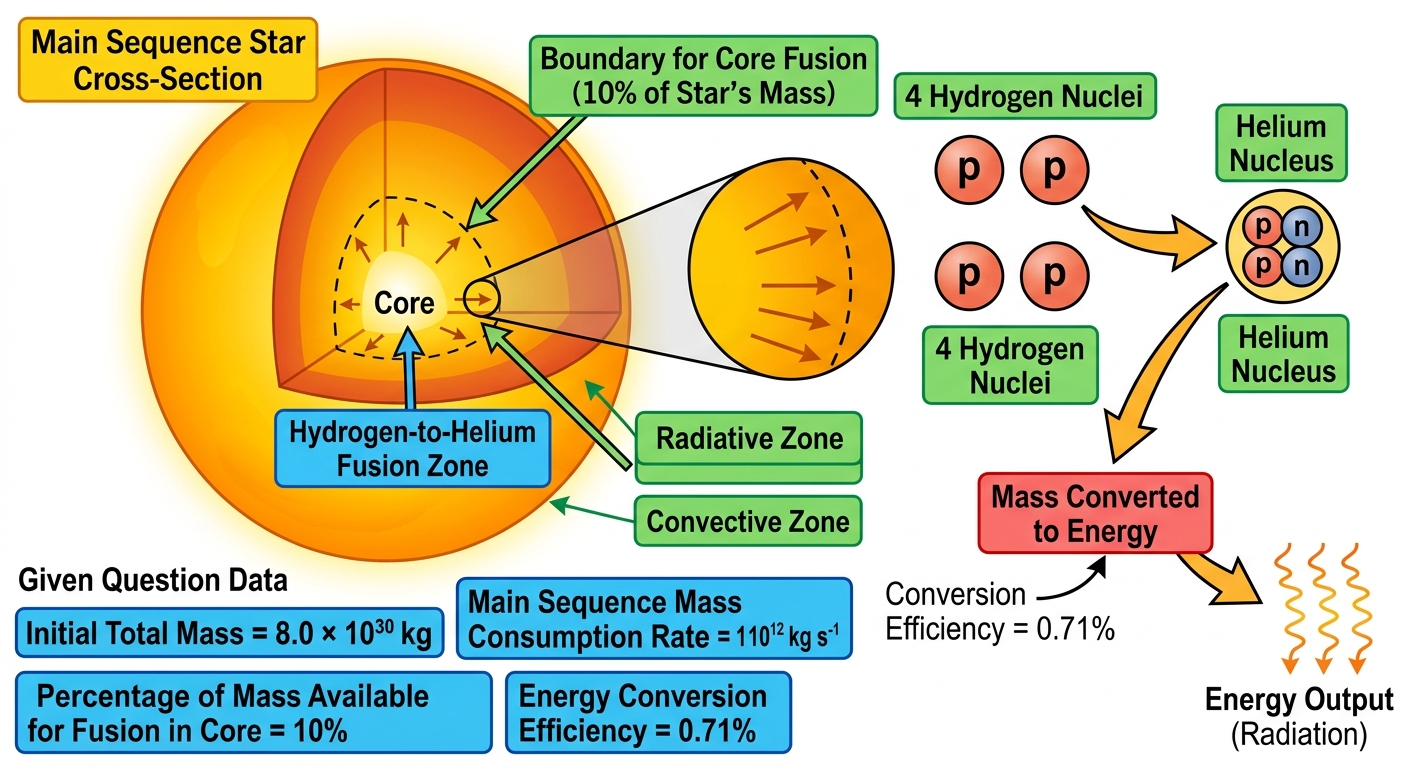
A star has an initial mass of . It converts hydrogen to helium; of the mass consumed is released as energy. The star's luminosity (power output) is . Only of the star's mass is available for fusion in the core.
(a)
State the condition that determines when a star leaves the main sequence. [1 mark]
(b)
Calculate the rate at which the star must consume hydrogen mass to sustain its luminosity of . [2 marks]
(c)
Calculate the time, in years, that the star spends on the main sequence. [2 marks]
Solutions
4ChallengeSAQ-LNuclear fusion and energy production in stars8 marksPaper 2~12 min
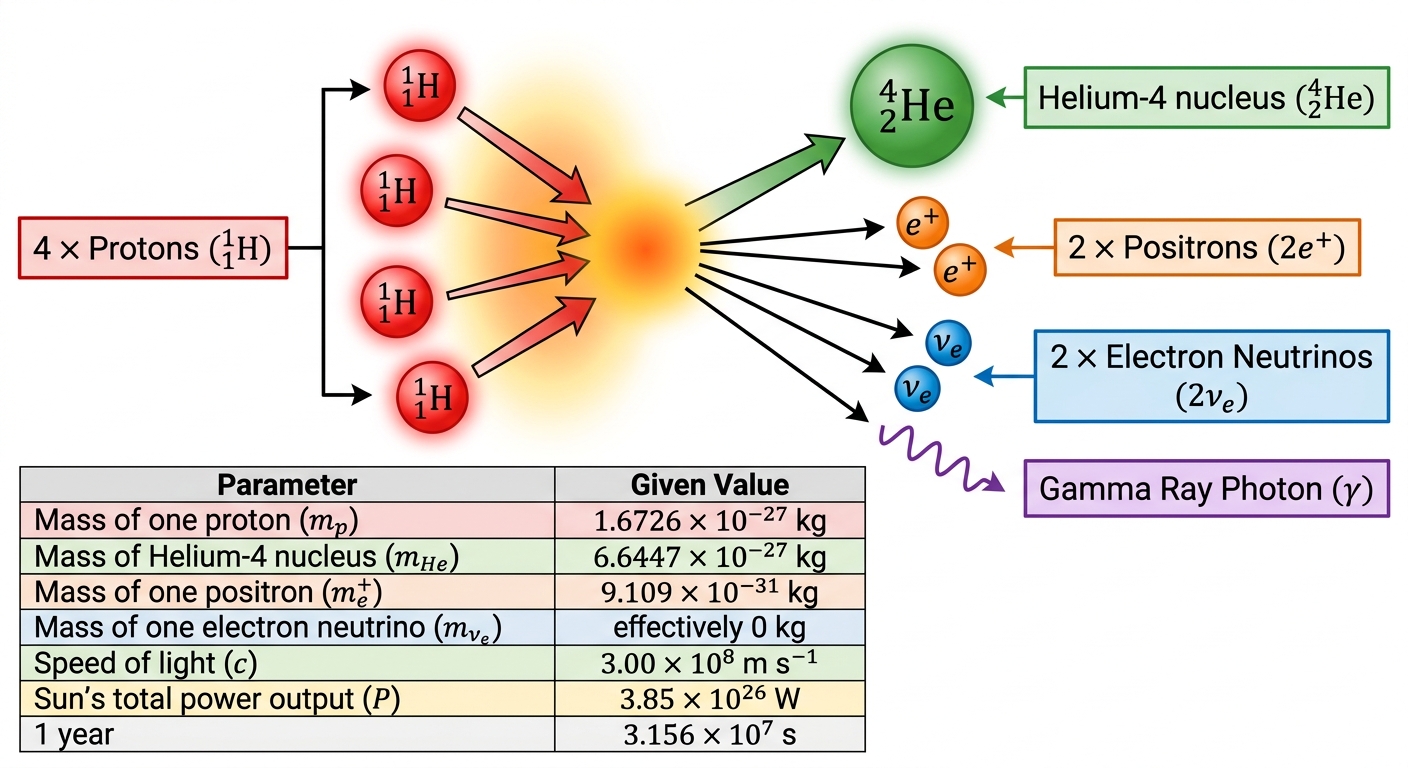
Data
- Mass of one proton:
- Mass of a helium- nucleus:
- Mass of one positron:
- Mass of one electron neutrino:
- Speed of light:
- Sun's total power output:
The proton–proton chain the core of a star like the Sun converts four protons into a helium- nucleus. The overall reaction is:
(a)
Calculate the mass defect for a single fusion event in which four protons fuse to produce one helium- nucleus and two positrons. [2 marks]
(b)
Calculate the energy released per fusion event in joules. [1 mark]
(c)
Calculate the number of fusion events occurring in the Sun per second. [2 marks]
(d)
Explain why the positrons produced in the reaction do not represent a long-term mass loss from the star. [2]
(e) The neutrinos produced in the proton–proton chain carry away approximately of the energy released per fusion event. Evaluate the significance of neutrino emission for the energy balance of the Sun, referring to both the immediate energy budget and the long-term stability of the star. [3 marks]
Solutions
That's every free question here — 4 of 86.
+82 more questions, plus Mock Papers & Worksheets, are waiting in Premium.