You're viewing 1 free preview question for Physics HL — subscribe to unlock 161 more, plus the Full Question Bank, Mock Papers & Worksheets.Upgrade
Quantum Physics · Paper 2 — Free Physics HL Practice Questions
1ChallengeLAQWave-particle duality8 marksPaper 2~12 min

Data
-
-
-
-
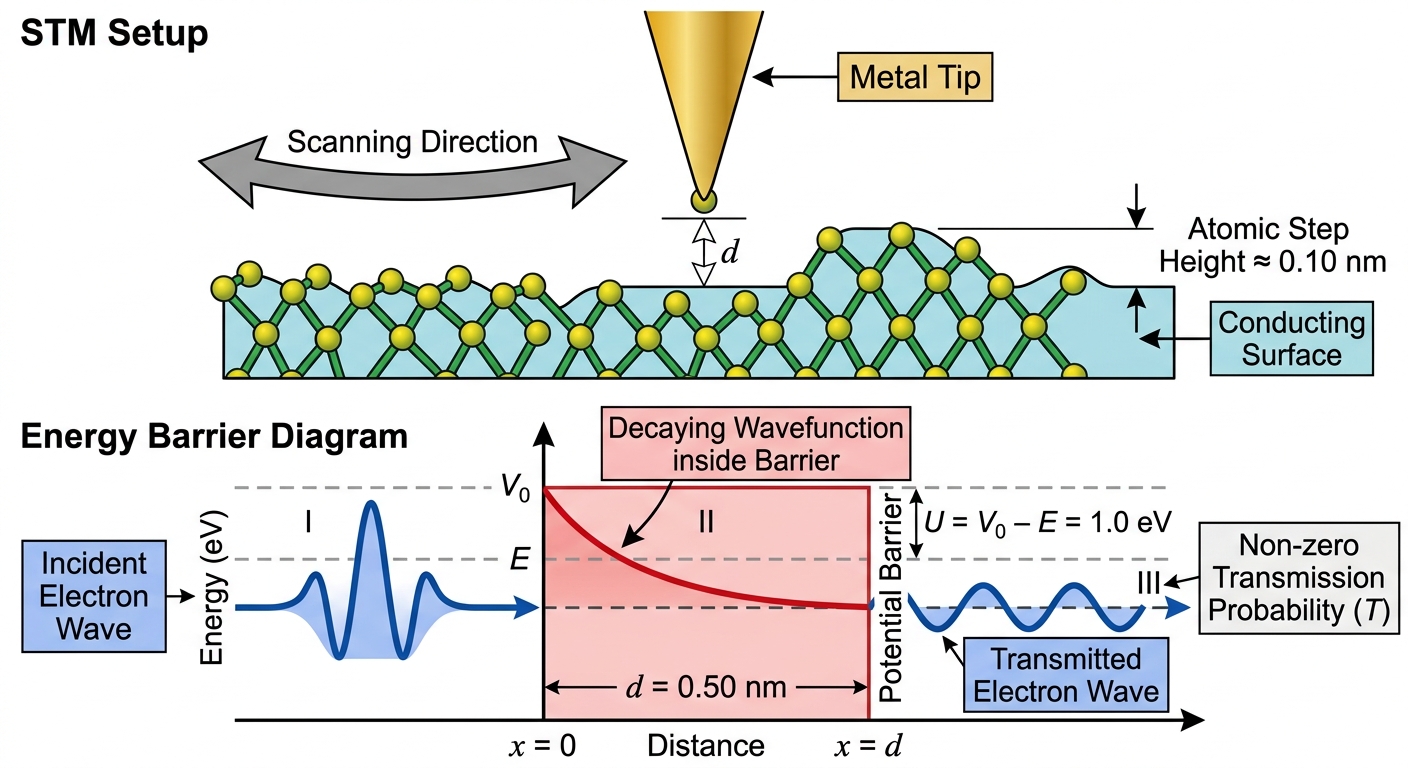
A metal tip in a scanning tunnelling microscope (STM) is held at distance from a conducting surface. Electrons in the metal have total energy less than the barrier height at the tip–surface gap.
(a)
Analyse the phenomenon of quantum tunnelling as evidence for the wave nature of particles, and evaluate how the STM exploits this phenomenon to achieve atomic-scale resolution.
In your answer:
- explain why classical mechanics predicts zero transmission probability for a particle with
- explain how the quantum wavefunction gives a non-zero transmission probability through a barrier of finite width
- describe the role of the de Broglie wavelength and the exponential decay constant inside the barrier
- evaluate how the exponential dependence of tunnelling current on tip–surface separation enables atomic-scale vertical resolution [6 marks]
(b)
The tip is held at from the surface. The barrier height above the electron energy is .
(i) Calculate the decay constant , where . [2 marks]
(ii) The tip is retracted to . Using , calculate the ratio of the tunnelling probability at to that . [2 marks]
(iii) Evaluate what the result of (b)(ii) implies about the ability of the STM to resolve individual atoms separated by vertically. [2 marks]
(ii) The tip is retracted to . Using , calculate the ratio of the tunnelling probability at to that . [2 marks]
(iii) Evaluate what the result of (b)(ii) implies about the ability of the STM to resolve individual atoms separated by vertically. [2 marks]

Solutions
That's every free question here — 1 of 162.
+161 more questions, plus Mock Papers & Worksheets, are waiting in Premium.