Radioactive Decay · Paper 2 — Free Physics HL Practice Questions
Free questions
Open in full, with answers, mark scheme and examiner insights.
Mass defect, binding energy and binding energy per nucleon
Masses: proton ; neutron ; lithium-7 nucleus . .
State what is meant by the mass defect of a nucleus.
Calculate the mass defect of a lithium-7 nucleus.
Calculate the binding energy per nucleon of lithium-7, in MeV.
revisionprep.com
Summary Answer
Not available for this question.
Model Answer
Not available for this question.
Marking Scheme
Not available for this question.
Examiner Insights
Not available for this question.
Activity, count rate, half-life and background radiation
A student counts the background radiation with a Geiger-Müller tube for five successive one-minute intervals: 18, 24, 21, 15 and 22 counts.
State two sources of background radiation.
Calculate the mean background count rate.
A source placed near the tube gives 245 counts in one minute. Calculate the count rate due to the source.
State why the five background readings are different.
revisionprep.com
Summary Answer
Not available for this question.
Model Answer
Not available for this question.
Marking Scheme
Not available for this question.
Examiner Insights
Not available for this question.
Strong nuclear force and nuclear stability
The diagram shows part of the chart of nuclides; filled squares are stable nuclides. X, Y and W are radioactive.
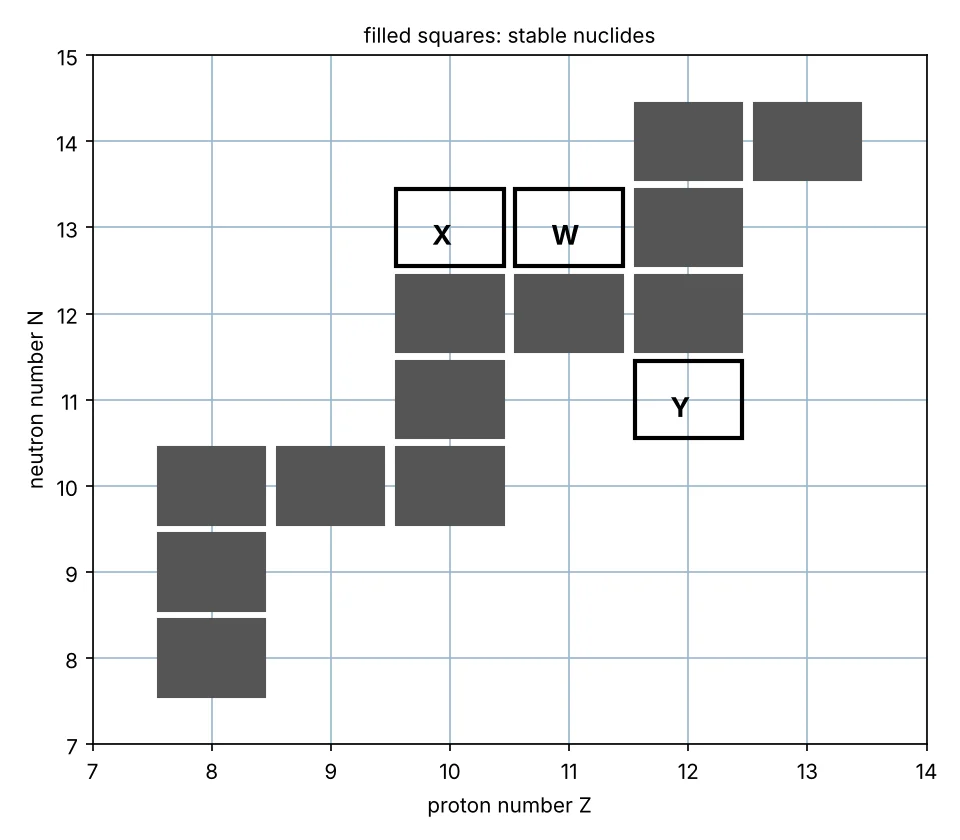
Identify which of X, Y and W decays by beta-plus emission, and explain your answer in terms of the neutron-to-proton ratio.
X is neon-23. Write the equation for its decay.
W decays to a stable nuclide. State the changes in and in when it decays.
revisionprep.com
Summary Answer
Not available for this question.
Model Answer
Not available for this question.
Marking Scheme
Not available for this question.
Examiner Insights
Not available for this question.
Decay constant, exponential decay law and activity (A = λN)
Gallium-68 is used in medical scans of tumours. The graph shows the activity of a dose of gallium-68 against the time after it is prepared.
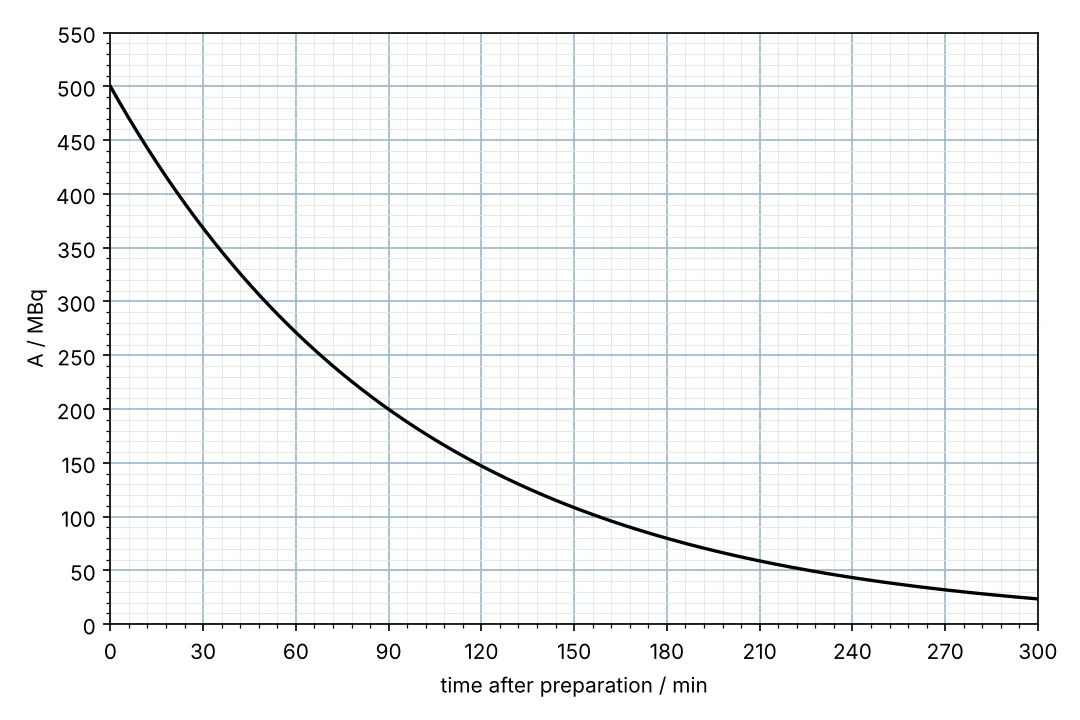
Use the graph to determine the half-life of gallium-68.
Calculate the decay constant of gallium-68 in .
Calculate the number of gallium-68 nuclei in the dose when it is prepared.
The scan needs an activity of at least at injection. Determine the latest time after preparation at which the dose can be injected.
State one advantage and one disadvantage, for the patient or the hospital, of the short half-life of gallium-68.
revisionprep.com
Summary Answer
Not available for this question.
Model Answer
Not available for this question.
Marking Scheme
Not available for this question.
Examiner Insights
Not available for this question.
Mass defect, binding energy and binding energy per nucleon
A fusion reactor uses a plasma of deuterium () and tritium () nuclei. In a single fusion event:
Rest masses: - Deuterium: - Tritium: - Helium-4: - Neutron:
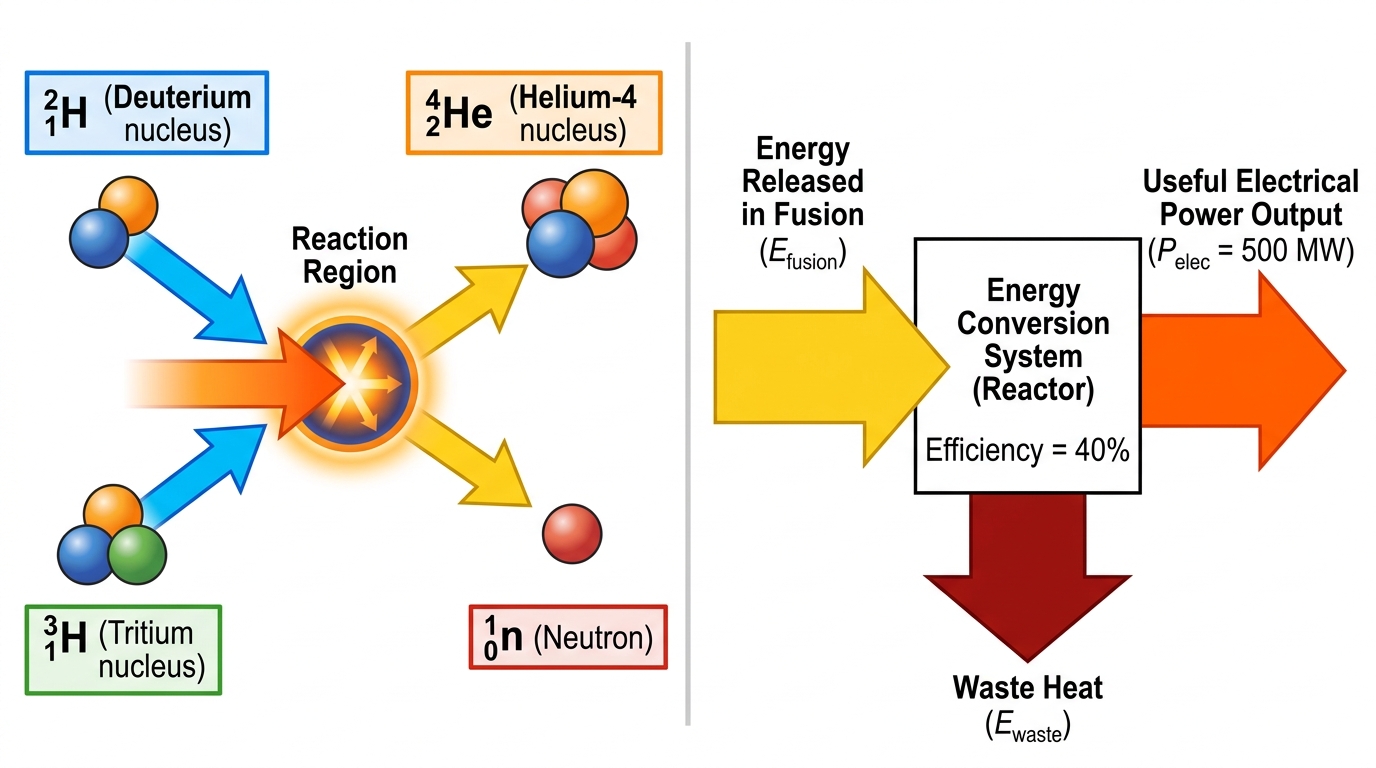
Calculate the mass defect for one fusion event.
Calculate the energy released in one fusion event.
The reactor produces a net electrical power output of . The overall energy conversion efficiency is . Determine the minimum number of fusion events per second required to sustain this output.
Most of the energy released is carried by the neutrons. Explain why this energy must be absorbed in a thick blanket around the reactor before electricity can be generated.
Calculate the mass of deuterium used each day.
revisionprep.com
Summary Answer
Not available for this question.
Model Answer
Not available for this question.
Marking Scheme
Not available for this question.
Examiner Insights
Not available for this question.
Alpha, beta and gamma decay: equations, neutrinos and properties
Alpha particles of kinetic energy and beta-minus particles move at right angles to the same uniform magnetic field of . alpha particle mass ; charge ; .
Explain why the alpha particles and beta particles curve in opposite directions.
Calculate the radius of the path of the alpha particles.
State and explain what happens to gamma rays in the field.
Explain why the alpha particles are deflected much less than beta particles of similar kinetic energy in the same field.
revisionprep.com
Summary Answer
Not available for this question.
Model Answer
Not available for this question.
Marking Scheme
Not available for this question.
Examiner Insights
Not available for this question.
That's every free question here — 6 of 135.
+129 more questions, plus Mock Papers & Worksheets, are waiting in Premium.