You're viewing 1 free preview question for Physics HL — subscribe to unlock 98 more, plus the Full Question Bank, Mock Papers & Worksheets.Upgrade
Structure of the Atom · Paper 2 — Free Physics HL Practice Questions
1MasterySAQ-SAtomic models (Bohr, quantum model)5 marksPaper 2~8 min

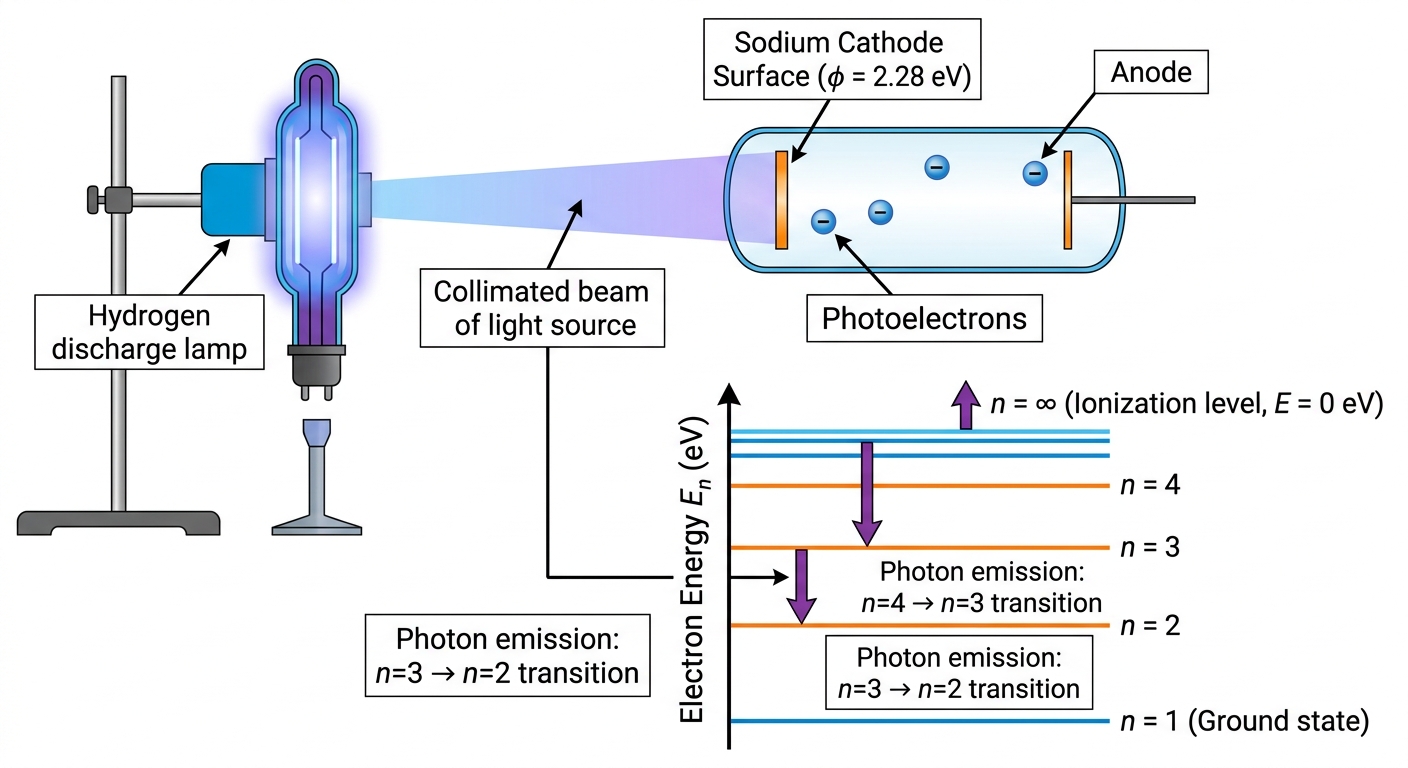
A student investigates the photoelectric effect using a sodium metal surface. The work function of sodium is . She illuminates the surface with light from a hydrogen discharge lamp emitting photons from the to transition.
(a)
State what is meant by the ground state in the Bohr model of the atom. [1 mark]
(b)
Calculate the maximum kinetic energy, in eV, of photoelectrons ejected from the sodium surface when illuminated by the to photons. [2 marks]
(c)
The student replaces the lamp with one emitting photons from the to transition in hydrogen. Deduce, with a calculation, whether the photoelectric effect occurs for this transition, and explain why the result differs from that in (b). [2 marks]

Solutions
That's every free question here — 1 of 99.
+98 more questions, plus Mock Papers & Worksheets, are waiting in Premium.