Doppler Effect · Paper 1 — Free Physics HL Practice Questions
Free questions
Open in full, with answers, mark scheme and examiner insights.
Doppler equations for sound with a moving source or observer
A stationary loudspeaker emits a note of frequency 1200 Hz. A driver moves directly away from the loudspeaker at . The speed of sound is . What frequency does the driver hear?
revisionprep.com
Summary Answer
Not available for this question.
Model Answer
Not available for this question.
Marking Scheme
Not available for this question.
Examiner Insights
Not available for this question.
Doppler equations for sound with a moving source or observer
The graph shows part of the spectrum of a star near a sodium absorption line. In the laboratory this line has a wavelength of 589.00 nm.
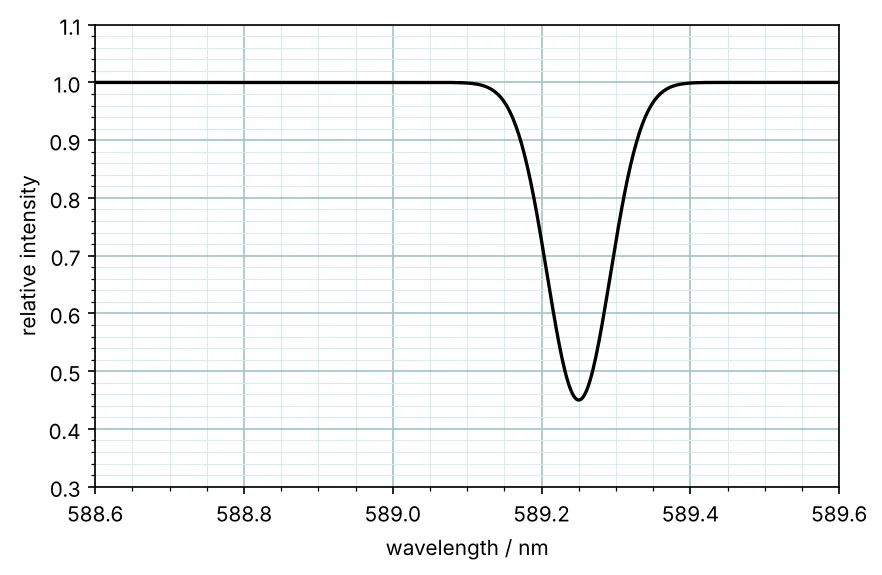
Determine the wavelength of the line in the star's spectrum, with its uncertainty.
Calculate the speed of the star relative to Earth and state its direction of motion.
Suggest why the wavelength of minimum intensity is used rather than an edge of the dip.
revisionprep.com
Summary Answer
Not available for this question.
Model Answer
Not available for this question.
Marking Scheme
Not available for this question.
Examiner Insights
Not available for this question.
Doppler effect for sound and light; Δf/f = Δλ/λ ≈ v/c
The diagram shows wavefronts on a water surface produced by a small dipper S that vibrates at 5.0 Hz while moving at constant speed along the x-axis. The wavefronts were emitted at equal time intervals. Positions can be read from the grid to ±0.2 cm.
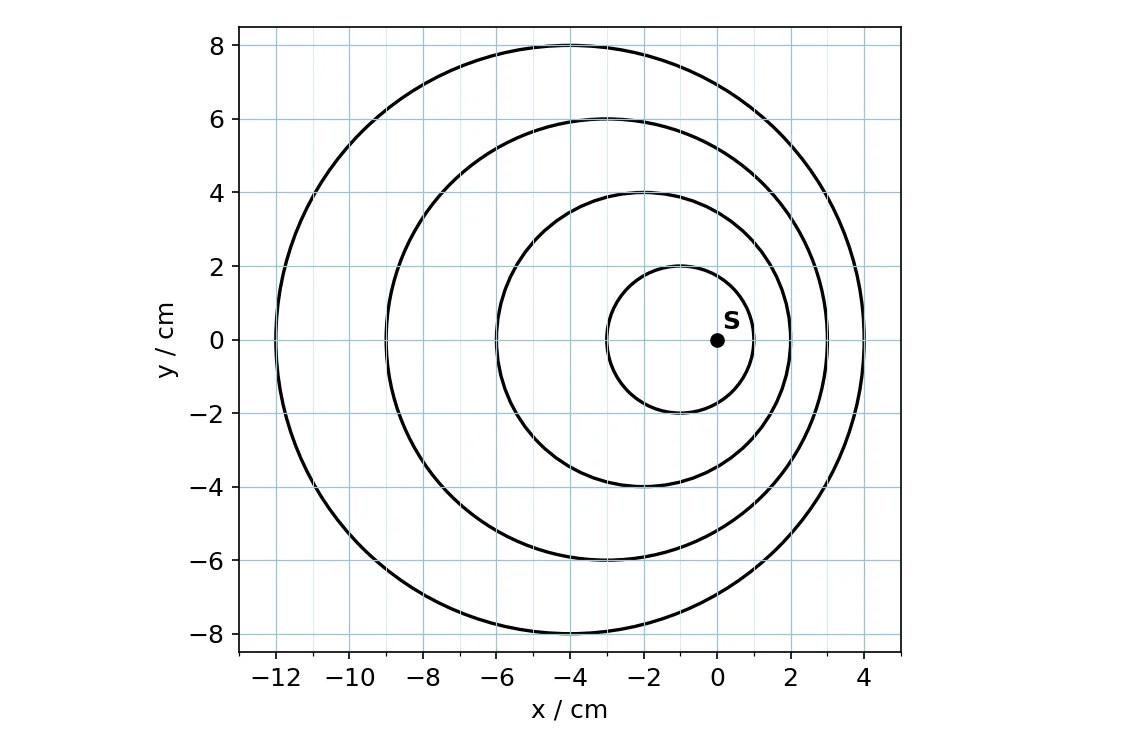
State the direction in which S is moving.
Determine the wavelength in front of S and behind S.
Hence show that the wave speed is about .
Determine the speed of S.
Use the moving-source equation to calculate the frequency of the waves reaching a stationary float placed in front of S and show that it agrees with the wavelength in front of S.
Determine the wavelength in front of S, with its absolute uncertainty, using the distance between the first and fourth wavefronts in front of S.
Explain why this method gives a smaller uncertainty than measuring a single spacing.
revisionprep.com
Summary Answer
Not available for this question.
Model Answer
Not available for this question.
Marking Scheme
Not available for this question.
Examiner Insights
Not available for this question.
Doppler equations for sound with a moving source or observer
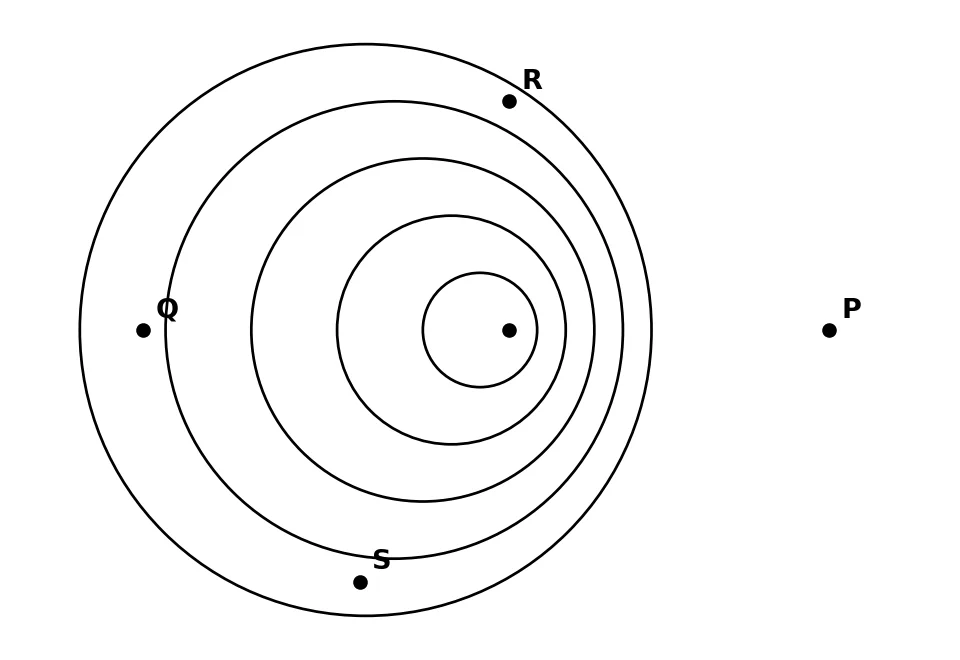
A source of sound moves at constant speed. The shows the wavefronts it has emitted and four stationary observers P, Q, R and S. Which observer hears the highest frequency?
revisionprep.com
Summary Answer
Not available for this question.
Model Answer
Not available for this question.
Marking Scheme
Not available for this question.
Examiner Insights
Not available for this question.
Doppler effect for sound and light; Δf/f = Δλ/λ ≈ v/c
In a laser Doppler experiment, light from a laser is reflected from a mirror on a trolley moving directly away from the laser at speed . The reflected light is combined with light straight from the laser, and the difference frequency is measured. The graph shows against with error bars. For much less than , .
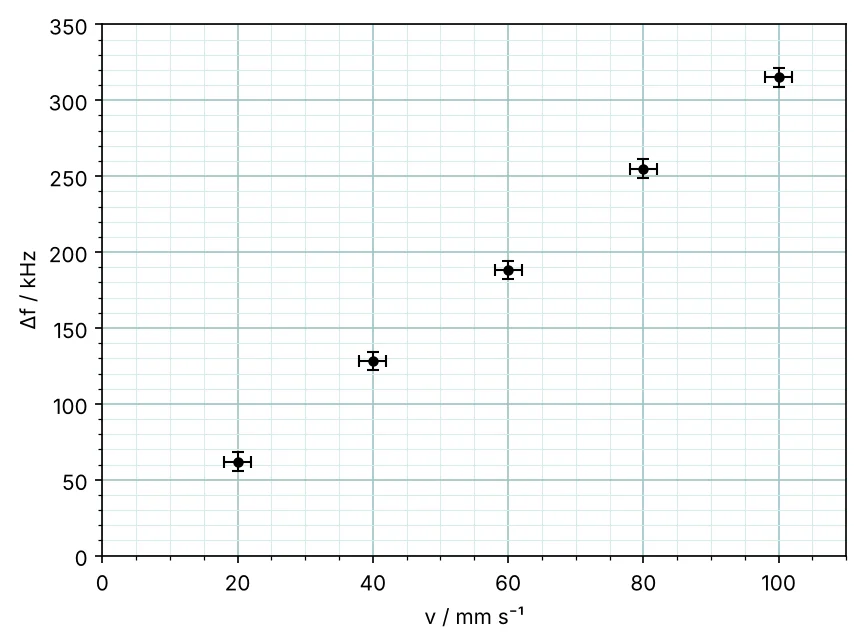
Show that , where is the wavelength of the laser light.
Determine the gradient of the graph in m⁻¹.
Determine the wavelength of the laser light.
Using the error bars, determine the percentage uncertainty in the wavelength.
The track is not quite parallel to the laser beam. Explain the effect of this on the value of the wavelength obtained.
revisionprep.com
Summary Answer
Not available for this question.
Model Answer
Not available for this question.
Marking Scheme
Not available for this question.
Examiner Insights
Not available for this question.
Doppler equations for sound with a moving source or observer
A student investigates the moving-source equation. A buzzer of fixed frequency is carried at speed directly towards a stationary microphone, which records the frequency . The graph shows against with error bars on and the line of best fit. The speed of sound is .
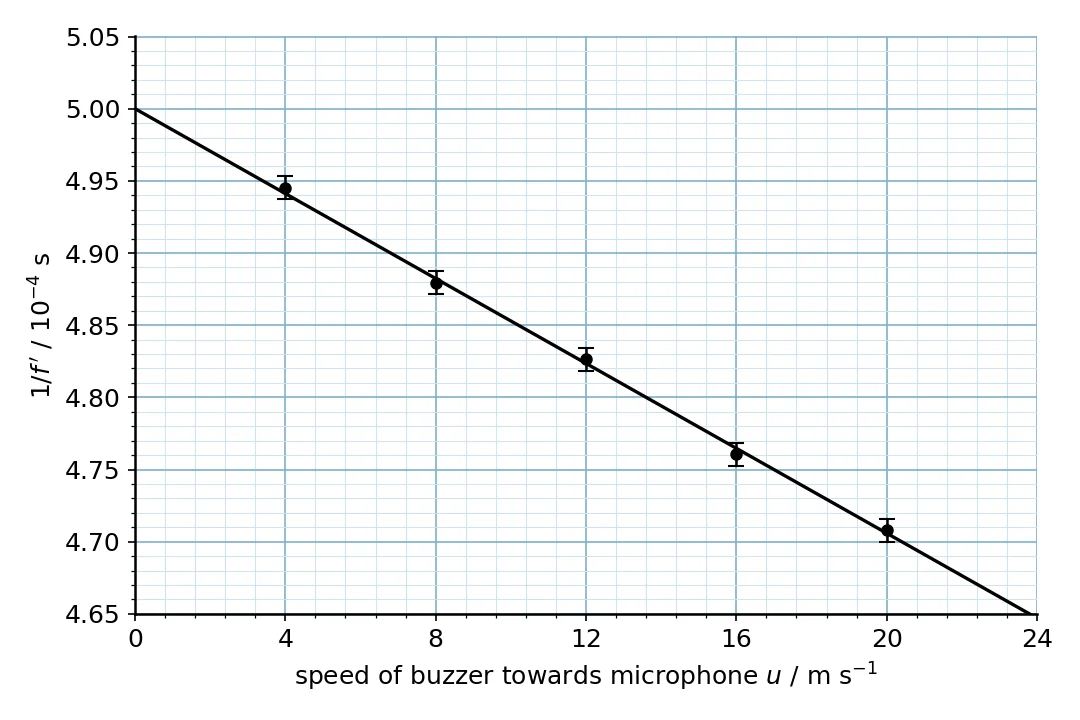
Derive an expression for in terms of , and and state what the intercept and the gradient of the graph represent.
Determine the frequency of the buzzer.
Determine the gradient of the line of best fit.
Determine the speed of sound.
Using the error bars, determine the percentage uncertainty in the speed of sound.
Comment on whether the result is consistent with a speed of sound of .
revisionprep.com
Summary Answer
Not available for this question.
Model Answer
Not available for this question.
Marking Scheme
Not available for this question.
Examiner Insights
Not available for this question.
That's every free question here — 6 of 35.
+29 more questions, plus Mock Papers & Worksheets, are waiting in Premium.