Wave Phenomena · Paper 1 — Free Physics HL Practice Questions
Free questions
Open in full, with answers, mark scheme and examiner insights.
Reflection, refraction, Snell's law, critical angle and total internal reflection
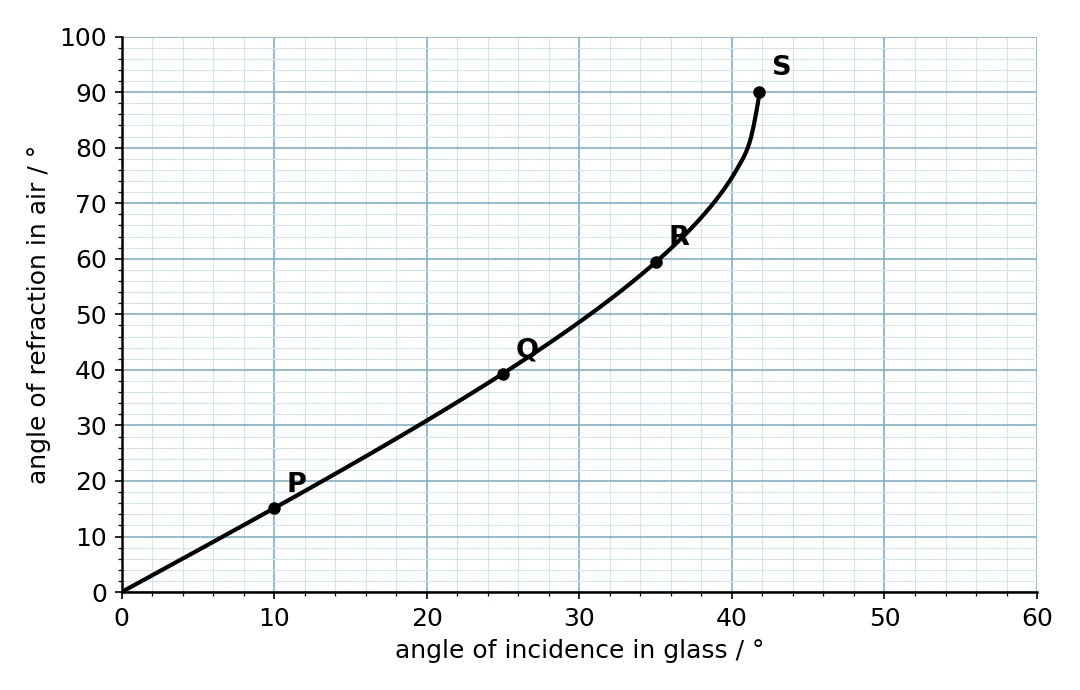
Figure 1 shows how the angle of refraction in air varies with the angle of incidence in glass for light leaving a glass block. Which point corresponds to the critical angle?
revisionprep.com
Summary Answer
Not available for this question.
Model Answer
Not available for this question.
Marking Scheme
Not available for this question.
Examiner Insights
Not available for this question.
Diffraction, superposition and double-source interference
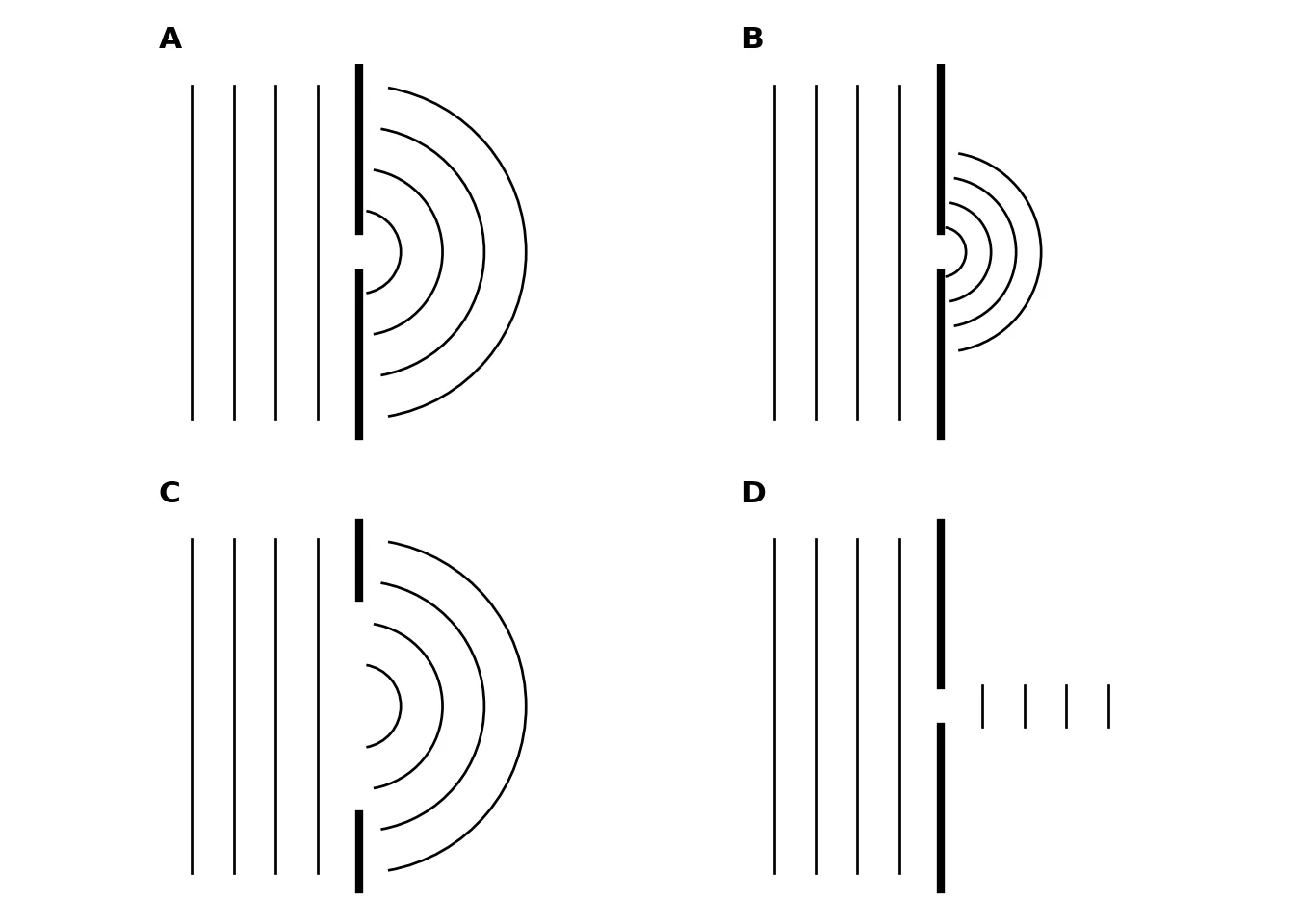
Plane water waves meet a gap in a barrier. The gap is about one wavelength wide. In each of Figure 1 the waves travel from left to right. Which shows the waves after they pass through the gap?
revisionprep.com
Summary Answer
Not available for this question.
Model Answer
Not available for this question.
Marking Scheme
Not available for this question.
Examiner Insights
Not available for this question.
Reflection, refraction, Snell's law, critical angle and total internal reflection
A student measures the critical angle of an acrylic block. Light is directed through the curved face of a semicircular block towards the centre of the flat face. The angle of incidence at the flat face is increased until the refracted ray just disappears. Table 1 shows five repeated readings.

Calculate the mean critical angle and its absolute uncertainty.
Determine the refractive index of the acrylic.
Explain why the light is aimed at the centre of the flat face through the curved face.
The student finds it difficult to judge the moment at which the refracted ray disappears. State whether this causes a random or a systematic error, and suggest how its effect on the result is reduced.
revisionprep.com
Summary Answer
Not available for this question.
Model Answer
Not available for this question.
Marking Scheme
Not available for this question.
Examiner Insights
Not available for this question.
Diffraction, superposition and double-source interference
A student uses red laser light and a set of double slits of different separation . The screen is 1.50 m from the slits. For each slit pair he measures the fringe spacing , with an uncertainty of ±0.1 mm. Figure 1 shows plotted against .
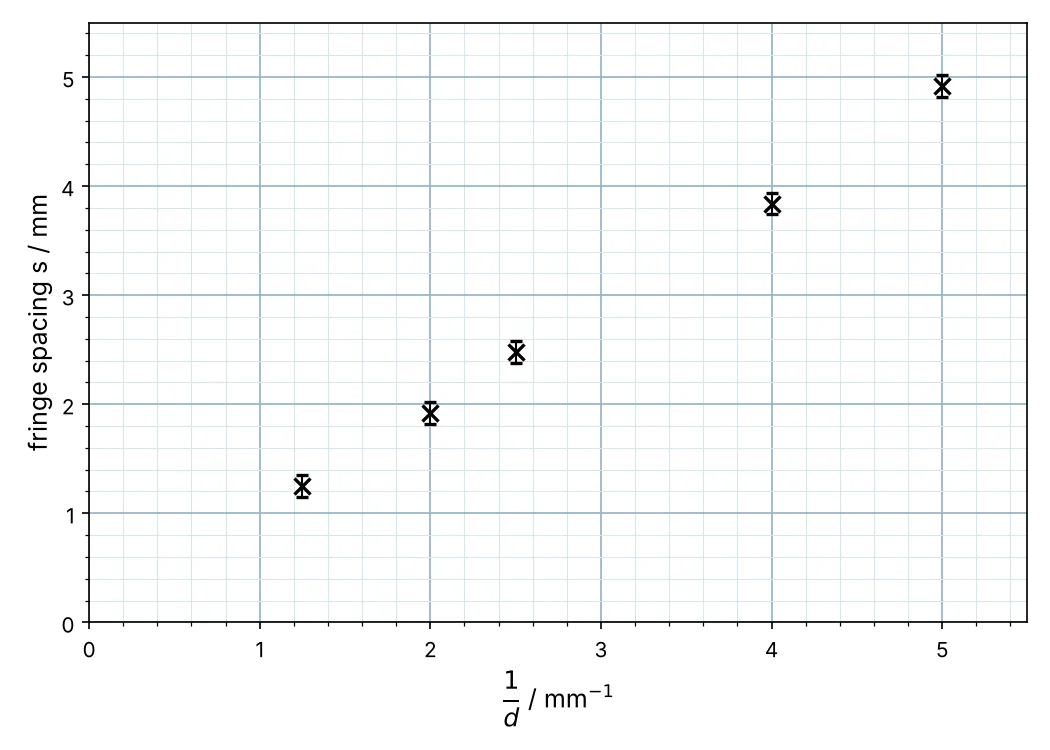
Explain why is plotted against .
Determine the gradient of the line of best fit for these data.
Hence determine the wavelength of the laser light.
Identify the point with the largest percentage uncertainty in , giving a reason.
Suggest how the student could reduce the uncertainty in each value of , and explain why this works.
revisionprep.com
Summary Answer
Not available for this question.
Model Answer
Not available for this question.
Marking Scheme
Not available for this question.
Examiner Insights
Not available for this question.
Diffraction, superposition and double-source interference
A diffraction grating is used with a lamp that emits red light of wavelength 700 nm. In the second order the red light appears at exactly the same angle as light of another wavelength in the third order. What is the other wavelength?
revisionprep.com
Summary Answer
Not available for this question.
Model Answer
Not available for this question.
Marking Scheme
Not available for this question.
Examiner Insights
Not available for this question.
Single-slit diffraction (θ = λ/b) and intensity patterns
Coherent light passes through a double slit. Each slit has width and the slit separation is . The pattern is modulated by the single-slit diffraction pattern of one slit. How many bright interference fringes lie within the central maximum of the single-slit pattern?
revisionprep.com
Summary Answer
Not available for this question.
Model Answer
Not available for this question.
Marking Scheme
Not available for this question.
Examiner Insights
Not available for this question.
That's every free question here — 6 of 45.
+39 more questions, plus Mock Papers & Worksheets, are waiting in Premium.