You're viewing 4 free preview questions for Physics HL — subscribe to unlock 108 more, plus the Full Question Bank, Mock Papers & Worksheets.Upgrade
Simple Harmonic Motion · Paper 2 — Free Physics HL Practice Questions
1FoundationSAQ-LPendulum and spring systems9 marksPaper 2~14 min

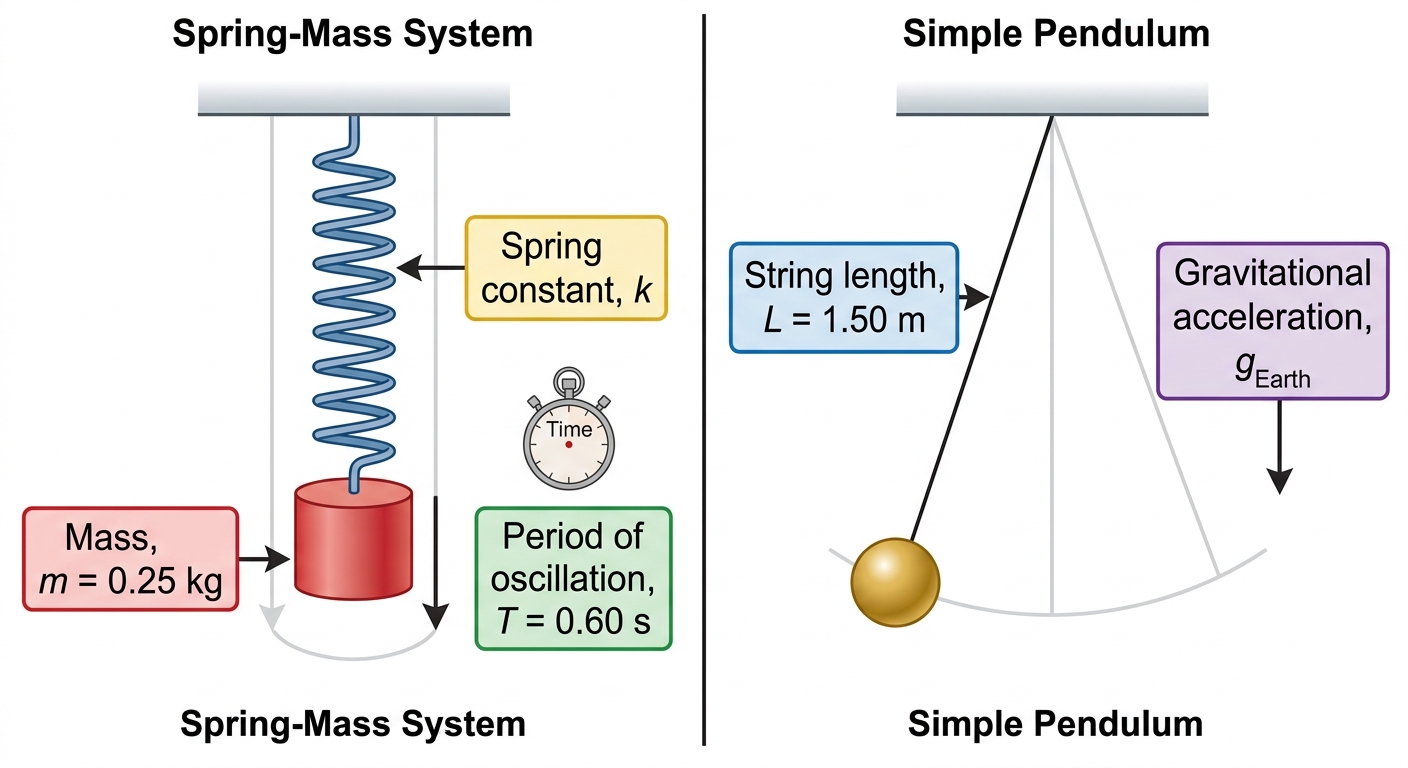
A spring-mass system oscillates with a period of 0.60 s when a 0.25 kg mass is attached. Separately, a simple pendulum of length 1.50 m is set into motion with small amplitude on Earth.
(a)
Determine the spring constant of the spring. [2 marks]
(b)
Determine the period of the pendulum on Earth. [2 marks]
(c)
The pendulum is taken to a planet where the gravitational field strength is half that of Earth. Determine the new period of the pendulum on this planet. [2 marks]
(d)
Explain why the period of the spring-mass system would remain unchanged on the planet in (c). [2]
(e) A spacecraft undergoes variable acceleration during flight. Evaluate which system — the spring-mass oscillator or the pendulum — would be more reliable for timekeeping aboard the spacecraft. [3 marks]

Solutions
2FoundationSAQ-SDisplacement, velocity, and acceleration in SHM4 marksPaper 2~6 min
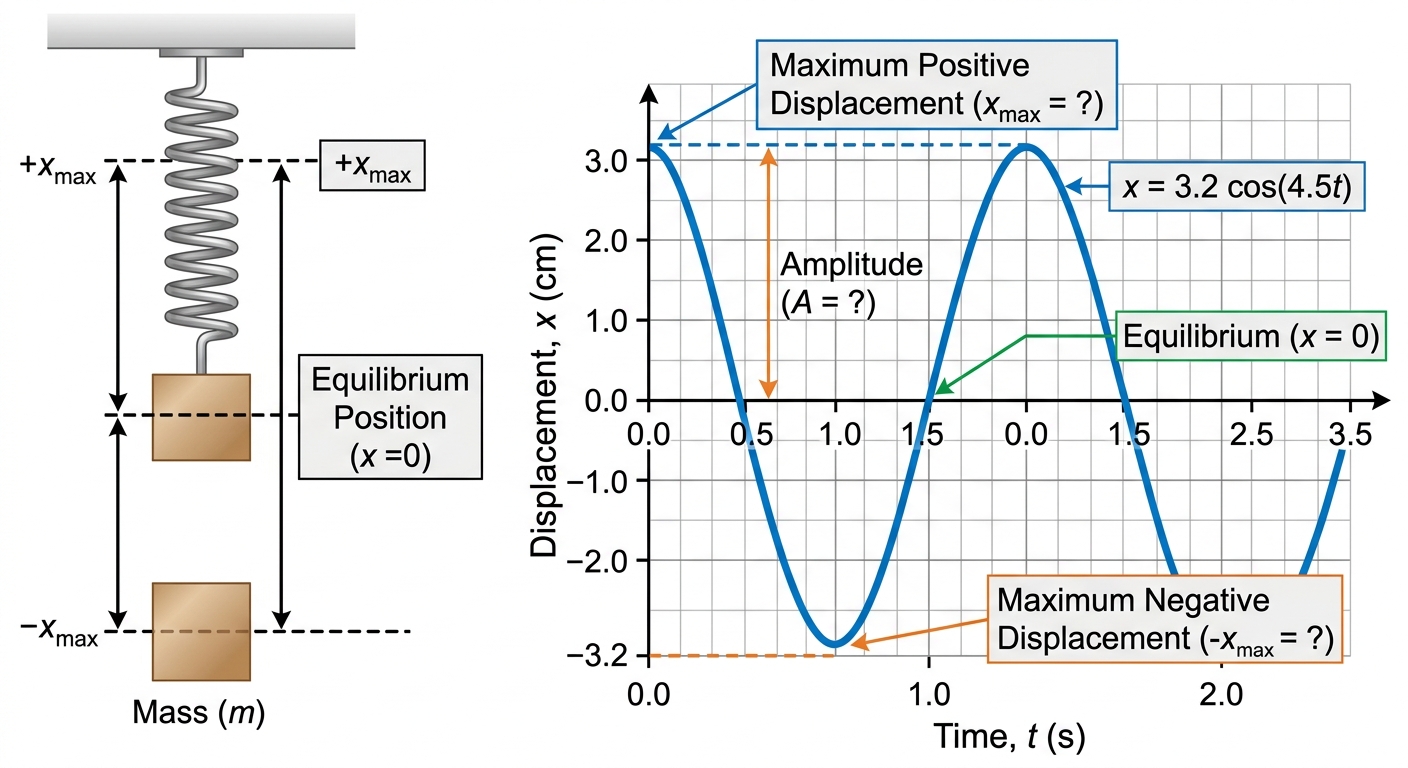
A mass-spring system oscillates with simple harmonic motion. The displacement of the mass from its equilibrium position is given by , where is in metres and is in seconds.
(a)
State two characteristics of the acceleration of a mass undergoing simple harmonic motion. [2 marks]
(b)
Calculate the magnitude of the maximum acceleration of the mass. [2 marks]
Solutions
3MasterySAQ-SDisplacement, velocity, and acceleration in SHM5 marksPaper 2~8 min
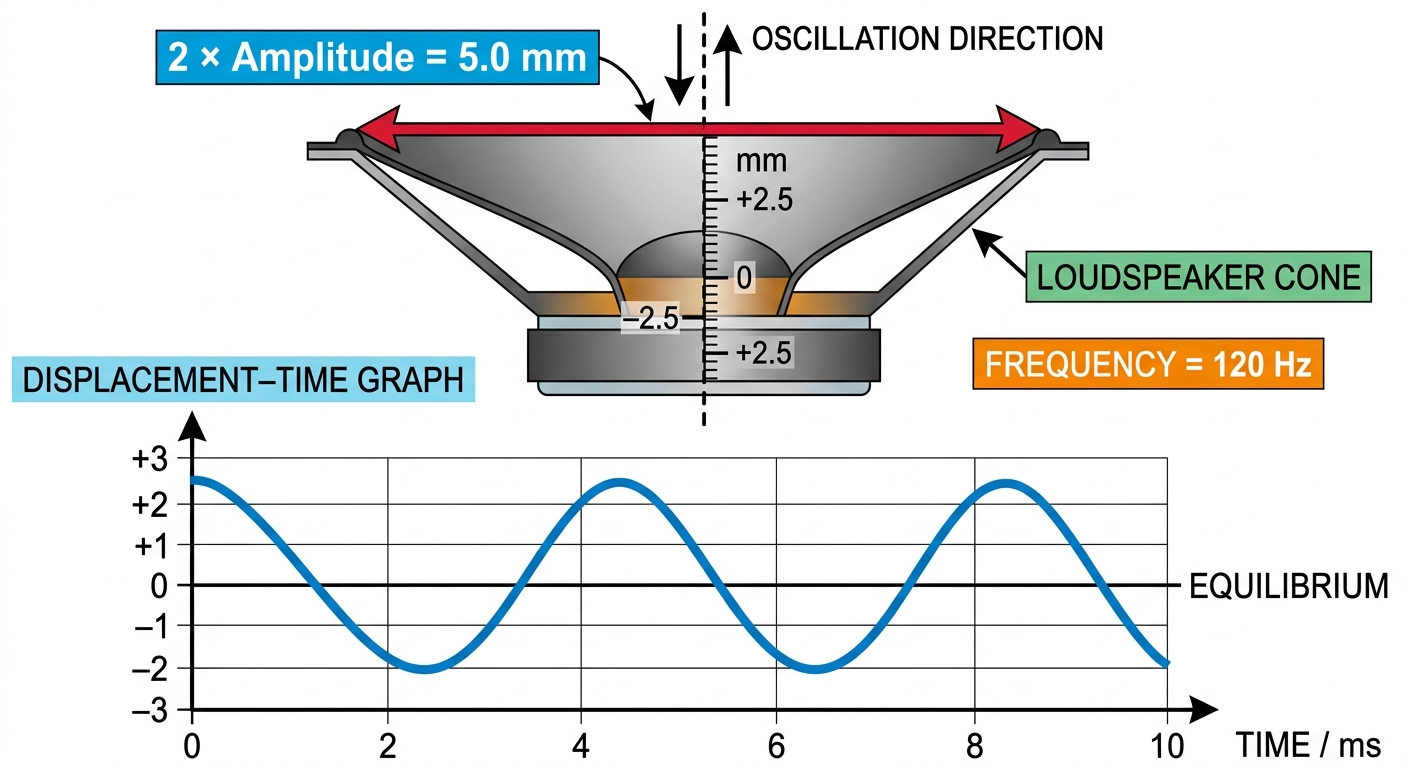
A loudspeaker cone oscillates with simple harmonic motion. The cone has an amplitude of and a frequency of . At time , the cone is at its maximum positive displacement.
(a)
State the acceleration of the cone at the instant it passes through the equilibrium position. [1 mark]
(b)
Calculate the magnitude of the maximum acceleration of the cone. [2 marks]
(c)
The cone passes through the equilibrium position with maximum speed. Using energy conservation, explain why the speed is maximum at this point and not any other displacement. [2 marks]
Solutions
4ChallengeSAQ-LPendulum and spring systems7 marksPaper 2~11 min
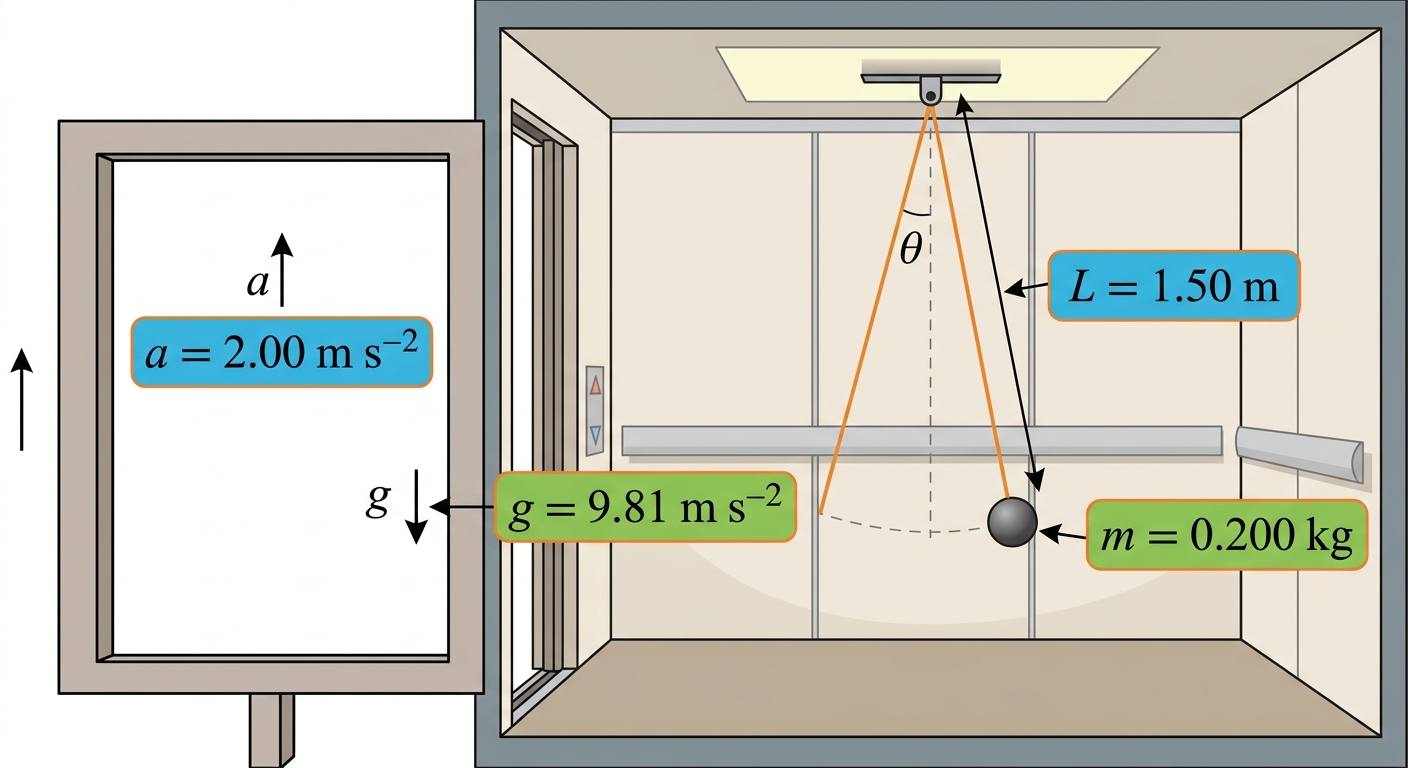
A pendulum consists of a small metal bob of mass attached to a light string of length . It is displaced by a small angle and released from rest. The pendulum is inside an elevator accelerating upward at .
(a)
Determine the effective gravitational acceleration experienced by the pendulum bob in the accelerating elevator. [1 mark]
(b)
Determine the period of the pendulum in the accelerating elevator. [2 marks]
(c)
The bob is detached from the string and attached instead to a vertical spring of spring constant . Calculate the period of oscillation of this spring–mass system inside the same accelerating elevator. [1 mark]
(d)
Explain why the period of the spring–mass system is unaffected by the elevator's acceleration, whereas the period of the pendulum is affected. Hence deduce which system would function as a more reliable clock in a non-inertial reference frame, and justify your answer. [3 marks]
Solutions
That's every free question here — 4 of 112.
+108 more questions, plus Mock Papers & Worksheets, are waiting in Premium.