Standing Waves and Resonance · Paper 2 — Free Physics HL Practice Questions
Free questions
Open in full, with answers, mark scheme and examiner insights.
Standing waves: nodes, antinodes and harmonics on strings and in pipes
Figure 1 shows a rope driven by a vibration generator at 24 Hz. The other end passes over a pulley and is held taut by hanging masses. The distance between adjacent nodes is 0.35 m.
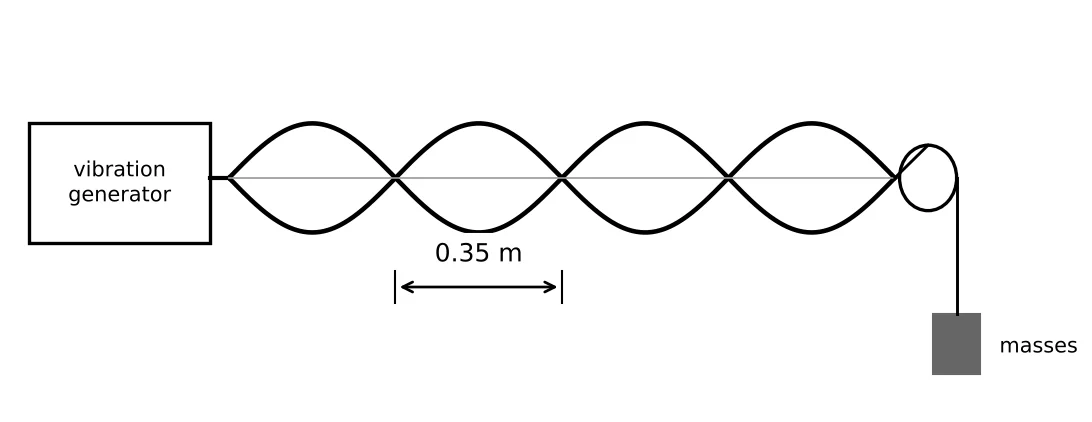
Describe how a node is formed on the rope.
Calculate the speed of the wave on the rope.
The frequency is increased to 48 Hz and the tension is unchanged. A new standing wave forms. Determine the new distance between adjacent nodes.
revisionprep.com
Summary Answer
Not available for this question.
Model Answer
Not available for this question.
Marking Scheme
Not available for this question.
Examiner Insights
Not available for this question.
Resonance, natural frequency and damping
A student hangs a mass from a spring and drives the top of the spring with a vibration generator of constant force amplitude. The amplitude of the mass is measured for different driving frequencies. Figure 1 shows the results for the system as set up (curve 1) and after a large card is attached to the mass (curve 2).
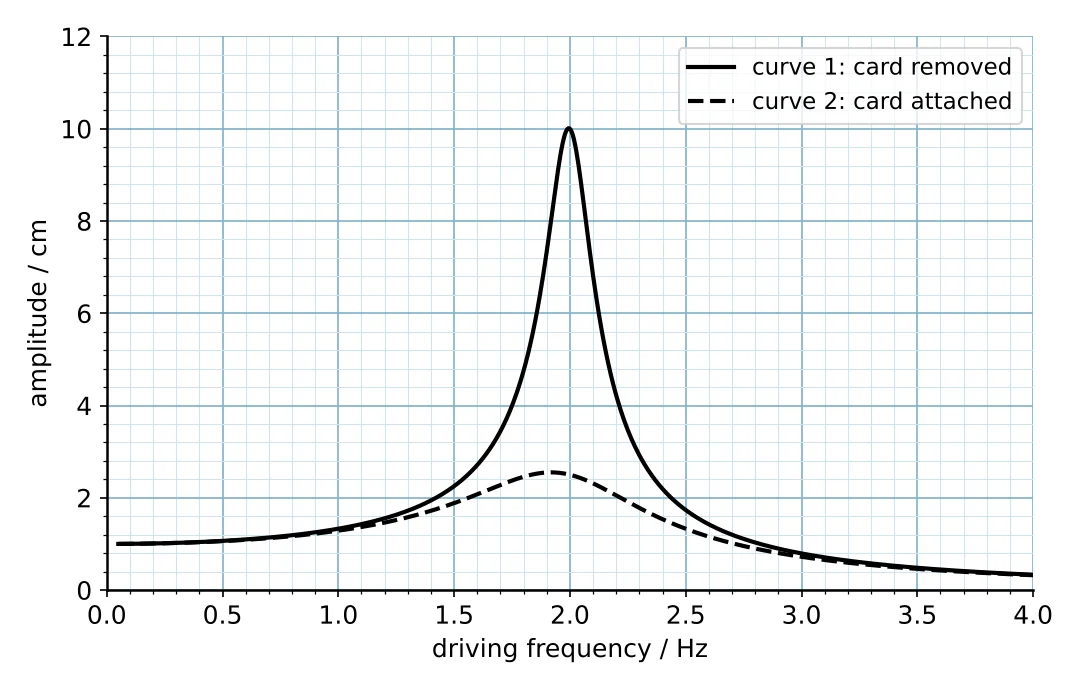
State the natural frequency of the system without the card.
Determine the factor by which the card reduces the maximum amplitude.
State two other differences between curve 1 and curve 2 caused by the card.
Explain why the two curves have almost the same amplitude at very low driving frequencies.
State how the amplitude at 4.0 Hz compares with the amplitude of curve 1 at its maximum.
revisionprep.com
Summary Answer
Not available for this question.
Model Answer
Not available for this question.
Marking Scheme
Not available for this question.
Examiner Insights
Not available for this question.
Standing waves: nodes, antinodes and harmonics on strings and in pipes
Figure 1 shows a standing wave on a string of length 1.5 m, driven by a vibrating source at a frequency of 60 Hz. The wavelength of the standing wave is 1.0 m.
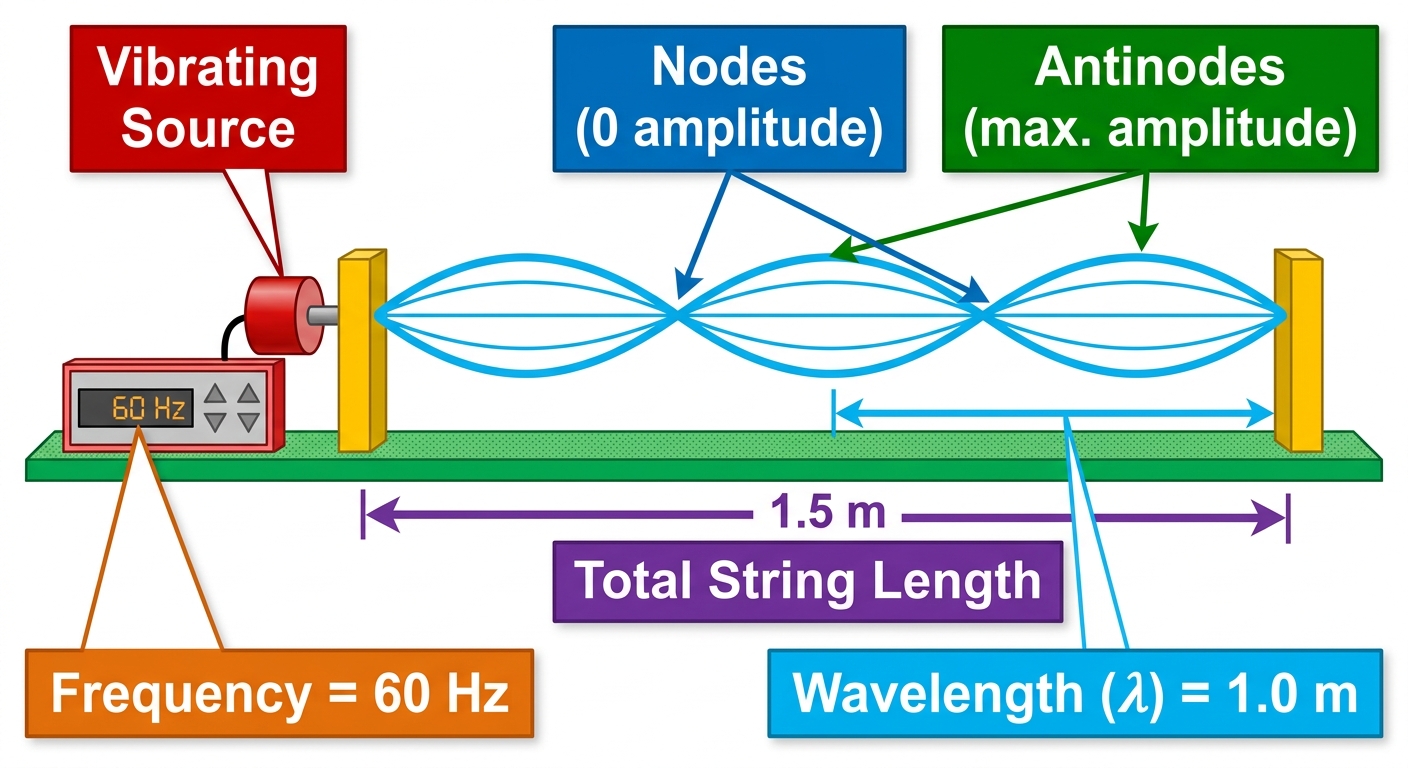
Determine the speed of the transverse waves on the string.
State the harmonic number of the standing wave in Figure 1.
Calculate the lowest frequency at which a standing wave can be set up on the string.
The frequency of the source is increased slowly from 60 Hz. Determine the next frequency at which a standing wave of large amplitude forms.
Explain why the antinodes of the standing wave have a much larger amplitude than the end of the string attached to the vibrating source.
Describe the motion of the points on the string that are 0.25 m and 0.75 m from the source.
The tension is increased so that the wave speed becomes 90 m s⁻¹ while the frequency stays at 60 Hz. Determine the number of loops on the string.
revisionprep.com
Summary Answer
Not available for this question.
Model Answer
Not available for this question.
Marking Scheme
Not available for this question.
Examiner Insights
Not available for this question.
Resonance, natural frequency and damping
Figure 1 shows a string of length 0.800 m fixed at one end and driven at the other by a vibrating driver. The speed of waves on the string is 96.0 m s⁻¹.
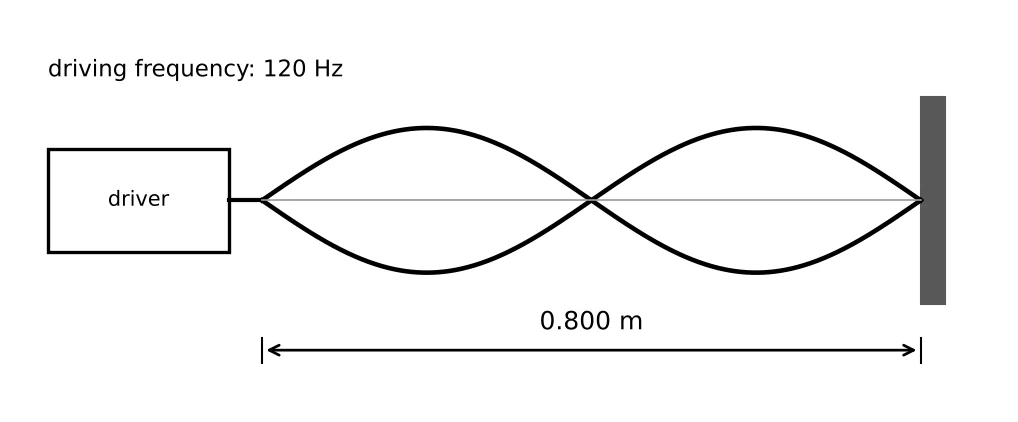
Show that the frequency of the standing wave in Figure 1 is 120 Hz.
State the harmonic number and the number of nodes, including the ends.
The string is lit by a strobe lamp that flashes 60 times per second. Explain why the string appears stationary.
The tension is reduced so that the wave speed becomes 72.0 m s⁻¹, and the driving frequency stays at 120 Hz. Evaluate whether a standing wave forms.
With the wave speed at 72.0 m s⁻¹, determine the driving frequency closest to 120 Hz at which a standing wave forms.
Suggest why the end of the string attached to the driver is treated as a node even though it moves slightly.
revisionprep.com
Summary Answer
Not available for this question.
Model Answer
Not available for this question.
Marking Scheme
Not available for this question.
Examiner Insights
Not available for this question.
Standing waves: nodes, antinodes and harmonics on strings and in pipes
Figure 1 shows the optical cavity of a laser: two parallel mirrors a distance L = 0.300 m apart. Light reflects back and forth between the mirrors and forms a standing wave with a node at each mirror. The laser emits red light of wavelength 633 nm. The speed of light is m s⁻¹.
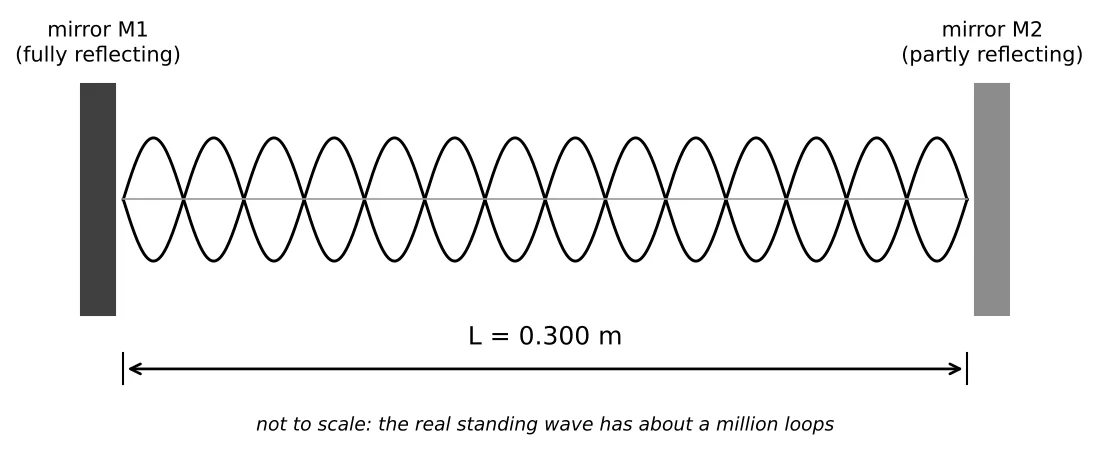
State the condition that the wavelength must meet for a standing wave to form in the cavity.
Calculate the frequency of the light.
Determine the number of half-wavelengths that fit in the cavity.
Show that adjacent standing waves allowed in the cavity differ in frequency by Hz.
The laser material can amplify light only over a frequency range of 1.5 GHz. Determine how many of the allowed standing waves fit within this range.
As the laser warms up, the mirror separation increases by m. Discuss the effect on the standing wave and on the frequencies of the light emitted.
revisionprep.com
Summary Answer
Not available for this question.
Model Answer
Not available for this question.
Marking Scheme
Not available for this question.
Examiner Insights
Not available for this question.
Resonance, natural frequency and damping
A tall office building sways when it is pushed by gusts of wind. Figure 1 shows how the amplitude of oscillation of the top floor varies with the driving frequency of the force, without and with a large damper installed near the top of the building.
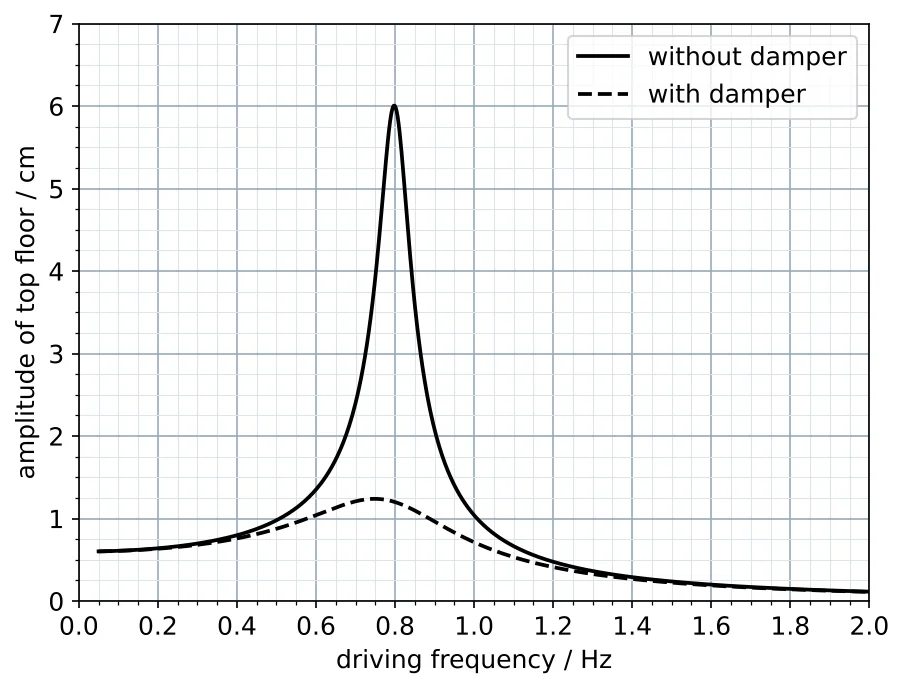
State the natural frequency of the building.
Calculate the period of the building's natural oscillation.
Explain why gusts that arrive regularly every 1.25 s are a particular danger to the building.
Determine, using Figure 1, the factor by which the damper reduces the largest amplitude.
Describe two other changes that the damper makes to the curve.
Explain why the two curves almost coincide at very low driving frequencies.
An engineer suggests that the building should be critically damped. Evaluate this suggestion.
revisionprep.com
Summary Answer
Not available for this question.
Model Answer
Not available for this question.
Marking Scheme
Not available for this question.
Examiner Insights
Not available for this question.
That's every free question here — 6 of 42.
+36 more questions, plus Mock Papers & Worksheets, are waiting in Premium.