You're viewing 4 free preview questions for Physics HL — subscribe to unlock 83 more, plus the Full Question Bank, Mock Papers & Worksheets.Upgrade
Wave Model · Paper 2 — Free Physics HL Practice Questions
1FoundationSAQ-LWave equations7 marksPaper 2~11 min

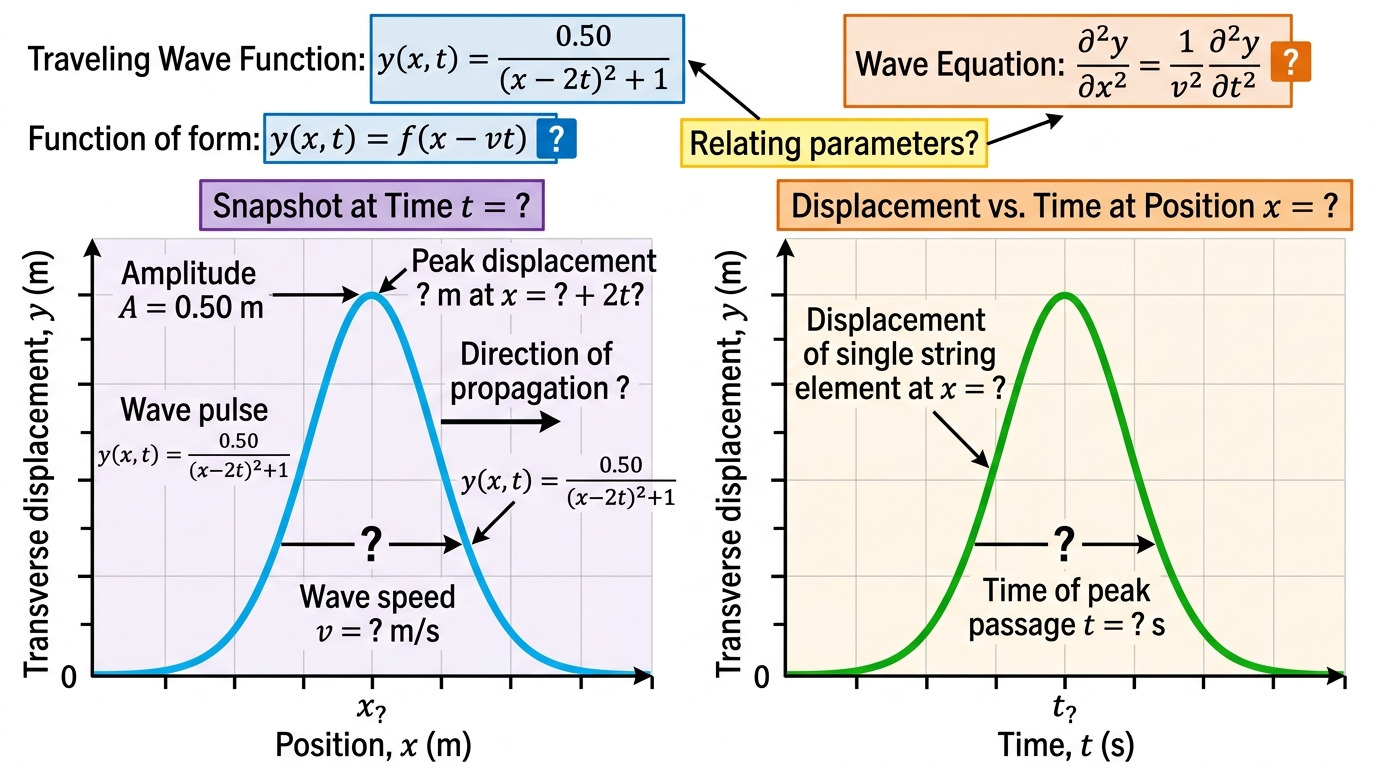
A wave pulse travelling along a string is described by
where and are in metres and is in seconds.
(a)
State the speed and direction of propagation of this pulse. [2 marks]
(b)
The table below shows values of calculated at and at .
/ m — at / m — at / m
0.0 — 0.50 — 0.10
1.0 — 0.25 — 0.50
2.0 — 0.10 — 0.25
3.0 — 0.050 — 0.10
Determine the displacement of the peak of the pulse between and , and show that this is consistent with your answer to (a). [2 marks]
(c)
State one advantage of using a pulse function, rather than a sinusoidal wave function, to model wave motion on a string. [1 mark]
(d)
Explain one limitation of the pulse model when applied to real wave behaviour on a string. [2 marks]

Solutions
2FoundationSAQ-SProperties of waves (amplitude, frequency, wavelength, speed)5 marksPaper 2~8 min
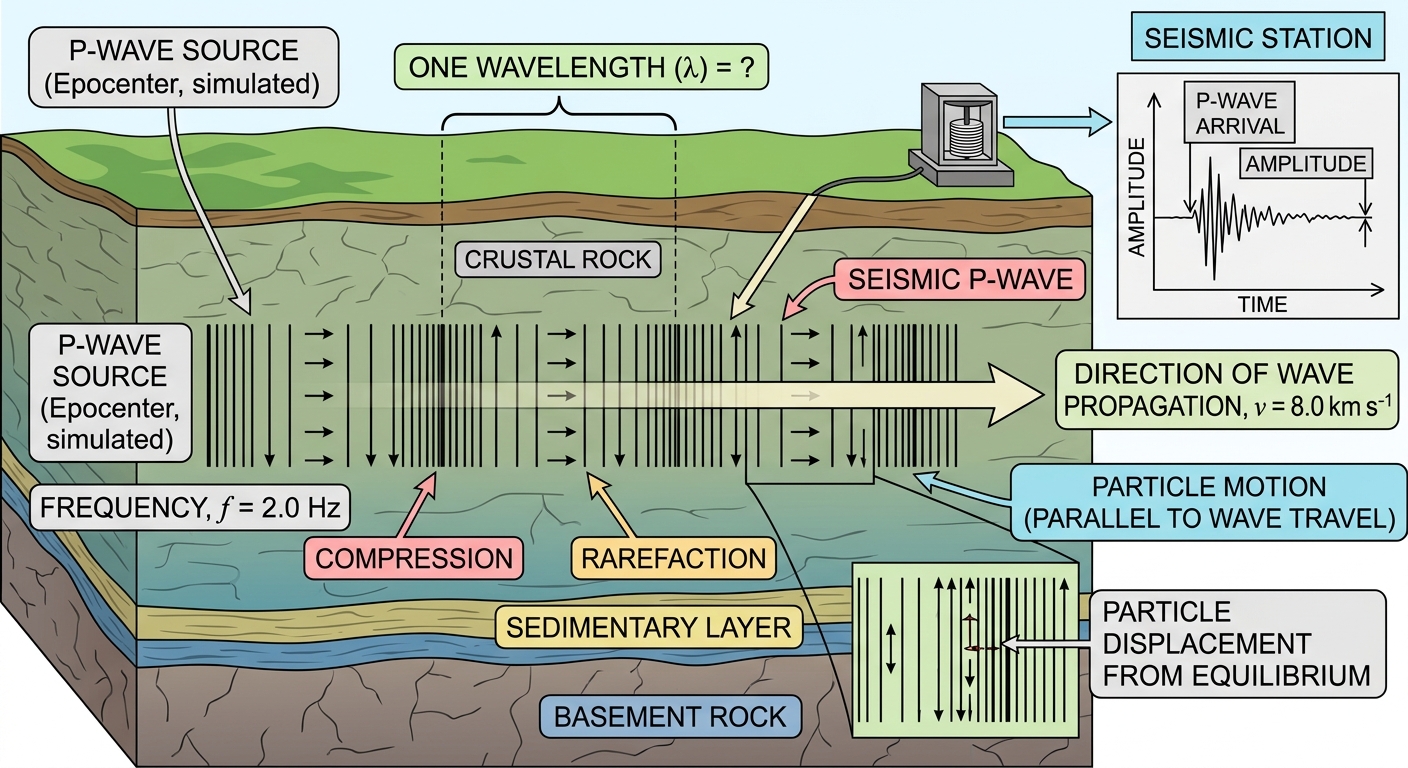
A seismic P-wave travels through the Earth at a speed of and has a frequency of .
(a)
State the relationship between wave intensity and wave amplitude . [1 mark]
(b)
A second seismic wave of the same frequency has an amplitude three times greater than the first wave. Determine the ratio of their intensities. [2 marks]
(c)
Calculate the wavelength of the seismic P-wave. Give your answer in metres.
Useful relationships: , [2 marks]
Solutions
3FoundationSAQ-SProperties of waves (amplitude, frequency, wavelength, speed)5 marksPaper 2~8 min
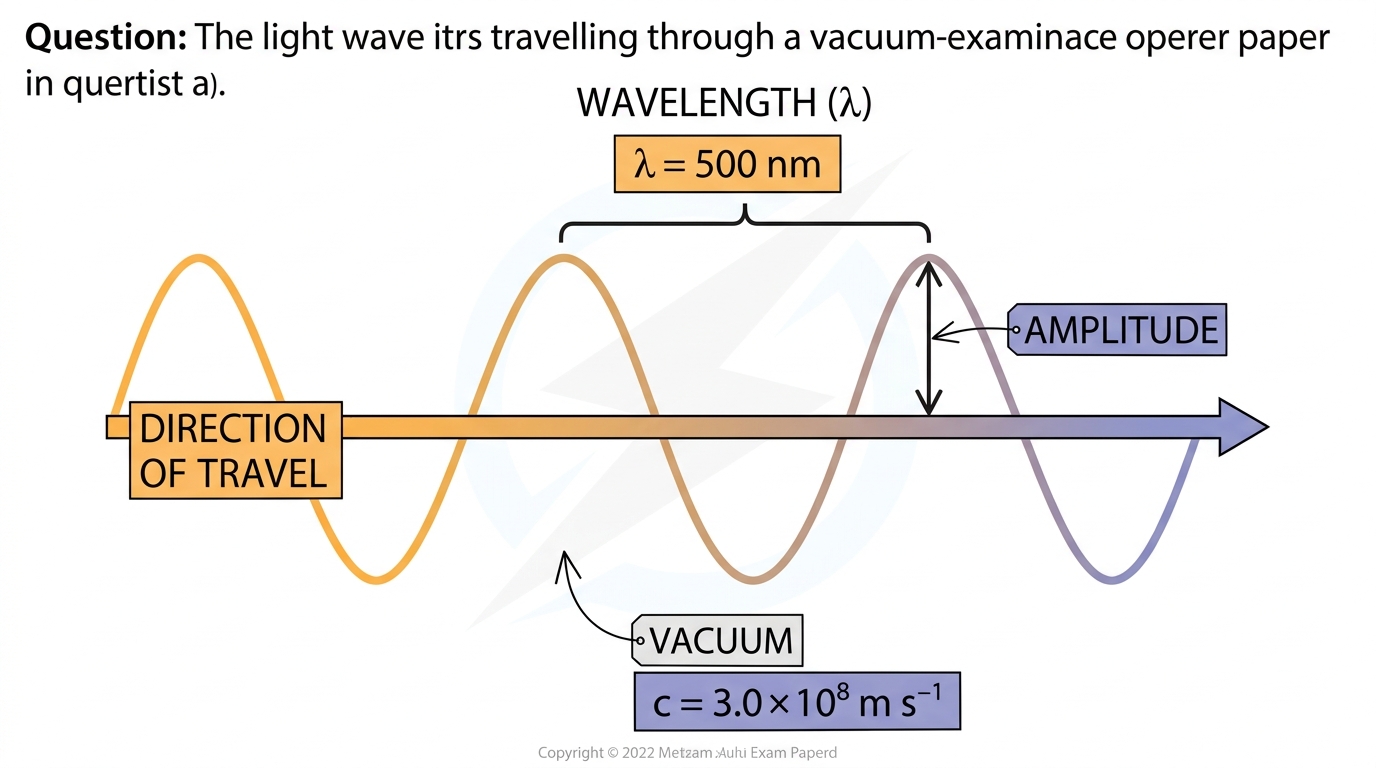
A light wave in vacuum has a wavelength of 500 nm and travels at .
(a)
Calculate the frequency of the light wave. [2 marks]
(b)
The light enters a glass block in which its speed is . Determine the wavelength of the light inside the glass. [2 marks]
(c)
Deduce whether the frequency of the light changes as it enters the glass. [1 mark]
Solutions
4MasterySAQ-STypes of waves: Transverse and longitudinal5 marksPaper 2~8 min
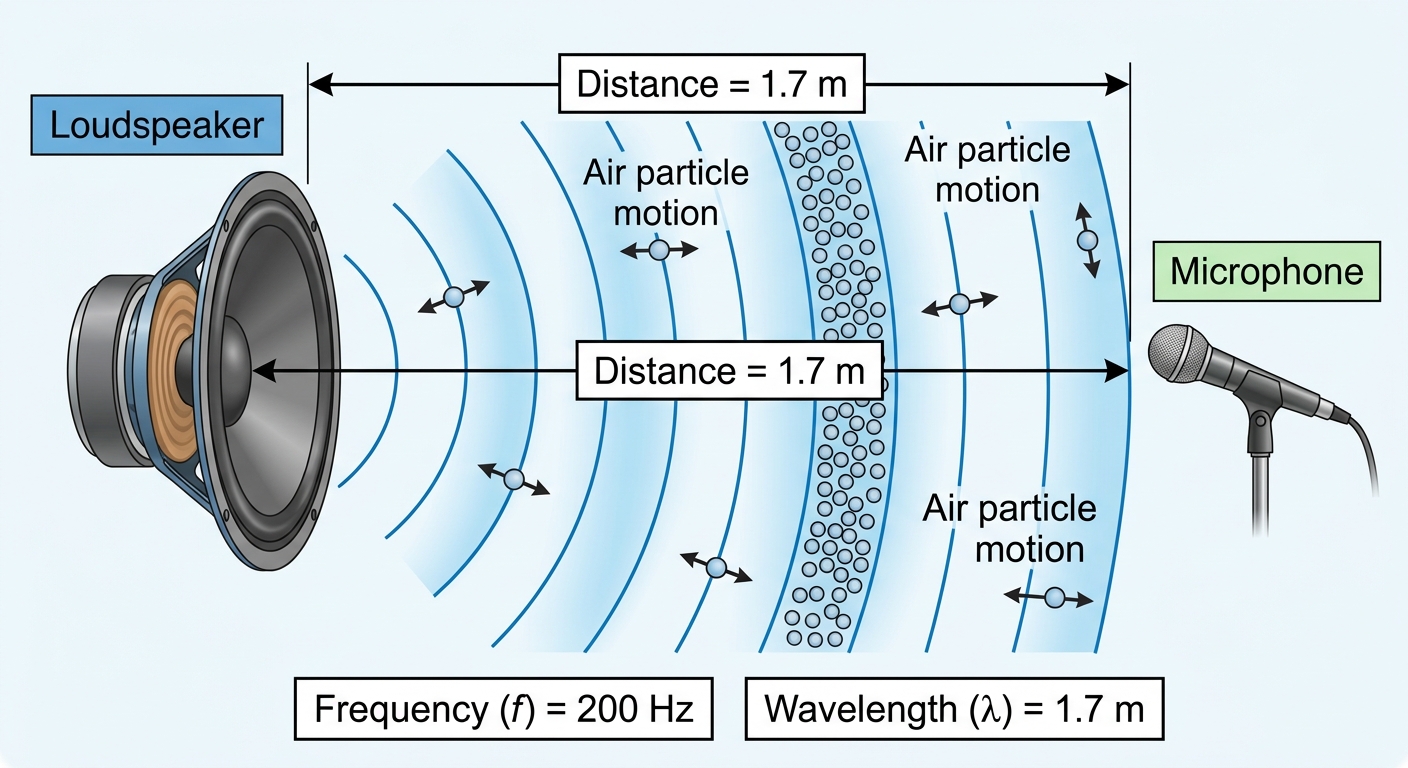
A loudspeaker produces a sound wave that travels through air toward a microphone placed 1.7 m away. The sound wave has a frequency of 200 Hz and a wavelength of 1.7 m.
(a)
State the type of wave that sound is. [1 mark]
(b)
Describe how energy is transferred from the loudspeaker to the microphone. Refer to the motion of the air particles and the pattern of pressure variation produced. [2 marks]
(c)
State one difference between the direction of particle oscillation in this sound wave and in a transverse wave travelling along a stretched string. [1 mark]
(d)
Justify why a sound wave cannot propagate as a transverse wave through air. [1 mark]
Solutions
That's every free question here — 4 of 87.
+83 more questions, plus Mock Papers & Worksheets, are waiting in Premium.