Wave Phenomena · Paper 2 — Free Physics HL Practice Questions
Free questions
Open in full, with answers, mark scheme and examiner insights.
Reflection, refraction, Snell's law, critical angle and total internal reflection
A student shines a laser pointer into a rectangular glass block at an angle of incidence of relative to the normal. The refractive index of the glass is .
State what happens to the speed and frequency of the light as it enters the glass from air.
Calculate the angle of refraction inside the glass.
revisionprep.com
Summary Answer
Not available for this question.
Model Answer
Not available for this question.
Marking Scheme
Not available for this question.
Examiner Insights
Not available for this question.
Multiple-slit interference and diffraction gratings (nλ = d sin θ)
Light from a sodium lamp, of wavelength 589 nm, is incident normally on a diffraction grating that has 600 lines per millimetre.
Calculate the separation of adjacent lines on the grating.
Calculate the angle between the central maximum and the first-order maximum.
The sodium lamp is replaced by a lamp that emits light of longer wavelength. State how the angle of the first-order maximum changes, and give a reason.
revisionprep.com
Summary Answer
Not available for this question.
Model Answer
Not available for this question.
Marking Scheme
Not available for this question.
Examiner Insights
Not available for this question.
Reflection, refraction, Snell's law, critical angle and total internal reflection
Figure 1 shows a right-angled glass prism whose other two angles are 45°. Light enters one short face along the normal and is turned through 90° by the long face.
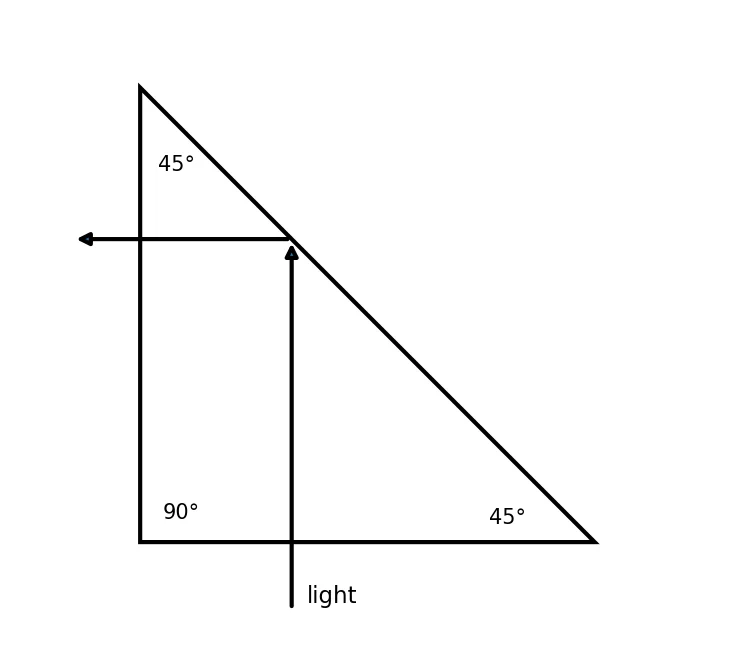
State why the light does not change direction as it enters the prism.
Show that the angle of incidence at the long face is 45°.
Determine the smallest refractive index of the glass for which all the light is reflected at the long face.
The prism is made instead from plastic of refractive index 1.38. Calculate the angle at which the light leaves the long face into the air.
Suggest why prisms in binoculars are made from glass of refractive index about 1.5 rather than 1.42.
revisionprep.com
Summary Answer
Not available for this question.
Model Answer
Not available for this question.
Marking Scheme
Not available for this question.
Examiner Insights
Not available for this question.
Diffraction, superposition and double-source interference
Figure 1 shows two pulses, P and Q, on a long rope at time . P moves to the right and Q moves to the left, both at . The rope is fixed at cm.
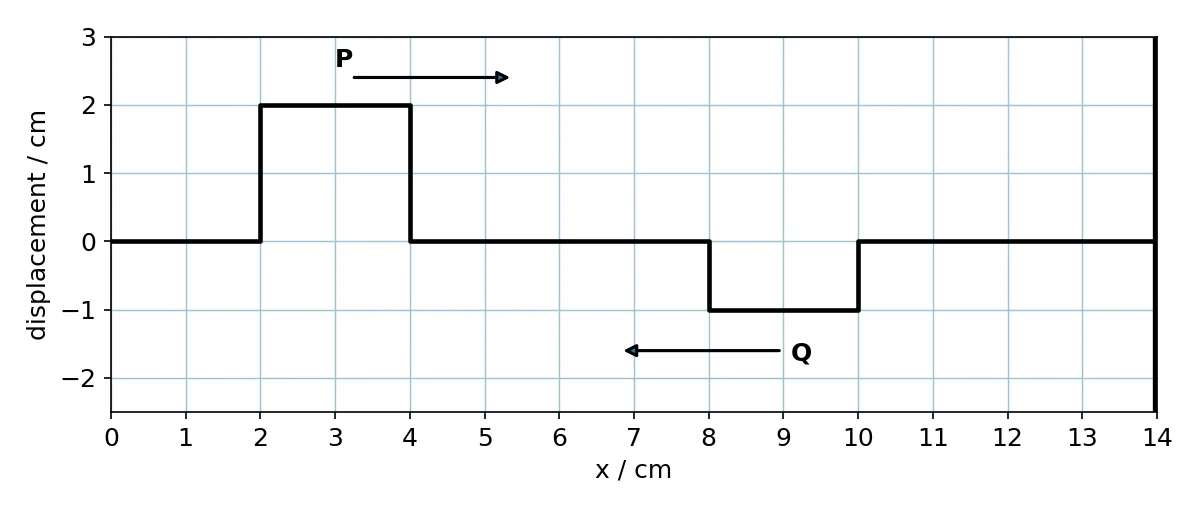
State the principle of superposition.
Determine the displacement of the rope at cm when s.
Determine the displacement at cm, cm and cm when s.
Describe pulse P after it has been reflected at the fixed end.
Calculate the time at which the front edge of P reaches the fixed end.
Determine the displacement at cm when s.
After the pulses have passed through each other, each has the same shape and speed as before. Explain why the overlap in (b) does not change the pulses.
revisionprep.com
Summary Answer
Not available for this question.
Model Answer
Not available for this question.
Marking Scheme
Not available for this question.
Examiner Insights
Not available for this question.
Diffraction, superposition and double-source interference
Two loudspeakers A and B, 1.2 m apart, emit sound of frequency 680 Hz in phase, as shown in Figure 1. A microphone starts at point O on the perpendicular bisector of AB, 3.0 m from the line joining the loudspeakers. The speed of sound is .
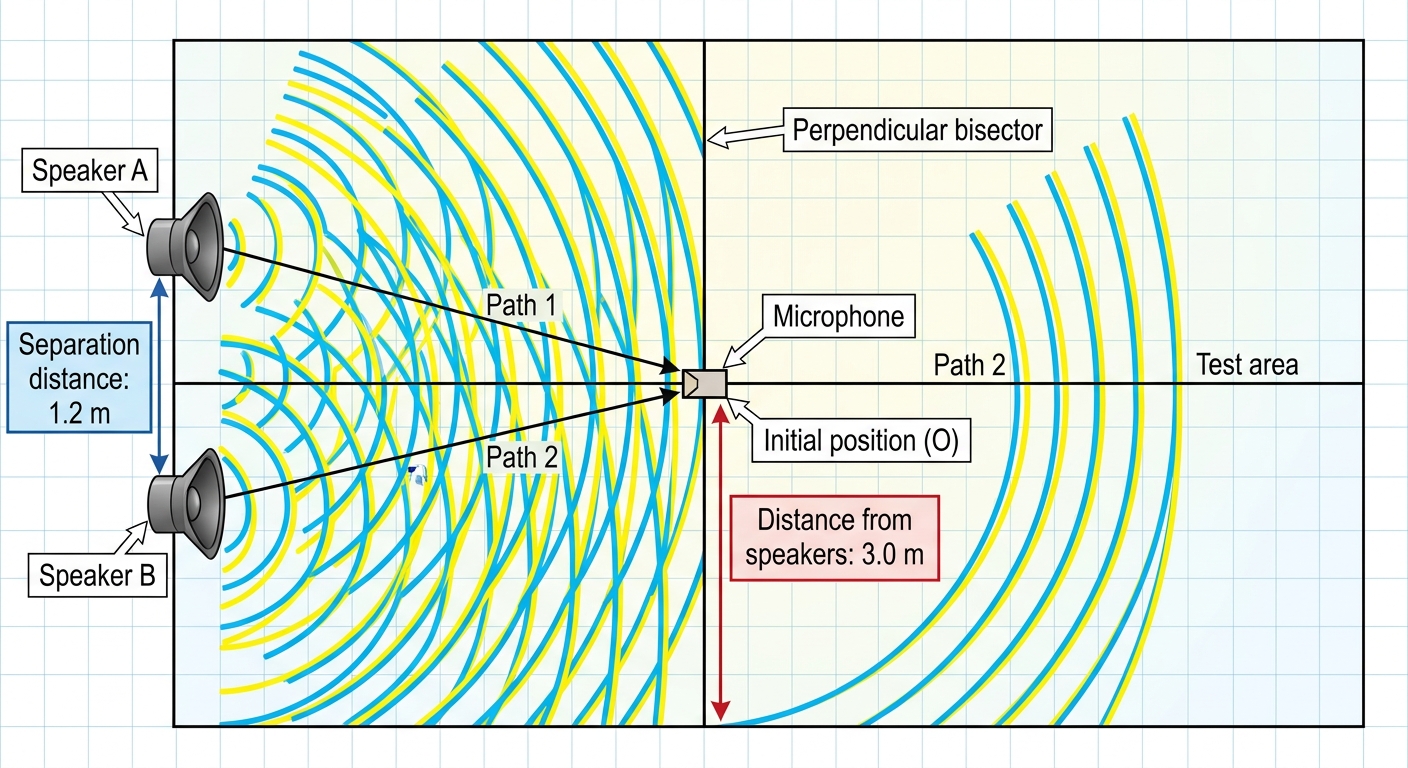
Determine the wavelength of the sound.
The microphone is moved 0.60 m from O, parallel to AB, so that it is level with loudspeaker B. Determine the path difference at this position.
Deduce whether the sound at this position is louder or quieter than at O.
Estimate the distance from O to the first quiet point, using the fringe-spacing relation .
The loudspeakers are reconnected so that they vibrate in antiphase. Explain why O is now a quiet point, and state the condition on path difference for a loud point.
A careful calculation shows that the first quiet point in (d) is actually 0.65 m from O. Evaluate the use of the fringe-spacing relation for this arrangement.
revisionprep.com
Summary Answer
Not available for this question.
Model Answer
Not available for this question.
Marking Scheme
Not available for this question.
Examiner Insights
Not available for this question.
Single-slit diffraction (θ = λ/b) and intensity patterns
A single slit of width 0.120 mm is illuminated at the same time by two lasers. Laser A emits light of wavelength 600 nm and laser B emits light of wavelength 400 nm. The beams are aligned so that both pass through the whole slit and fall on a screen 2.0 m from the slit.
Calculate the angle between the centre of the pattern and the first minimum for laser A.
Show that the second minimum for laser A and the third minimum for laser B are at the same angle.
Determine the distance from the centre of the pattern to the point in (b).
A student states that the screen is completely dark at the point in (b). Evaluate this statement.
revisionprep.com
Summary Answer
Not available for this question.
Model Answer
Not available for this question.
Marking Scheme
Not available for this question.
Examiner Insights
Not available for this question.
That's every free question here — 6 of 49.
+43 more questions, plus Mock Papers & Worksheets, are waiting in Premium.