You're viewing free preview questions — 6 questions previewing here — subscribe to unlock 46 more, plus the Full Question Bank, Mock Papers & Worksheets.Upgrade
Back

The Periodic Table Introductory — Free MYP1 Sciences Practice Questions

Free questions

Open in full, with answers, mark scheme and examiner insights.

Question 1Criterion A · Band 1-4 · Easy · 2 marksrevisionprep.com

Structure and Layout of the Periodic Table
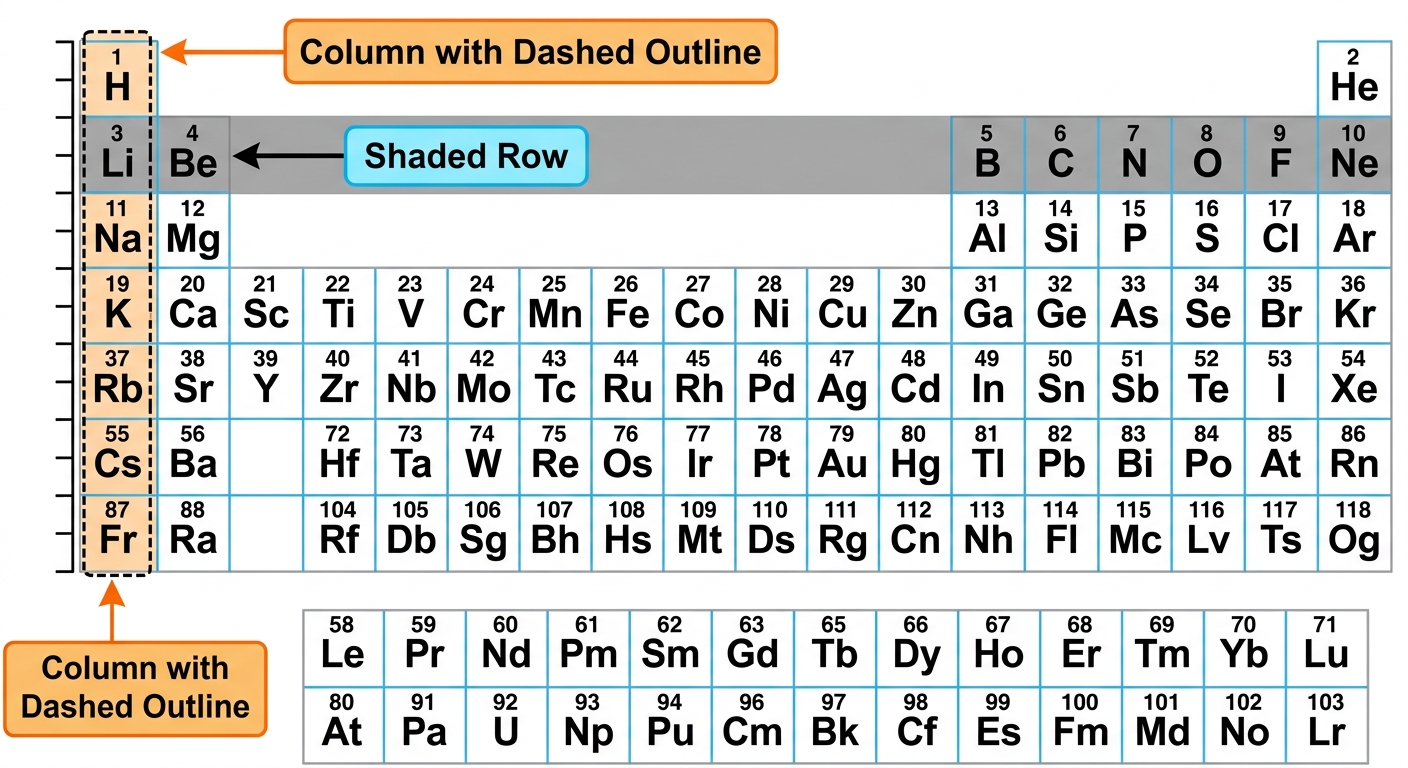
The diagram shows a periodic table. One row is shaded and one column has a dashed outline.
Question diagram
(a)
Name a horizontal row of the table. [1]Criterion A (i) · Level 1-2
(b)
Name a vertical column of the table. [1]Criterion A (i) · Level 3-4

revisionprep.com

Summary Answer

Not available for this question.

Model Answer

Not available for this question.

Marking Scheme

Not available for this question.

Examiner Insights

Not available for this question.

Question 2Criterion A · Band 1-4 · Easy · 2 marksrevisionprep.com

Groups and Periods Explained

The picture compares a medicine cabinet with the periodic table.

A pharmacy sorts medicines by type on each shelf, and by strength along each shelf.
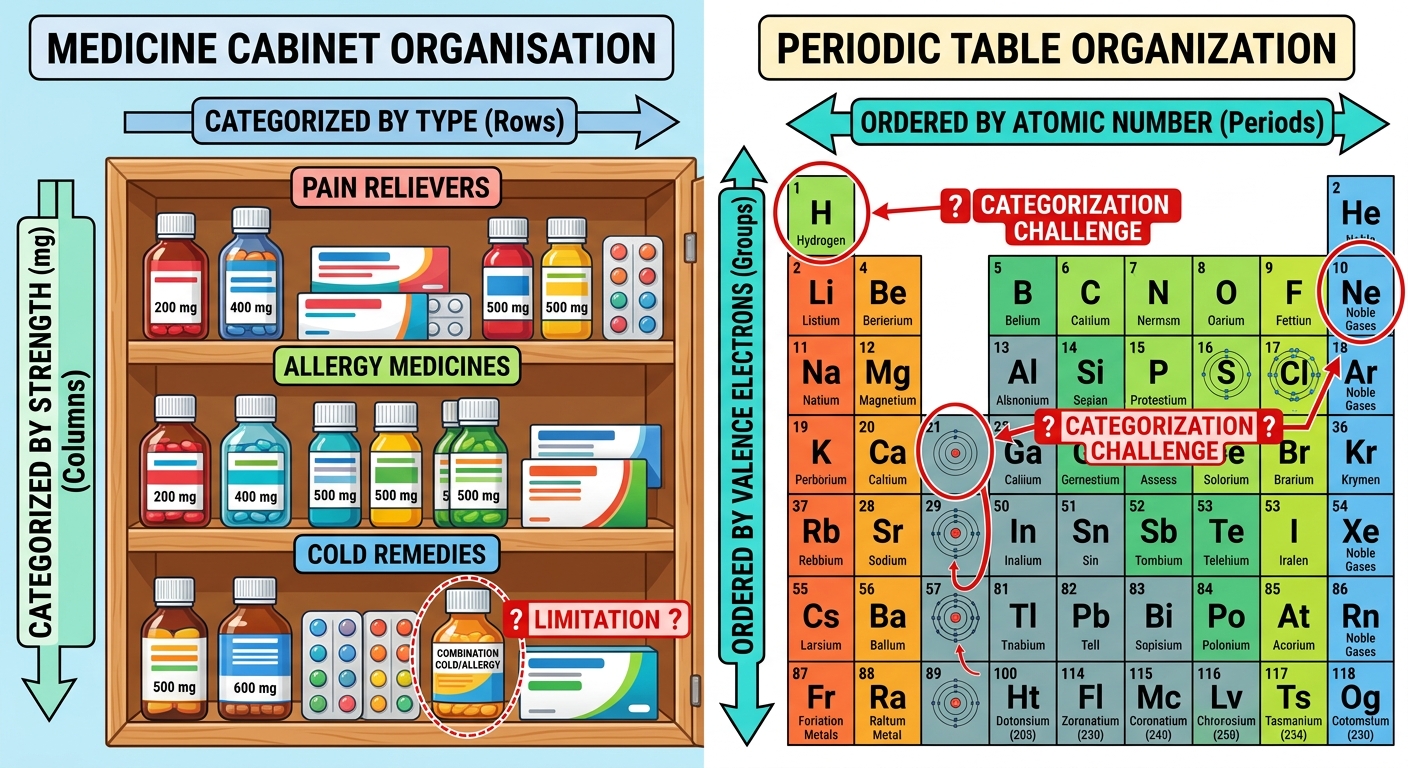
Question diagram
(a)
Identify which part matches the groups of the periodic table. [1]Criterion A (i) · Level 1-2
(b)
Explain why. [1]Criterion A (iii) · Level 3-4

revisionprep.com

Summary Answer

Not available for this question.

Model Answer

Not available for this question.

Marking Scheme

Not available for this question.

Examiner Insights

Not available for this question.

Question 3Criterion B · Band 1-6 · Medium · 6 marksrevisionprep.com

Metals Non-Metals and Metalloids

Mia has five unlabelled solid elements. She wants to sort them into metals and non-metals. She has a battery, wires, a bulb, a small hammer, safety goggles and sandpaper.
(a)
Write a prediction for how a metal will behave in each test. [1]Criterion B (i) · Level 1-2
(b)
Describe how she would test whether each sample conducts electricity. [1]Criterion B (iii) · Level 3-4
(c)
Explain why she rubs each sample with sandpaper first. [1]Criterion B (iii) · Level 3-4
(d)
Describe a results table she could use. [1]

(e) Explain why using three tests is better than using one. [2]
Criterion B (iii) · Level 3-4

revisionprep.com

Summary Answer

Not available for this question.

Model Answer

Not available for this question.

Marking Scheme

Not available for this question.

Examiner Insights

Not available for this question.

Question 4Criterion C · Band 1-6 · Medium · 6 marksrevisionprep.com

Trends in Group 1 and Group 7 Elements

Group 7 elements are called the halogens.
Fluorine: pale yellow gas, boils at −188 °C
Chlorine: green gas, boils at −34 °C
Bromine: red-brown liquid, boils at 59 °C
Iodine: grey-black solid, boils at 184 °C
(a)
Describe the trend in boiling point down Group 7. [1]Criterion C (iii) · Level 1-2
(b)
Describe the trend in colour down the group. [1]Criterion C (iii) · Level 3-4
(c)
Plot a bar chart of the boiling points with labelled axes. [2]Criterion C (ii) · Level 3-4
(d)
Predict the state of astatine, the next element, at room temperature. [1]

(e) Compare this trend with the melting point trend in Group 1. [1]
Criterion C (iii) · Level 5-6

revisionprep.com

Summary Answer

Not available for this question.

Model Answer

Not available for this question.

Marking Scheme

Not available for this question.

Examiner Insights

Not available for this question.

Question 5Criterion B · Band 1-6 · Medium · 6 marksrevisionprep.com

Using the Periodic Table for Prediction

Ben wants to find out if Group 2 metals also get more reactive going down the group. His teacher gives him magnesium and calcium, which are safe to use in small pieces. He puts each in cold water and collects the gas for 2 minutes.
Magnesium: 1 cm³ of gas
Calcium: 40 cm³ of gas
(a)
Write a hypothesis. [1]Criterion B (i) · Level 1-2
(b)
Identify the independent and the dependent variable. [2]Criterion B (i) · Level 3-4
(c)
State two things he must keep the same. [1]Criterion B (iii) · Level 3-4
(d)
Describe what the results show. [1]

(e) Predict how strontium, below calcium, would react, and explain. [1]
Criterion B (ii) · Level 3-4

revisionprep.com

Summary Answer

Not available for this question.

Model Answer

Not available for this question.

Marking Scheme

Not available for this question.

Examiner Insights

Not available for this question.

Question 6Criterion C · Band 1-8 · Challenge · 7 marksrevisionprep.com

Structure and Layout of the Periodic Table

The noble gases are in the last group (Group 0, also called 18). Boiling points:
Helium: −269 °C
Neon: −246 °C
Argon: −186 °C
Krypton: −153 °C
(a)
Describe the trend in boiling point down the group. [1]Criterion C (iii) · Level 1-2
(b)
Draw a bar chart of the four boiling points with labelled axes. [2]Criterion C (ii) · Level 3-4
(c)
Predict the boiling point of xenon, the next element down. [1]Criterion C (iii) · Level 3-4
(d)
State the state of all these elements at room temperature. [1]

(e) Explain why helium is used in party balloons instead of hydrogen, and use the data to predict whether xenon, below krypton, has a higher or lower boiling point. [2]
Criterion C (iii) · Level 3-4

revisionprep.com

Summary Answer

Not available for this question.

Model Answer

Not available for this question.

Marking Scheme

Not available for this question.

Examiner Insights

Not available for this question.

That's every free question here — 6 of 52.

+46 more questions, plus Mock Papers & Worksheets, are waiting in Premium.

Upgrade