You're viewing free preview questions — 6 questions previewing here — subscribe to unlock 49 more, plus the Full Question Bank, Mock Papers & Worksheets.Upgrade
Back

Energy Transformations — Free MYP1 Sciences Practice Questions

Free questions

Open in full, with answers, mark scheme and examiner insights.

Question 1Criterion D · Band 1-4 · Easy · 4 marksrevisionprep.com

Energy Conversion from One Form to Another

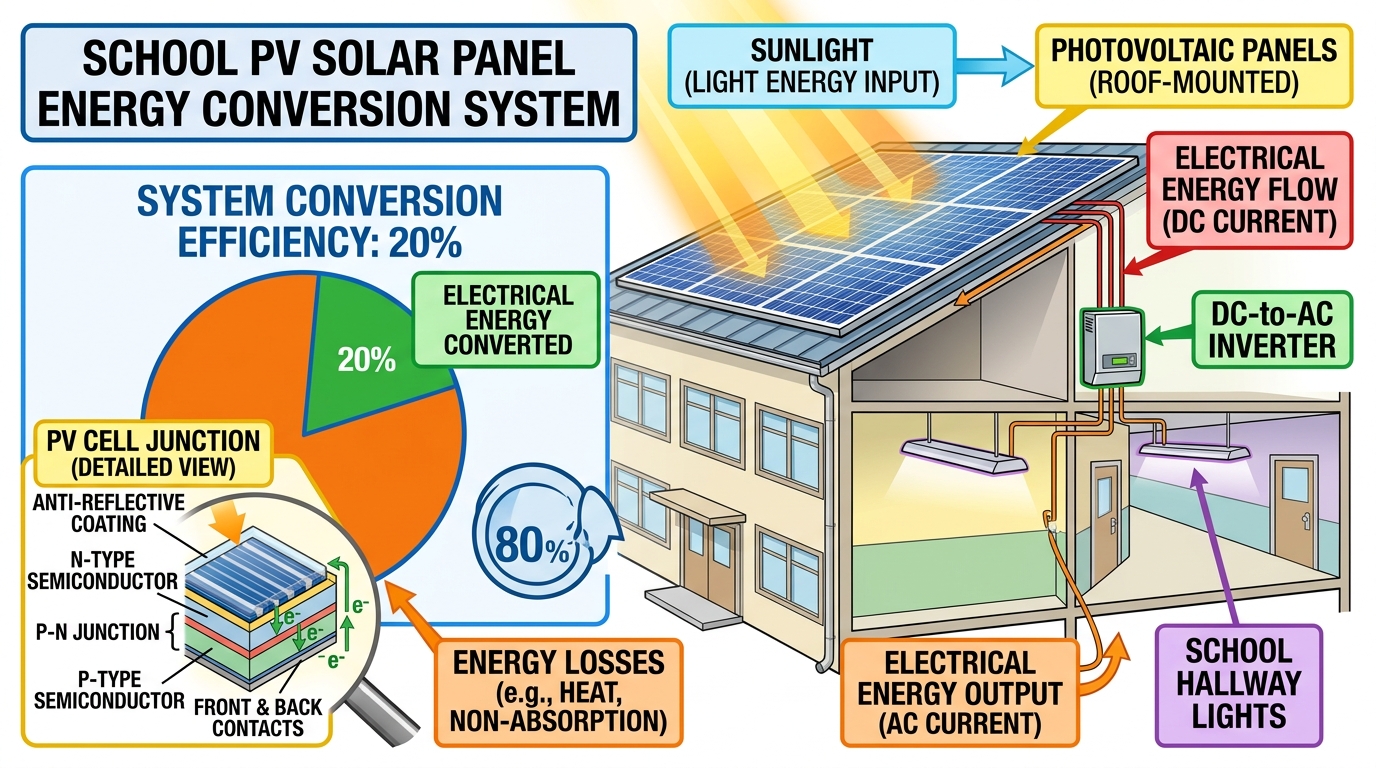
The picture shows the school's solar panel system.

A school puts solar panels on its roof to power the hallway lights. 20% of the light energy reaching the panels becomes electrical energy.
Question diagram
(a)
The picture shows that 80% of the light energy is not converted. State what happens to it. [1]Criterion D (i) · Level 1-2
(b)
Describe one benefit of the panels for the school. [1]Criterion D (i) · Level 1-2
(c)
Discuss one limitation, referring to the 20% figure. [2]Criterion D (ii) · Level 3-4

revisionprep.com

Summary Answer

Not available for this question.

Model Answer

Not available for this question.

Marking Scheme

Not available for this question.

Examiner Insights

Not available for this question.

Question 2Criterion A · Band 1-4 · Easy · 2 marksrevisionprep.com

Energy Changes in Everyday Devices

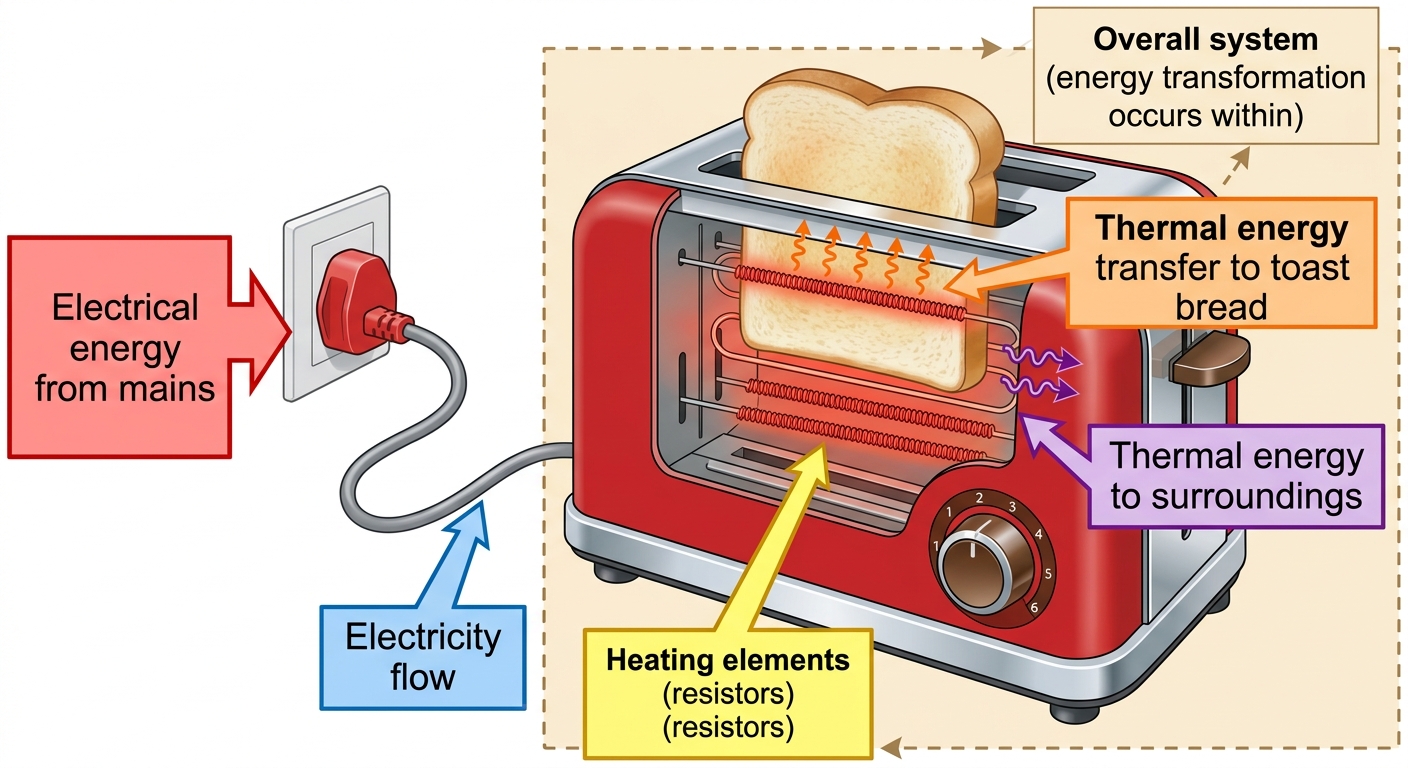
The picture shows a toaster plugged into the mains, toasting bread.
Question diagram
(a)
Name the useful energy output of the toaster, and say where it goes. [1]Criterion A (i) · Level 1-2
(b)
The picture shows thermal energy escaping to the surroundings. Suggest one design change that would waste less energy. [1]Criterion A (ii) · Level 3-4

revisionprep.com

Summary Answer

Not available for this question.

Model Answer

Not available for this question.

Marking Scheme

Not available for this question.

Examiner Insights

Not available for this question.

Question 3Criterion A · Band 1-4 · Medium · 5 marksrevisionprep.com

Energy Conversion from One Form to Another

A torch is on for ten minutes. An electric fan runs for ten minutes. A solar calculator has its panel covered by a hand.
(a)
Name one effect, other than light, the torch produces. [1]Criterion A (ii) · Level 1-2
(b)
Describe two effects, other than moving air, the fan produces. [2]Criterion A (ii) · Level 3-4
(c)
Explain why the calculator stops working when its panel is covered. [2]Criterion A (ii) · Level 3-4

revisionprep.com

Summary Answer

Not available for this question.

Model Answer

Not available for this question.

Marking Scheme

Not available for this question.

Examiner Insights

Not available for this question.

Question 4Criterion B · Band 3-6 · Medium · 8 marksrevisionprep.com

Useful vs Wasted Energy

Amara wants to find out which type of light bulb wastes the most energy as heat. She has a filament bulb, a halogen bulb and an LED bulb, all with the same brightness. She also has a thermometer, a light meter and a stopwatch.
(a)
State a question Amara could investigate. [1]Criterion B (i) · Level 3-4
(b)
Predict which bulb will waste the most energy as heat. Give a reason. [2]Criterion B (ii) · Level 3-4
(c)
Outline how she should carry out a fair test. [3]Criterion B (iii) · Level 5-6
(d)
Explain why she uses the light meter. [1]

(e) Identify one safety rule for this test. [1]
Criterion B (iii) · Level 5-6

revisionprep.com

Summary Answer

Not available for this question.

Model Answer

Not available for this question.

Marking Scheme

Not available for this question.

Examiner Insights

Not available for this question.

Question 5Criterion C · Band 3-6 · Medium · 6 marksrevisionprep.com

Energy Flow Diagrams and Sankey Diagrams Introductory

A desk fan takes in 200 J of electrical energy. It gives out 150 J of kinetic energy, 40 J of heat and 10 J of sound.
A student draws a Sankey diagram where 1 small square on the grid stands for 10 J.
(a)
Calculate how many squares wide each arrow should be. [2]Criterion C (iii) · Level 3-4
(b)
Draw the Sankey diagram to scale, with labels and values. [3]Criterion C (ii) · Level 5-6
(c)
Another student says the diagram must be wrong because the wasted arrows look tiny. Explain why the diagram is still correct. [1]Criterion C (iv) · Level 5-6

revisionprep.com

Summary Answer

Not available for this question.

Model Answer

Not available for this question.

Marking Scheme

Not available for this question.

Examiner Insights

Not available for this question.

Question 6Criterion C · Band 1-8 · Challenge · 8 marksrevisionprep.com

Examples Light Bulb Toaster Car Engine
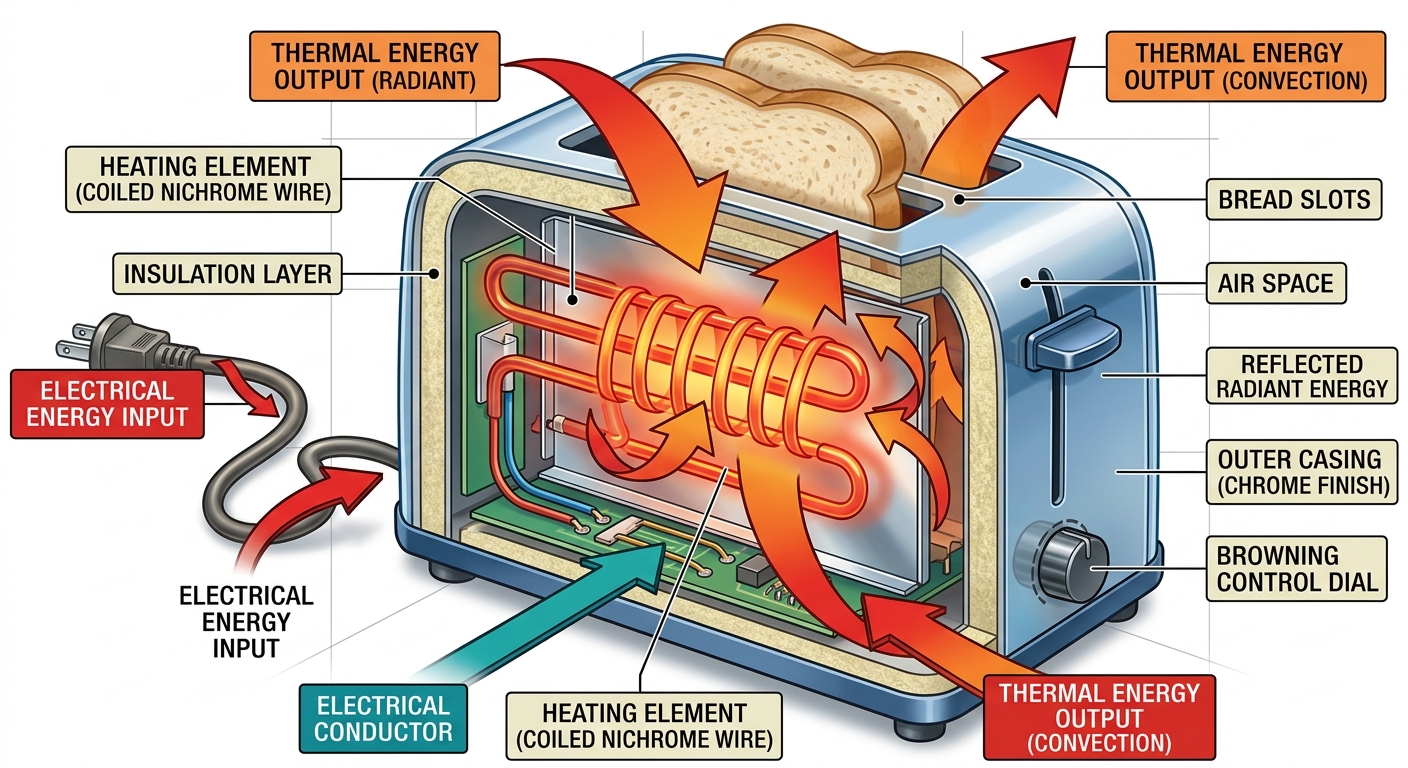
The picture shows a toaster. It takes in 1000 J of electrical energy. 700 J heats the bread, and 300 J heats the air and the outer casing.
Question diagram
(a)
Write the energy change that happens in the heating element. [1]Criterion C (ii) · Level 1-2
(b)
Identify the useful output and the wasted output, with their values. [2]Criterion C (ii) · Level 3-4
(c)
Draw a labelled Sankey diagram for the toaster. [2]Criterion C (i) · Level 3-4
(d)
The picture shows an insulation layer. Explain how a thicker layer would change your Sankey diagram, and discuss whether the toaster could ever give 1000 J of useful energy. [3]Criterion C (ii) · Level 7-8

revisionprep.com

Summary Answer

Not available for this question.

Model Answer

Not available for this question.

Marking Scheme

Not available for this question.

Examiner Insights

Not available for this question.

That's every free question here — 6 of 55.

+49 more questions, plus Mock Papers & Worksheets, are waiting in Premium.

Upgrade