You're viewing free preview questions — 6 questions previewing here — subscribe to unlock 59 more, plus the Full Question Bank, Mock Papers & Worksheets.Upgrade
Back

Atomic Structure Introductory — Free MYP1 Sciences Practice Questions

Free questions

Open in full, with answers, mark scheme and examiner insights.

Question 1Criterion A · Band 1-2 · Easy · 2 marksrevisionprep.com

Atoms and Their Subatomic Particles

Atoms are made of three types of tiny particle.
(a)
Name the three particles. [1]Criterion A (i) · Level 1-2
(b)
State the charge of each particle. [1]Criterion A (i) · Level 1-2

revisionprep.com

Summary Answer

Not available for this question.

Model Answer

Not available for this question.

Marking Scheme

Not available for this question.

Examiner Insights

Not available for this question.

Question 2Criterion A · Band 1-2 · Easy · 2 marksrevisionprep.com

Atomic Number and Mass Number Basic

Every element has its own atomic number.
(a)
State what the atomic number tells you. [1]Criterion A (i) · Level 1-2
(b)
Describe how atomic number is used to order the periodic table. [1]Criterion A (i) · Level 1-2

revisionprep.com

Summary Answer

Not available for this question.

Model Answer

Not available for this question.

Marking Scheme

Not available for this question.

Examiner Insights

Not available for this question.

Question 3Criterion B · Band 3-6 · Medium · 7 marksrevisionprep.com

Structure of a Simple Atom

Scientists cannot see inside atoms, so they fire tiny particles at them and watch where the particles go. Your class can try the same idea: a hidden shape is taped under a large board. You roll marbles under the board and see where they come out.
Research question: can we work out the shape of a hidden object from how marbles bounce off it?
(a)
Outline how this activity is like Rutherford's gold foil experiment. [2]Criterion B (i) · Level 3-4
(b)
Write a prediction for what will happen if the hidden shape is small and in the middle. [1]Criterion B (ii) · Level 3-4
(c)
State two things to keep the same each time you roll a marble. [2]Criterion B (iii) · Level 3-4
(d)
Describe how to collect enough data to find the shape. [2]Criterion B (iii) · Level 5-6

revisionprep.com

Summary Answer

Not available for this question.

Model Answer

Not available for this question.

Marking Scheme

Not available for this question.

Examiner Insights

Not available for this question.

Question 4Criterion D · Band 1-6 · Medium · 4 marksrevisionprep.com

Introduction to the Concept of Ions

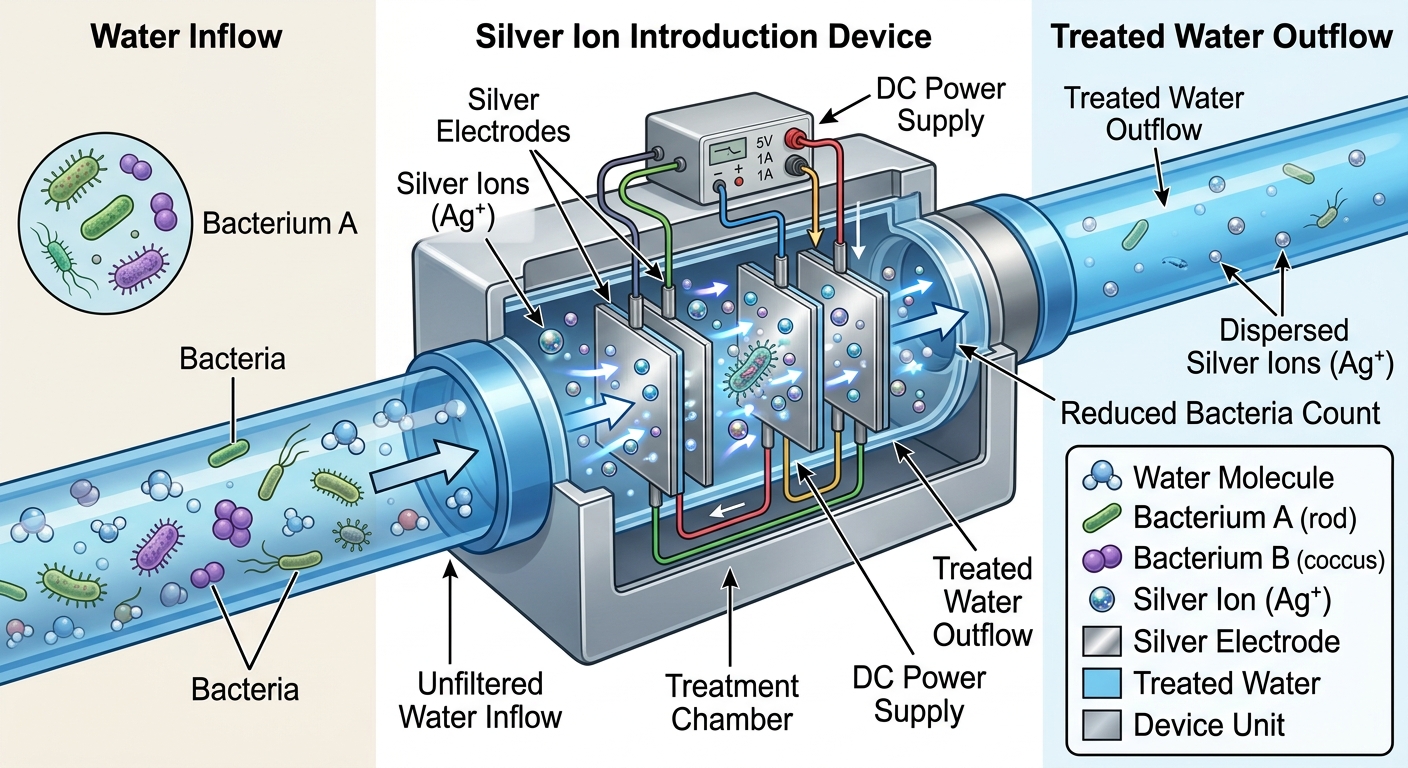
The picture shows a device that adds silver ions to a town's water. Silver ions can kill harmful bacteria. The device is expensive and may change the taste of the water.
Question diagram
(a)
Identify one benefit of the device. [1]Criterion D (i) · Level 1-2
(b)
Silver ions have a charge of 1+. Explain how a silver atom became a silver ion. [1]Criterion D (i) · Level 3-4
(c)
Discuss whether the town should use the device, giving one economic and one social point. [2]Criterion D (ii) · Level 5-6

revisionprep.com

Summary Answer

Not available for this question.

Model Answer

Not available for this question.

Marking Scheme

Not available for this question.

Examiner Insights

Not available for this question.

Question 5Criterion A · Band 3-6 · Medium · 2 marksrevisionprep.com

Historical Models of the Atom Simplified

Thomson's model: positive charge spread thinly through the atom. Rutherford fired positive particles at gold foil.
(a)
Predict what Thomson's model says should happen to the particles. [1]Criterion A (iii) · Level 3-4
(b)
Explain why a few particles bouncing back proved Thomson's model wrong. [1]Criterion A (iii) · Level 5-6

revisionprep.com

Summary Answer

Not available for this question.

Model Answer

Not available for this question.

Marking Scheme

Not available for this question.

Examiner Insights

Not available for this question.

Question 6Criterion C · Band 1-8 · Challenge · 8 marksrevisionprep.com

Atoms and Their Subatomic Particles

A class counted the particles in some atoms and ions.
Lithium atom3 protons3 electrons
Lithium ion3 protons2 electrons
Oxygen atom8 protons8 electrons
Oxide ion8 protons10 electrons
Magnesium ion12 protons10 electrons

Kim says: 'A particle is positive when it has more electrons than protons.'
(a)
Calculate the overall charge of each particle. [2]Criterion C (i) · Level 1-2
(b)
Present the charges in a table with the headings: particle, protons, electrons, charge. [1]Criterion C (i) · Level 1-2
(c)
Describe the pattern linking the numbers of protons and electrons with the sign of the charge. [2]Criterion C (ii) · Level 3-4
(d)
Evaluate Kim's statement using the data. Then use the correct rule to predict the charge of a particle with 11 protons and 10 electrons, with a reason. [3]Criterion C (iii) · Level 7-8

revisionprep.com

Summary Answer

Not available for this question.

Model Answer

Not available for this question.

Marking Scheme

Not available for this question.

Examiner Insights

Not available for this question.

That's every free question here — 6 of 65.

+59 more questions, plus Mock Papers & Worksheets, are waiting in Premium.

Upgrade