Physical and Chemical Changes — Free MYP1 Sciences Practice Questions
Free questions
Open in full, with answers, mark scheme and examiner insights.
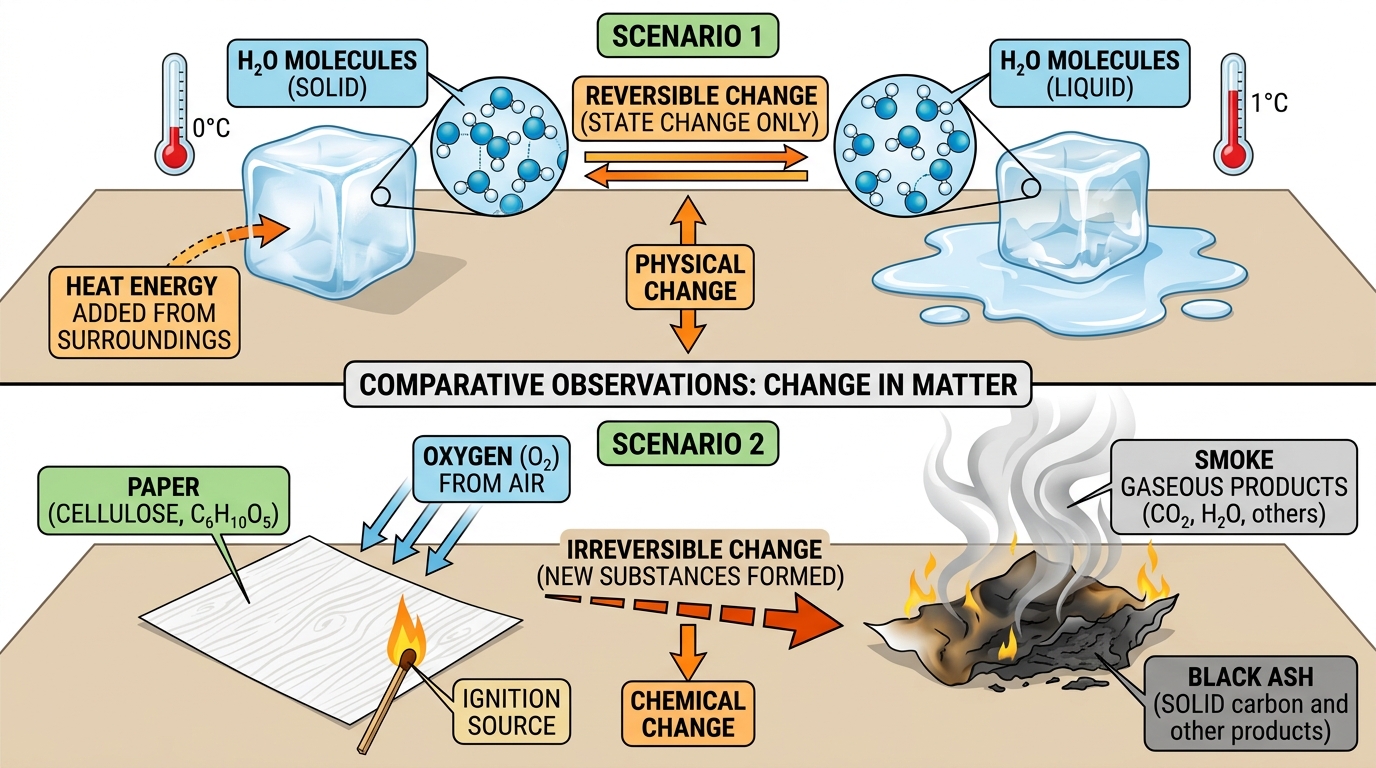
Definition and Comparison of Physical and Chemical Changes
Scenario 1: an ice cube melts into a puddle.
Scenario 2: a piece of paper burns, leaving ash and smoke.
revisionprep.com
Summary Answer
Not available for this question.
Model Answer
Not available for this question.
Marking Scheme
Not available for this question.
Examiner Insights
Not available for this question.
Investigating Changes in the Lab
revisionprep.com
Summary Answer
Not available for this question.
Model Answer
Not available for this question.
Marking Scheme
Not available for this question.
Examiner Insights
Not available for this question.
Definition and Comparison of Physical and Chemical Changes
| Time (min) | 0 | 10 | 20 | 30 |
|---|---|---|---|---|
| Mass (g) | 20.0 | 18.5 | 17.0 | 15.5 |
(e) A student says melting wax causes the mass loss. Explain why this is wrong. [1]Criterion C (iv) · Level 3-4
revisionprep.com
Summary Answer
Not available for this question.
Model Answer
Not available for this question.
Marking Scheme
Not available for this question.
Examiner Insights
Not available for this question.
Examples of Reversible and Irreversible Changes
| Time (min) | 0 | 1 | 2 | 3 | 4 | 5 | 6 | 7 |
|---|---|---|---|---|---|---|---|---|
| Temperature (°C) | 80 | 70 | 62 | 55 | 55 | 55 | 48 | 40 |
(e) Predict what the graph would look like if the solid wax were heated again, and explain. [1]Criterion C (iv) · Level 3-4
revisionprep.com
Summary Answer
Not available for this question.
Model Answer
Not available for this question.
Marking Scheme
Not available for this question.
Examiner Insights
Not available for this question.
Mixtures and Changes in States
| Temperature (°C) | 20 | 40 | 60 |
|---|---|---|---|
| Time to dissolve (s) | 120 | 60 | 25 |
(e) Predict the time at 80 °C and explain why hot water dissolves sugar faster. [2]Criterion B (ii) · Level 3-4
revisionprep.com
Summary Answer
Not available for this question.
Model Answer
Not available for this question.
Marking Scheme
Not available for this question.
Examiner Insights
Not available for this question.
Signs of a Chemical Change
| Spoons of baking soda | 1 | 2 | 3 | 4 |
|---|---|---|---|---|
| Balloon width (cm) | 20 | 30 | 38 | 38 |
(e) Explain why 4 spoons gave no bigger balloon than 3, and suggest how Ravi could change his method to make a bigger balloon with 4 spoons. [3]Criterion B (ii) · Level 3-4
revisionprep.com
Summary Answer
Not available for this question.
Model Answer
Not available for this question.
Marking Scheme
Not available for this question.
Examiner Insights
Not available for this question.
That's every free question here — 6 of 70.
+64 more questions, plus Mock Papers & Worksheets, are waiting in Premium.