You're viewing free preview questions — 6 questions previewing here — subscribe to unlock 82 more, plus the Full Question Bank, Mock Papers & Worksheets.Upgrade
Back

States of Matter and Particle Theory — Free MYP1 Sciences Practice Questions

Free questions

Open in full, with answers, mark scheme and examiner insights.

Question 1Criterion D · Band 1-4 · Easy · 2 marksrevisionprep.com

Classification of Materials like Natural or Artificial and theri usage

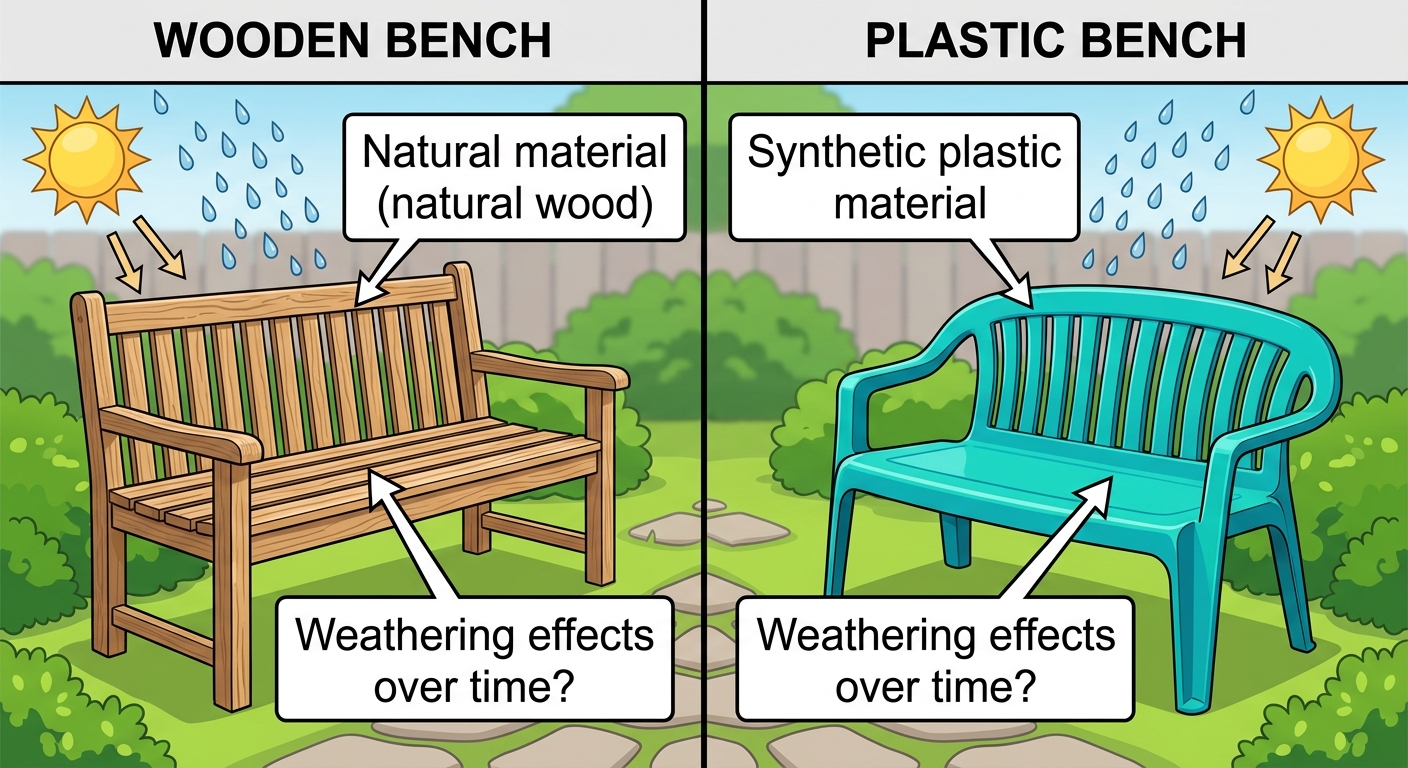
The picture shows the two benches.

A family must choose between a wooden bench and a plastic bench for the garden.
Question diagram
(a)
The picture labels the wooden bench natural and the plastic bench synthetic. State what 'synthetic' means. [1]Criterion D (i) · Level 1-2
(b)
Describe one problem with the wooden bench outdoors. [1]Criterion D (ii) · Level 3-4

revisionprep.com

Summary Answer

Not available for this question.

Model Answer

Not available for this question.

Marking Scheme

Not available for this question.

Examiner Insights

Not available for this question.

Question 2Criterion A · Band 1-4 · Easy · 2 marksrevisionprep.com

Sublimation and Deposition

Dry ice is solid carbon dioxide. It turns straight into a gas when it warms.
(a)
Name this change of state. [1]Criterion A (i) · Level 1-2
(b)
Describe how it is different from melting. [1]Criterion A (ii) · Level 3-4

revisionprep.com

Summary Answer

Not available for this question.

Model Answer

Not available for this question.

Marking Scheme

Not available for this question.

Examiner Insights

Not available for this question.

Question 3Criterion C · Band 1-6 · Medium · 6 marksrevisionprep.com

Particle Model of Matter

Leo drops one drop of food colouring into still water at different temperatures and times how long it takes to spread evenly.
10 °C: 300 s
30 °C: 150 s
50 °C: 75 s
70 °C: 40 s
(a)
Name the process of particles spreading out. [1]Criterion C (iii) · Level 1-2
(b)
Plot a line graph of the data with labelled axes. [2]Criterion C (ii) · Level 3-4
(c)
Describe the pattern. [1]Criterion C (iii) · Level 3-4
(d)
Explain the pattern using the particle model. [1]

(e) Predict the time at 90 °C. [1]
Criterion C (iv) · Level 5-6

revisionprep.com

Summary Answer

Not available for this question.

Model Answer

Not available for this question.

Marking Scheme

Not available for this question.

Examiner Insights

Not available for this question.

Question 4Criterion B · Band 1-6 · Medium · 6 marksrevisionprep.com

Changes of State Melting Boiling Condensation Freezing

Noor wants to find the best wrapping to stop an ice cube melting in her lunchbox. She has identical ice cubes, foil, cotton wool, a woollen sock, a plastic bag and a timer.
(a)
Write a hypothesis. [1]Criterion B (i) · Level 1-2
(b)
Identify the independent and the dependent variable. [2]Criterion B (i) · Level 3-4
(c)
State two things she must keep the same. [1]Criterion B (iii) · Level 3-4
(d)
Explain why she should also leave one ice cube unwrapped. [1]

(e) Explain, using energy, why a good wrapping slows melting. [1]
Criterion B (iii) · Level 3-4

revisionprep.com

Summary Answer

Not available for this question.

Model Answer

Not available for this question.

Marking Scheme

Not available for this question.

Examiner Insights

Not available for this question.

Question 5Criterion C · Band 1-6 · Medium · 6 marksrevisionprep.com

Energy and Particle Movement in State Changes

Liquid wax is left to cool. Temperature every minute:
0 min: 80 °C
1 min: 70 °C
2 min: 62 °C
3 min: 55 °C
4 min: 55 °C
5 min: 55 °C
6 min: 48 °C
7 min: 40 °C
(a)
Plot a cooling curve with labelled axes. [2]Criterion C (ii) · Level 1-2
(b)
Identify the freezing point of the wax. [1]Criterion C (iii) · Level 3-4
(c)
Name the change of state during the flat part. [1]Criterion C (iii) · Level 3-4
(d)
Explain why the temperature stays the same while the wax freezes. [1]

(e) Describe how the particles' movement changes from 0 to 7 minutes. [1]
Criterion C (iv) · Level 5-6

revisionprep.com

Summary Answer

Not available for this question.

Model Answer

Not available for this question.

Marking Scheme

Not available for this question.

Examiner Insights

Not available for this question.

Question 6Criterion B · Band 1-8 · Challenge · 7 marksrevisionprep.com

Solids Liquids and Gases Basic Properties

Aria wants to show which state of matter can be squashed. She has three sealed plastic syringes: one full of air, one of water and one of sand. She pushes each plunger as hard as she can and reads the volume.
Start: all 20 mL
Air: 8 mL
Water: 20 mL
Sand: 19 mL
(a)
Write a hypothesis. [1]Criterion B (i) · Level 1-2
(b)
Identify the independent and the dependent variable. [2]Criterion B (i) · Level 3-4
(c)
State one thing she kept the same. [1]Criterion B (iii) · Level 3-4
(d)
Calculate how much the air was squashed by. [1]

(e) Explain why the sand squashed a little even though it is a solid, and predict what would happen with a syringe of solid wax, with a reason. [2]
Criterion B (ii) · Level 3-4

revisionprep.com

Summary Answer

Not available for this question.

Model Answer

Not available for this question.

Marking Scheme

Not available for this question.

Examiner Insights

Not available for this question.

That's every free question here — 6 of 88.

+82 more questions, plus Mock Papers & Worksheets, are waiting in Premium.

Upgrade