You're viewing free preview questions — 6 questions previewing here — subscribe to unlock 41 more, plus the Full Question Bank, Mock Papers & Worksheets.Upgrade
Back

Color and the Electromagnetic Spectrum — Free MYP1 Sciences Practice Questions

Free questions

Open in full, with answers, mark scheme and examiner insights.

Question 1Criterion A · Band 1-2 · Easy · 2 marksrevisionprep.com

White Light and the Visible Spectrum

White light can be split into the colours of the visible spectrum.
(a)
List the seven colours in order, starting from red. [1]Criterion A (i) · Level 1-2
(b)
Outline what 'white light' is made of. [1]Criterion A (i) · Level 1-2

revisionprep.com

Summary Answer

Not available for this question.

Model Answer

Not available for this question.

Marking Scheme

Not available for this question.

Examiner Insights

Not available for this question.

Question 2Criterion D · Band 1-4 · Easy · 2 marksrevisionprep.com

Overview of the Electromagnetic Spectrum
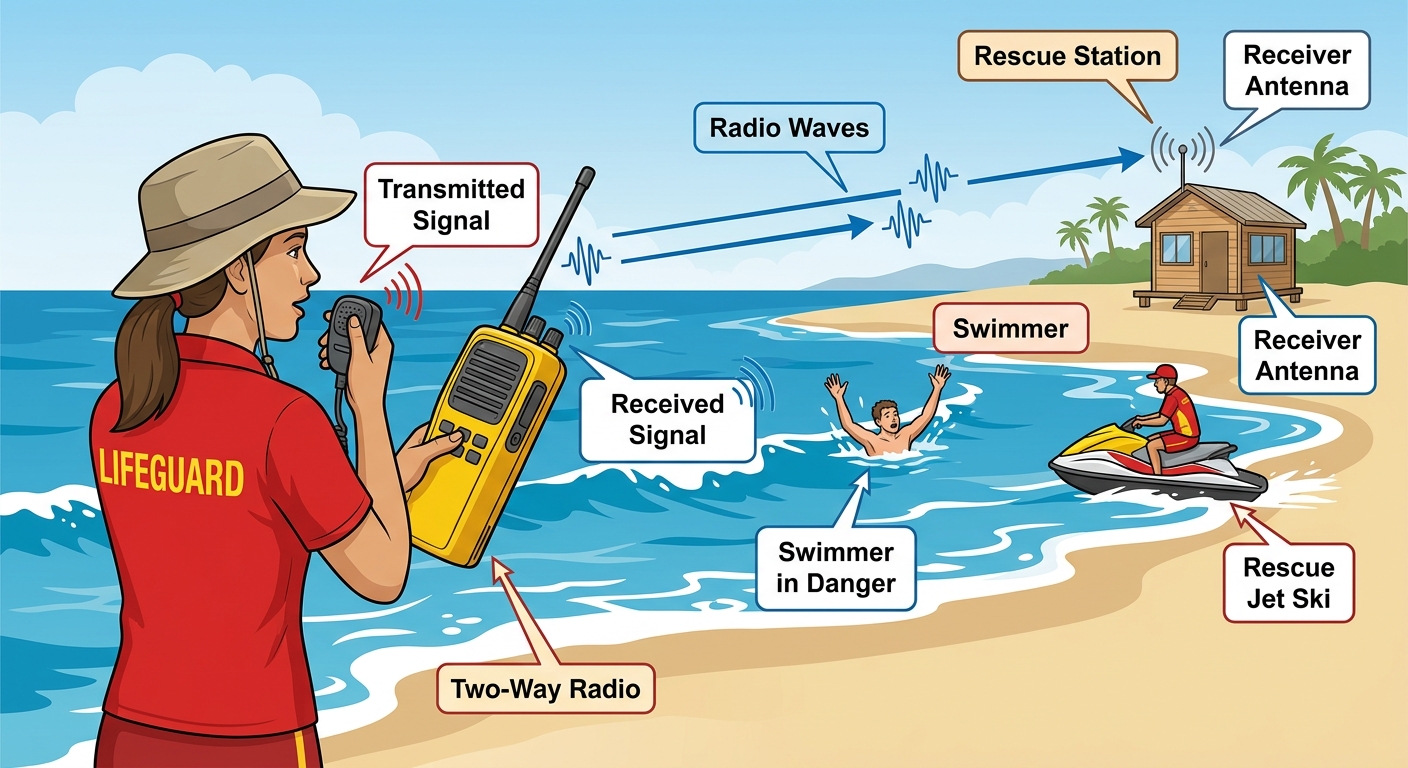
The picture shows a lifeguard using a two-way radio to call a rescue station.
Question diagram
(a)
Describe one advantage of radio waves for the lifeguard. [1]Criterion D (i) · Level 1-2
(b)
Suggest one reason the signal might be weak on some parts of the beach. [1]Criterion D (i) · Level 3-4

revisionprep.com

Summary Answer

Not available for this question.

Model Answer

Not available for this question.

Marking Scheme

Not available for this question.

Examiner Insights

Not available for this question.

Question 3Criterion A · Band 1-6 · Medium · 5 marksrevisionprep.com

White Light and the Visible Spectrum

A student shines red, green and blue light onto four objects.
Red apple: red under red light; black under green; black under blue.
Green leaf: black under red; green under green; black under blue.
Yellow banana: red under red; green under green; black under blue.
(a)
Identify the colour of light the red apple reflects. [1]Criterion A (iii) · Level 1-2
(b)
Explain why the apple looks black under green light. [2]Criterion A (ii) · Level 3-4
(c)
Use the results to explain which colours the yellow banana reflects. [2]Criterion A (iii) · Level 5-6

revisionprep.com

Summary Answer

Not available for this question.

Model Answer

Not available for this question.

Marking Scheme

Not available for this question.

Examiner Insights

Not available for this question.

Question 4Criterion B · Band 1-6 · Medium · 8 marksrevisionprep.com

Dispersion of Light Through a Prism

Kenji wonders whether water spreads white light into a wider rainbow than glass does. He has a glass prism, a hollow plastic prism he can fill with water, a ray box (a lamp that makes a narrow beam) and a white screen.
(a)
Write a research question for his investigation. [1]Criterion B (i) · Level 1-2
(b)
Write a prediction and give a scientific reason. [2]Criterion B (ii) · Level 3-4
(c)
Identify the independent and dependent variables, and two control variables. [2]Criterion B (iii) · Level 3-4
(d)
Describe how he should measure and record the results so they are reliable. [2]

(e) State one safety point. [1]
Criterion B (iii) · Level 5-6

revisionprep.com

Summary Answer

Not available for this question.

Model Answer

Not available for this question.

Marking Scheme

Not available for this question.

Examiner Insights

Not available for this question.

Question 5Criterion A · Band 1-6 · Medium · 4 marksrevisionprep.com

Primary and Secondary Colors of Light

Red and green LIGHT mixed together look yellow. Red and green PAINT mixed together look a muddy brown.
(a)
State the primary colours of light. [1]Criterion A (i) · Level 1-2
(b)
Explain why mixing lights gives a brighter colour. [1]Criterion A (ii) · Level 3-4
(c)
Explain why mixing paints gives a darker colour. [2]Criterion A (ii) · Level 5-6

revisionprep.com

Summary Answer

Not available for this question.

Model Answer

Not available for this question.

Marking Scheme

Not available for this question.

Examiner Insights

Not available for this question.

Question 6Criterion C · Band 1-8 · Challenge · 9 marksrevisionprep.com

Dispersion of Light Through a Prism

A class measured how much each colour is bent by a prism, three times each.
Red38°38°39°
Green41°40°41°
Blue43°44°44°

Ben says: 'Only red light bends, because red is the brightest colour.'
(a)
Calculate the mean bending angle for each colour, to the nearest degree. [2]Criterion C (i) · Level 1-2
(b)
Describe the pattern in the means. [1]Criterion C (ii) · Level 1-2
(c)
Explain the pattern using wavelength. [1]Criterion C (ii) · Level 3-4
(d)
Discuss Ben's claim using the data. Reach a conclusion, and describe how you could test whether brightness affects how much light bends. [3]

(e) Suggest why the three readings for each colour are not identical, and one improvement. [2]
Criterion C (iii) · Level 7-8

revisionprep.com

Summary Answer

Not available for this question.

Model Answer

Not available for this question.

Marking Scheme

Not available for this question.

Examiner Insights

Not available for this question.

That's every free question here — 6 of 47.

+41 more questions, plus Mock Papers & Worksheets, are waiting in Premium.

Upgrade