You're viewing free preview questions — 6 questions previewing here — subscribe to unlock 37 more, plus the Full Question Bank, Mock Papers & Worksheets.Upgrade
Back

Properties of Waves — Free MYP1 Sciences Practice Questions

Free questions

Open in full, with answers, mark scheme and examiner insights.

Question 1Criterion A · Band 1-4 · Easy · 2 marksrevisionprep.com

Definition of a Wave and Wave Types

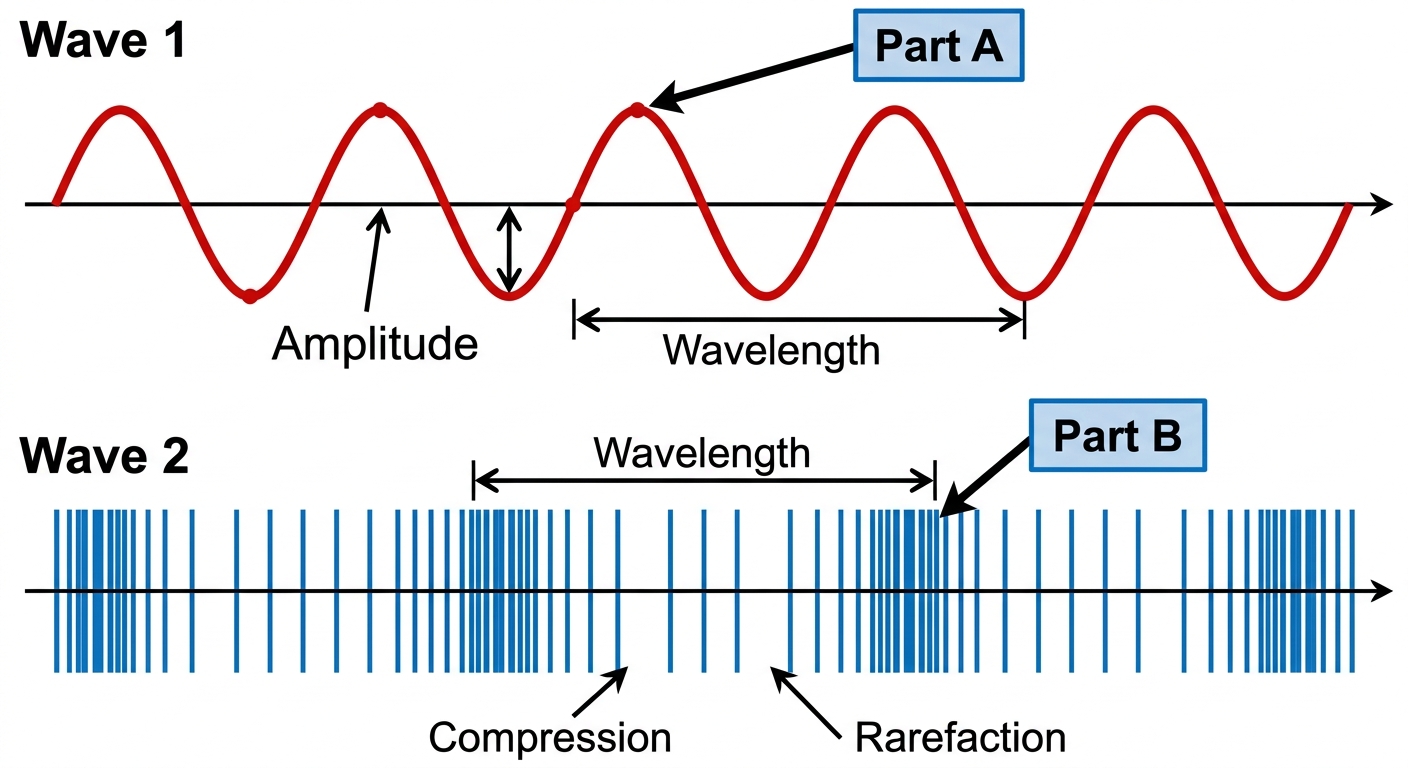
The diagram shows two waves. Wave 1 has high and low points. Wave 2 has squashed and stretched regions. Part A is on Wave 1 and Part B is on Wave 2.
Question diagram
(a)
Identify the type of each wave. [1]Criterion A (i) · Level 1-2
(b)
Describe how you would measure the wavelength of Wave 1. [1]Criterion A (ii) · Level 3-4

revisionprep.com

Summary Answer

Not available for this question.

Model Answer

Not available for this question.

Marking Scheme

Not available for this question.

Examiner Insights

Not available for this question.

Question 2Criterion D · Band 1-4 · Easy · 2 marksrevisionprep.com

Transverse vs Longitudinal Waves

The picture shows a doctor using ultrasound to check a baby inside its mother. Ultrasound is a longitudinal sound wave too high for us to hear.
Question diagram
(a)
State one advantage of ultrasound over an operation. [1]Criterion D (i) · Level 1-2
(b)
Describe how the ultrasound makes a picture. [1]Criterion D (ii) · Level 3-4

revisionprep.com

Summary Answer

Not available for this question.

Model Answer

Not available for this question.

Marking Scheme

Not available for this question.

Examiner Insights

Not available for this question.

Question 3Criterion B · Band 1-6 · Medium · 7 marksrevisionprep.com

Definition of a Wave and Wave Types

Leo puts a ringing alarm clock inside a sealed glass jar. He slowly pumps air out of the jar and measures the sound level outside.
Air removed (%)025507595
Sound level (dB)6052443520
(a)
Write a hypothesis for this test. [1]Criterion B (i) · Level 1-2
(b)
Identify the independent and the dependent variable. [2]Criterion B (i) · Level 1-2
(c)
State one thing he must keep the same. [1]Criterion B (iii) · Level 3-4
(d)
Describe the pattern. [1]

(e) Predict what would happen if all the air were removed, and explain why. [2]
Criterion B (ii) · Level 3-4

revisionprep.com

Summary Answer

Not available for this question.

Model Answer

Not available for this question.

Marking Scheme

Not available for this question.

Examiner Insights

Not available for this question.

Question 4Criterion C · Band 1-6 · Medium · 6 marksrevisionprep.com

Transverse vs Longitudinal Waves

Earthquakes send out two kinds of waves through the ground. P waves are longitudinal. S waves are transverse. A scientist records when each wave reaches towns at different distances.
Distance (km)100200300400
P wave arrives (s)17345067
S wave arrives (s)295786114
(a)
Draw a line graph of both waves on the same axes, with a key. [2]Criterion C (ii) · Level 3-4
(b)
Identify which wave travels faster, with evidence. [1]Criterion C (iii) · Level 1-2
(c)
Calculate the speed of the P wave in km per second. [1]Criterion C (iii) · Level 3-4
(d)
Describe what happens to the time gap between the two waves as distance increases. [1]

(e) Explain how the time gap could warn people in a far-away town. [1]
Criterion C (iii) · Level 3-4

revisionprep.com

Summary Answer

Not available for this question.

Model Answer

Not available for this question.

Marking Scheme

Not available for this question.

Examiner Insights

Not available for this question.

Question 5Criterion C · Band 1-6 · Medium · 6 marksrevisionprep.com

Key Terms Wavelength Frequency Amplitude Speed

Zainab makes waves on a long spring and changes the frequency. She measures the wavelength each time.
Frequency (Hz)2468
Wavelength (cm)12643
(a)
Draw a line graph of wavelength against frequency, with labelled axes. [2]Criterion C (ii) · Level 3-4
(b)
Describe the pattern. [1]Criterion C (iii) · Level 1-2
(c)
Calculate the wave speed for each row using speed = frequency × wavelength. [1]Criterion C (iii) · Level 3-4
(d)
Predict the wavelength at 12 Hz. [1]

(e) Explain why the speed stayed the same even though she changed the frequency. [1]
Criterion C (iii) · Level 3-4

revisionprep.com

Summary Answer

Not available for this question.

Model Answer

Not available for this question.

Marking Scheme

Not available for this question.

Examiner Insights

Not available for this question.

Question 6Criterion B · Band 1-8 · Challenge · 9 marksrevisionprep.com

Wave Behavior Reflection Refraction and Diffraction

Sam sends straight water waves (wavelength 2 cm) towards a gap in a barrier in a ripple tank. He changes the gap width and measures how much the waves spread out after the gap.
Gap width (cm)1248
Spreading (degrees)80603010
(a)
Write a hypothesis for his test. [1]Criterion B (i) · Level 1-2
(b)
Identify the independent and the dependent variable. [2]Criterion B (i) · Level 1-2
(c)
State one thing he must keep the same. [1]Criterion B (iii) · Level 3-4
(d)
Name the wave behaviour he is studying. [1]

(e) Describe the pattern. [1]

(f) Explain why you can hear someone talking round a doorway but cannot see them. Use the pattern in Sam's results in your answer. [3]
Criterion B (ii) · Level 1-2

revisionprep.com

Summary Answer

Not available for this question.

Model Answer

Not available for this question.

Marking Scheme

Not available for this question.

Examiner Insights

Not available for this question.

That's every free question here — 6 of 43.

+37 more questions, plus Mock Papers & Worksheets, are waiting in Premium.

Upgrade