You're viewing free preview questions — 6 questions previewing here — subscribe to unlock 54 more, plus the Full Question Bank, Mock Papers & Worksheets.Upgrade
Back

Sound Waves and Vibrations — Free MYP1 Sciences Practice Questions

Free questions

Open in full, with answers, mark scheme and examiner insights.

Question 1Criterion D · Band 1-4 · Easy · 3 marksrevisionprep.com

How Sound is Produced and Transmitted

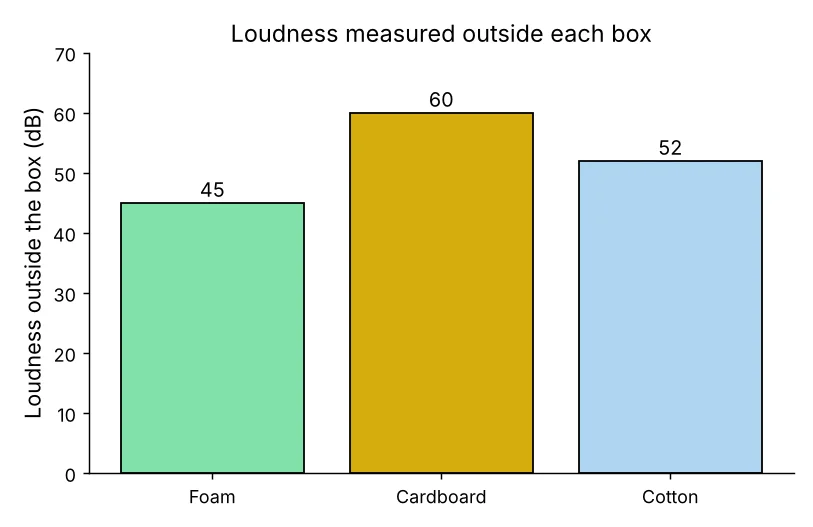
The bar chart shows the student's results.

A student puts a phone playing music in boxes made of different materials and measures the loudness outside.
Foam: 45 dB
Cardboard: 60 dB
Cotton: 52 dB
Question diagram
(a)
Name the material that blocks sound best. [1]Criterion D (i) · Level 1-2
(b)
Suggest one real use of this material. [1]Criterion D (ii) · Level 3-4
(c)
State one thing the student must keep the same. [1]Criterion D (iii) · Level 3-4

revisionprep.com

Summary Answer

Not available for this question.

Model Answer

Not available for this question.

Marking Scheme

Not available for this question.

Examiner Insights

Not available for this question.

Question 2Criterion A · Band 1-4 · Easy · 2 marksrevisionprep.com

Representation of Sound as Longitudinal Waves

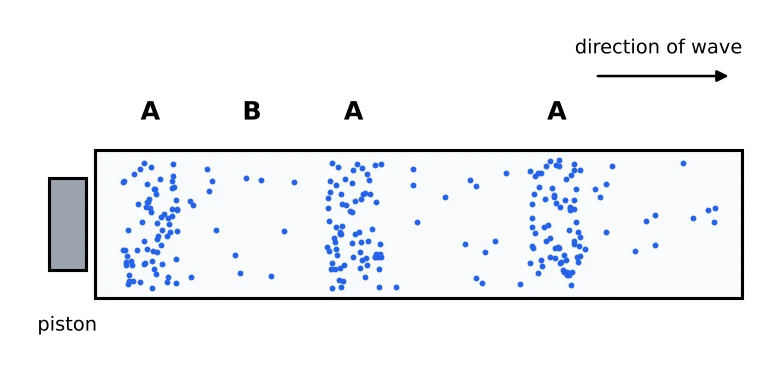
The picture shows a sound wave made by a vibrating piston.

In a sound wave, some regions have air particles pushed close together and some have particles spread far apart.
Question diagram
(a)
Look at the picture. Name the regions marked A and the region marked B. [1]Criterion A (i) · Level 1-2
(b)
Describe how the wavelength of a sound wave can be measured. [1]Criterion A (ii) · Level 3-4

revisionprep.com

Summary Answer

Not available for this question.

Model Answer

Not available for this question.

Marking Scheme

Not available for this question.

Examiner Insights

Not available for this question.

Question 3Criterion C · Band 1-6 · Medium · 7 marksrevisionprep.com

Vibrations in Solids Liquids and Gases

A scientist times how long sound takes to travel 100 m through three materials.
Air: 0.29 s
Water: 0.067 s
Steel: 0.017 s
(a)
Calculate the speed of sound in each material (speed = distance ÷ time). [2]Criterion C (iii) · Level 3-4
(b)
Draw a bar chart of the speeds with labelled axes. [2]Criterion C (ii) · Level 3-4
(c)
Describe the pattern from gas to liquid to solid. [1]Criterion C (iii) · Level 1-2
(d)
Explain the pattern using particles. [1]

(e) Suggest why a very short time like 0.017 s is hard to measure accurately in school. [1]
Criterion C (iv) · Level 3-4

revisionprep.com

Summary Answer

Not available for this question.

Model Answer

Not available for this question.

Marking Scheme

Not available for this question.

Examiner Insights

Not available for this question.

Question 4Criterion C · Band 1-6 · Medium · 6 marksrevisionprep.com

Speed of Sound in Different Media

During a storm, Kofi counts the seconds between seeing lightning and hearing thunder. A weather app tells him how far away each strike was.
Delay (s)36912
Distance (km)1.02.03.04.0
(a)
Draw a line graph of distance against delay, with labelled axes. [2]Criterion C (ii) · Level 3-4
(b)
Describe the pattern. [1]Criterion C (iii) · Level 1-2
(c)
Calculate the speed of sound from the 3 s result. [1]Criterion C (iii) · Level 3-4
(d)
Explain why the lightning is seen before the thunder is heard. [1]

(e) Kofi counts 15 seconds. Predict the distance and suggest one safety action. [1]
Criterion C (iv) · Level 3-4

revisionprep.com

Summary Answer

Not available for this question.

Model Answer

Not available for this question.

Marking Scheme

Not available for this question.

Examiner Insights

Not available for this question.

Question 5Criterion B · Band 1-6 · Medium · 6 marksrevisionprep.com

Echoes and Reverberation

Sam and Ava want to measure the speed of sound using echoes. They stand 50 m from a tall flat wall. Sam claps in time with the echoes, so each clap happens just as the last echo returns. Ava times 20 claps.
Trial 1: 6.1 s
Trial 2: 5.8 s
Trial 3: 6.0 s
(a)
Calculate the mean time for 20 claps. [1]Criterion B (ii) · Level 1-2
(b)
Calculate the total distance the sound travelled in 20 claps. [1]Criterion B (ii) · Level 3-4
(c)
Calculate the speed of sound. [1]Criterion B (ii) · Level 3-4
(d)
Explain why timing 20 claps is better than timing one echo. [1]

(e) State two things they should do to make the test reliable. [1]

(f) Suggest why their result is slightly lower than 340 m/s. [1]
Criterion B (iii) · Level 3-4

revisionprep.com

Summary Answer

Not available for this question.

Model Answer

Not available for this question.

Marking Scheme

Not available for this question.

Examiner Insights

Not available for this question.

Question 6Criterion B · Band 1-8 · Challenge · 8 marksrevisionprep.com

How Sound is Produced and Transmitted

Lily makes string telephones from two paper cups and 5 m of different strings. A friend whispers into one cup. Lily rates how clearly she hears it from 0 (nothing) to 5 (very clear).
Wool: 1
Cotton thread: 3
Fishing line: 5
(a)
Write a hypothesis for her test. [1]Criterion B (i) · Level 1-2
(b)
Identify the independent and the dependent variable. [2]Criterion B (i) · Level 1-2
(c)
State two things she must keep the same. [1]Criterion B (iii) · Level 3-4
(d)
Suggest how she could make the clarity rating fairer. [1]

(e) Explain how the sound travels from one cup to the other, why it works only when the string is tight, and use the results to predict how well a thin metal wire would work. [3]
Criterion B (iii) · Level 3-4

revisionprep.com

Summary Answer

Not available for this question.

Model Answer

Not available for this question.

Marking Scheme

Not available for this question.

Examiner Insights

Not available for this question.

That's every free question here — 6 of 60.

+54 more questions, plus Mock Papers & Worksheets, are waiting in Premium.

Upgrade