You're viewing free preview questions — 4 questions previewing here — subscribe to unlock 61 more, plus the Full Question Bank, Mock Papers & Worksheets.Upgrade
Perimeter and Area of 2D Shapes — Free MYP2 Mathematics Practice Questions

1QuestionArea of Rectangles Triangles and ParallelogramsConcept Practice
3 marks~5 minCriterion A
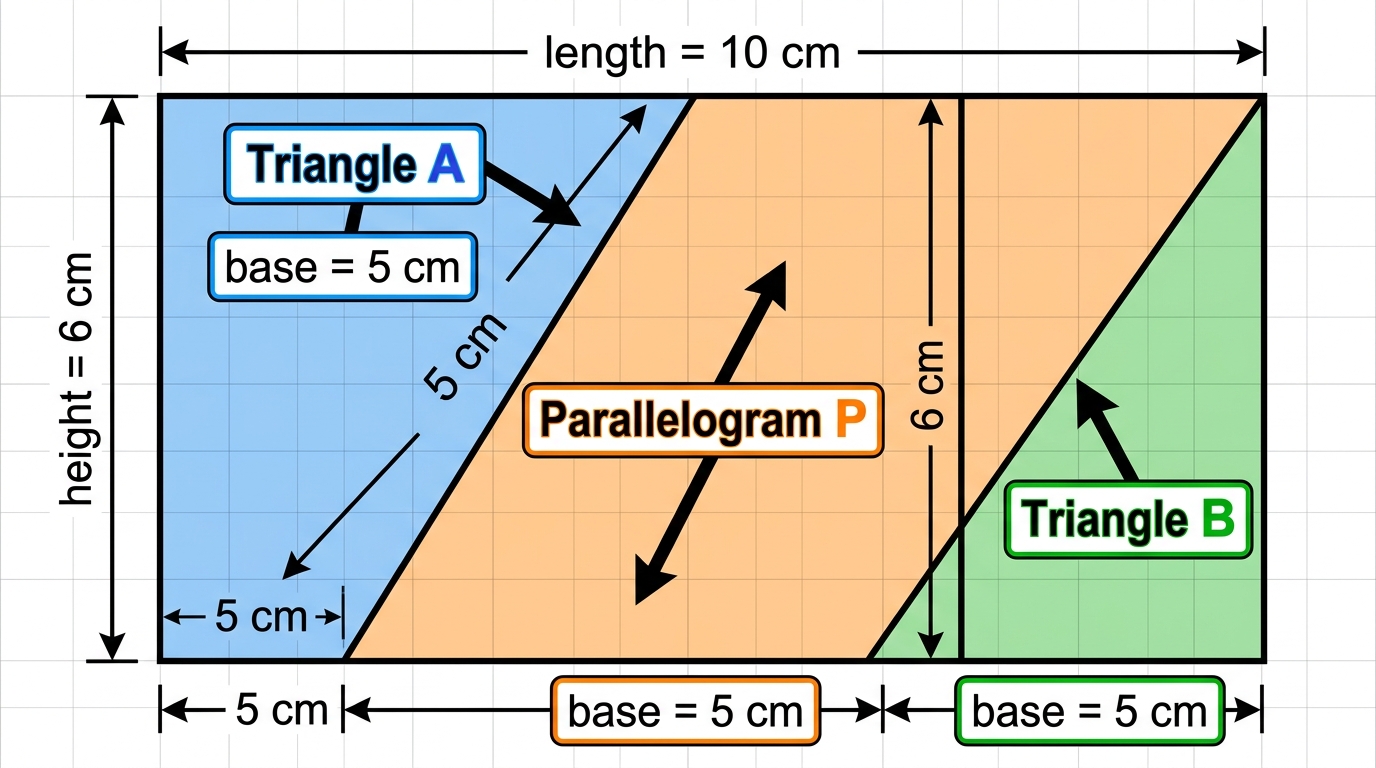
The diagram shows a rectangle divided into triangle A, parallelogram P, and triangle B. The rectangle has length 10 cm and height 6 cm. Triangles A and B each have base 5 cm and height 6 cm. Parallelogram P has base 5 cm and height 6 cm.
a
Calculate the areas of triangle A and triangle B. [1]
b
Calculate the area of parallelogram P. [1]
c
Describe the relationship between the area of the rectangle and the areas of triangle A, parallelogram P, and triangle B combined. [1]

Solutions
2QuestionArea of Trapeziums and Compound ShapesAssessment Practice
4 marks~6 minCriterion D
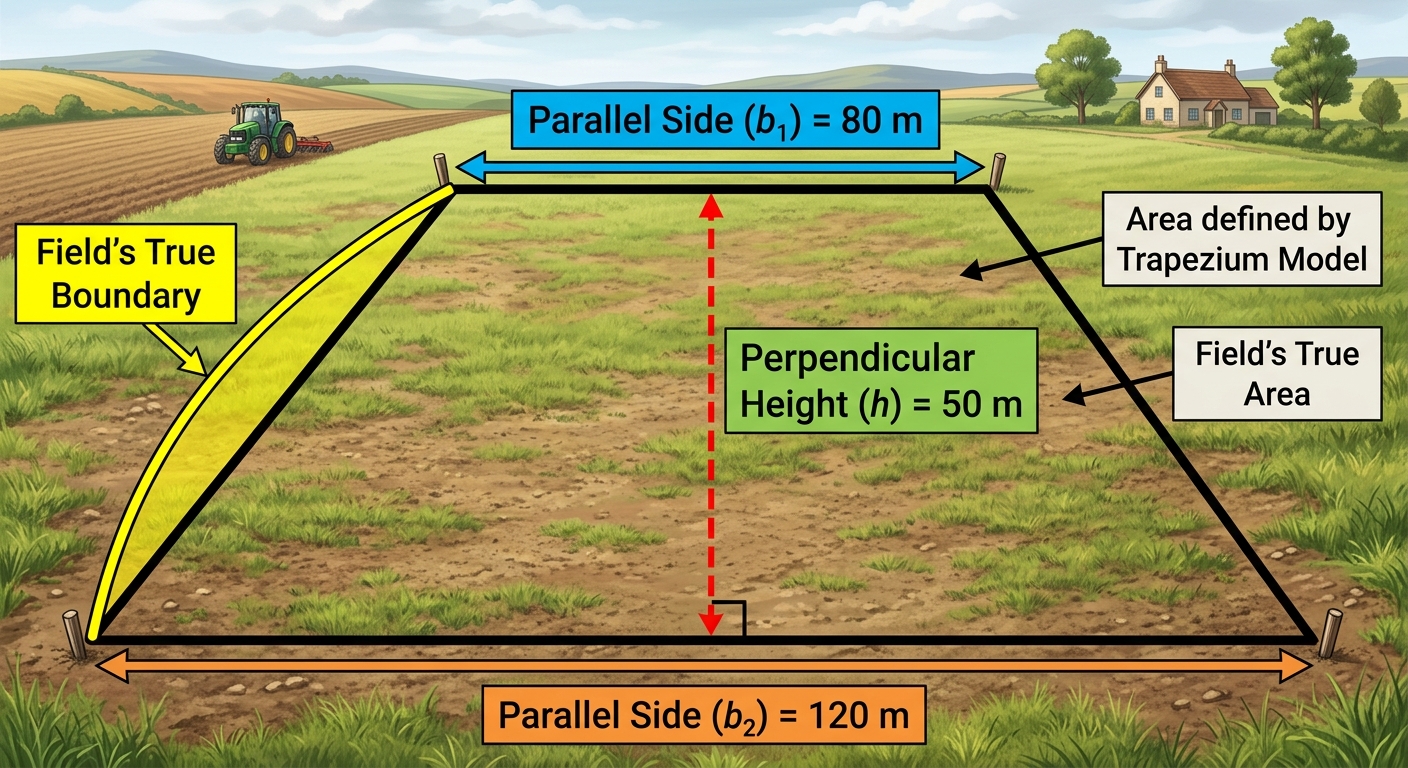
A farmer has a field shaped like a trapezium (a quadrilateral with one pair of parallel sides). The parallel sides measure 80 m and 120 m, and the perpendicular height is 50 m. One non-parallel side curves slightly outward, making the true area larger than the trapezium model suggests.
where and are the parallel sides and is the perpendicular height.
where and are the parallel sides and is the perpendicular height.
a
Calculate the area of the field using the formula above. Show your working. [2]
b
Explain whether the trapezium formula overestimates or underestimates the true area of this field, and identify one real-world limitation of using a straight-sided shape to model a field with a curved boundary. [2]
Solutions
3QuestionFinding Perimeter of Irregular ShapesAssessment Practice
5 marks~8 minCriterion C
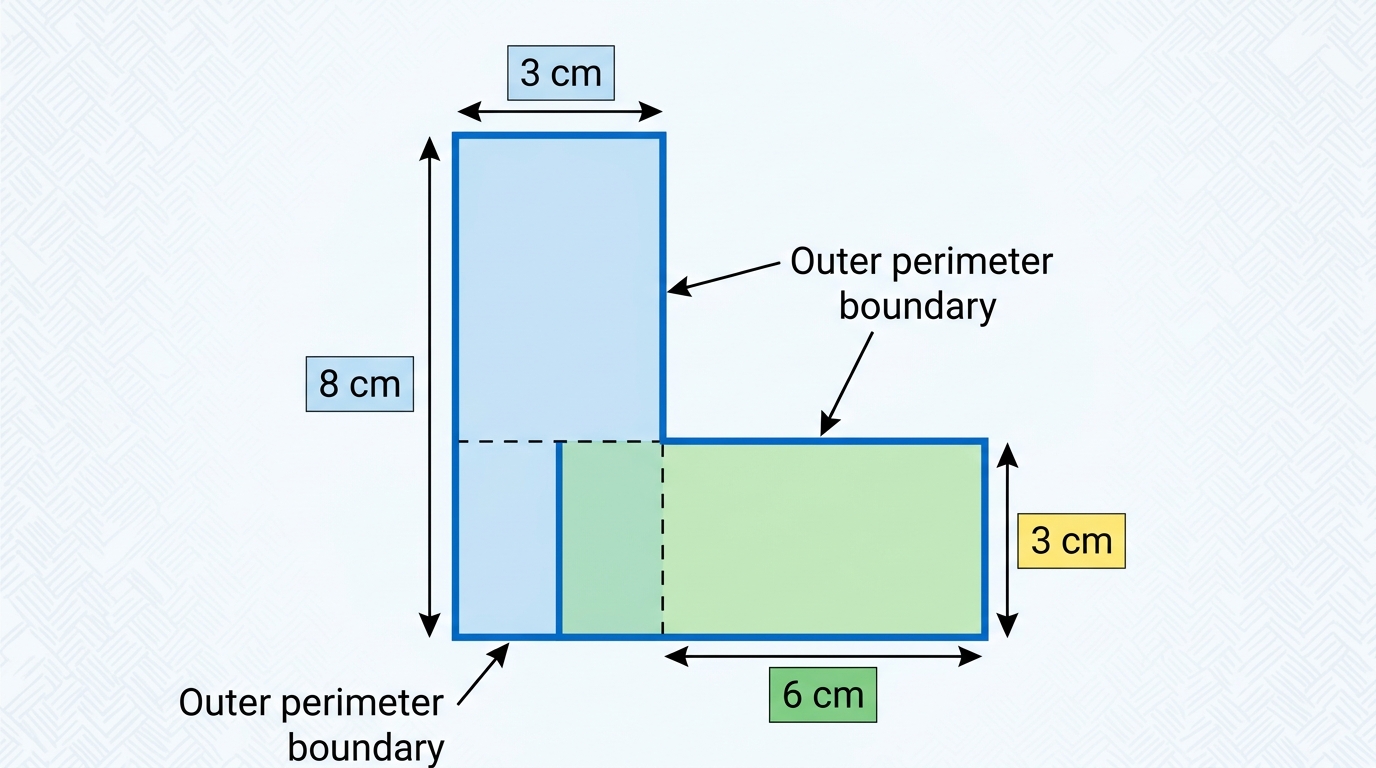
An L-shaped figure is formed by joining a vertical rectangle (width cm, height cm) to a horizontal rectangle (width cm, height cm), as shown.
A student calculates the perimeter by adding all sides of both rectangles separately: cm.
A student calculates the perimeter by adding all sides of both rectangles separately: cm.
a
Identify the six outer side lengths of the L-shaped figure. [1]
b
Calculate the correct perimeter of the L-shaped figure. Show your working. [2]
c
Explain why the student's method gives the wrong answer. [2]
Solutions
4QuestionFinding Perimeter of Irregular ShapesAssessment Practice
12 marks~18 minCriterion B
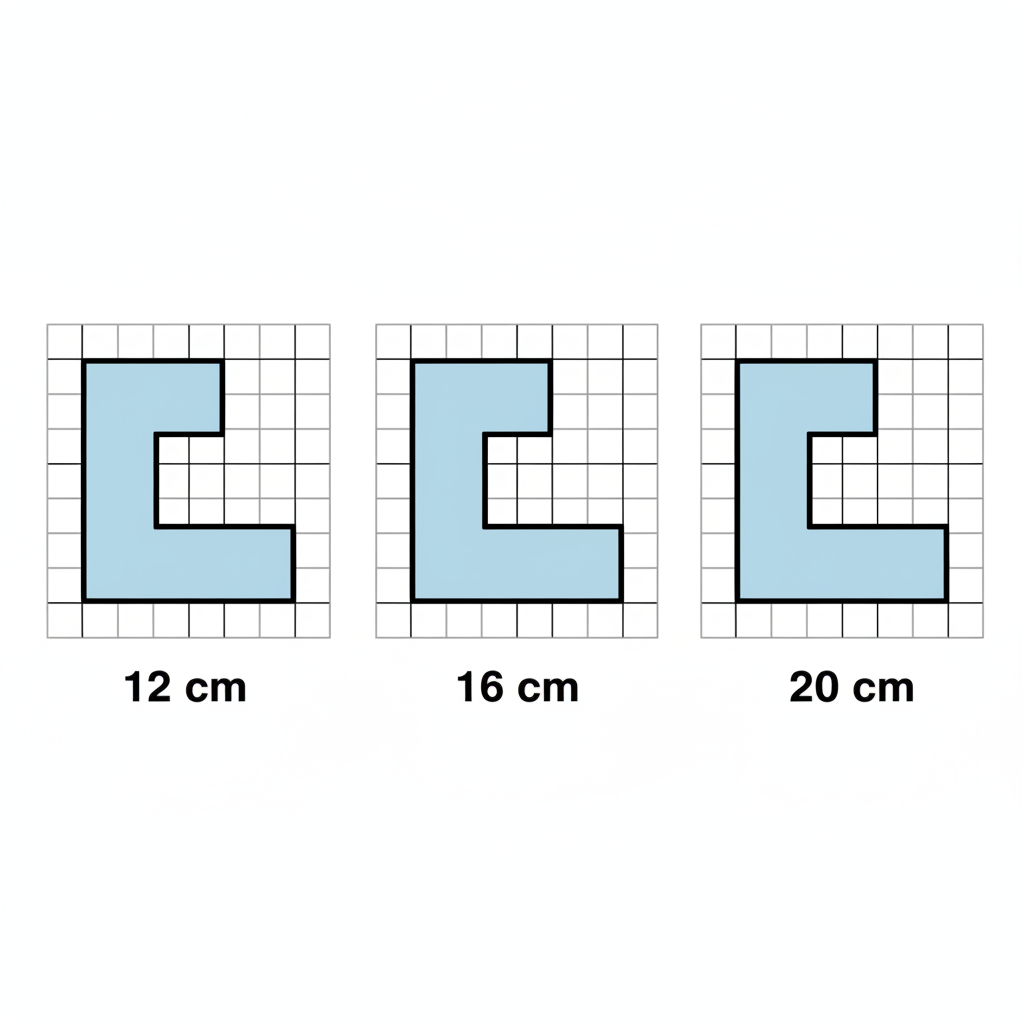
The perimeters of the first three L-shaped polygons in a sequence are 12 cm, 16 cm, and 20 cm. Each grid square has a side length of 1 cm.
a
Identify the pattern in the perimeters and state the perimeter of the 4th and 5th shapes. [2]
b
On the grid provided, draw the 5th shape. Explain how your drawing follows the same pattern as the first three shapes. [4]
c
Calculate the perimeter of your 5th shape by adding each side length. Compare this value with your prediction from part (a). [6]
Solutions
That's every free question here — 4 of 65.
+61 more questions, plus Mock Papers & Worksheets, are waiting in Premium.