You're viewing free preview questions — 4 questions previewing here — subscribe to unlock 59 more, plus the Full Question Bank, Mock Papers & Worksheets.Upgrade
Symmetry and Tessellations — Free MYP2 Mathematics Practice Questions

1QuestionCreating Symmetrical DesignsConcept Practice
2 marks~3 minCriterion A
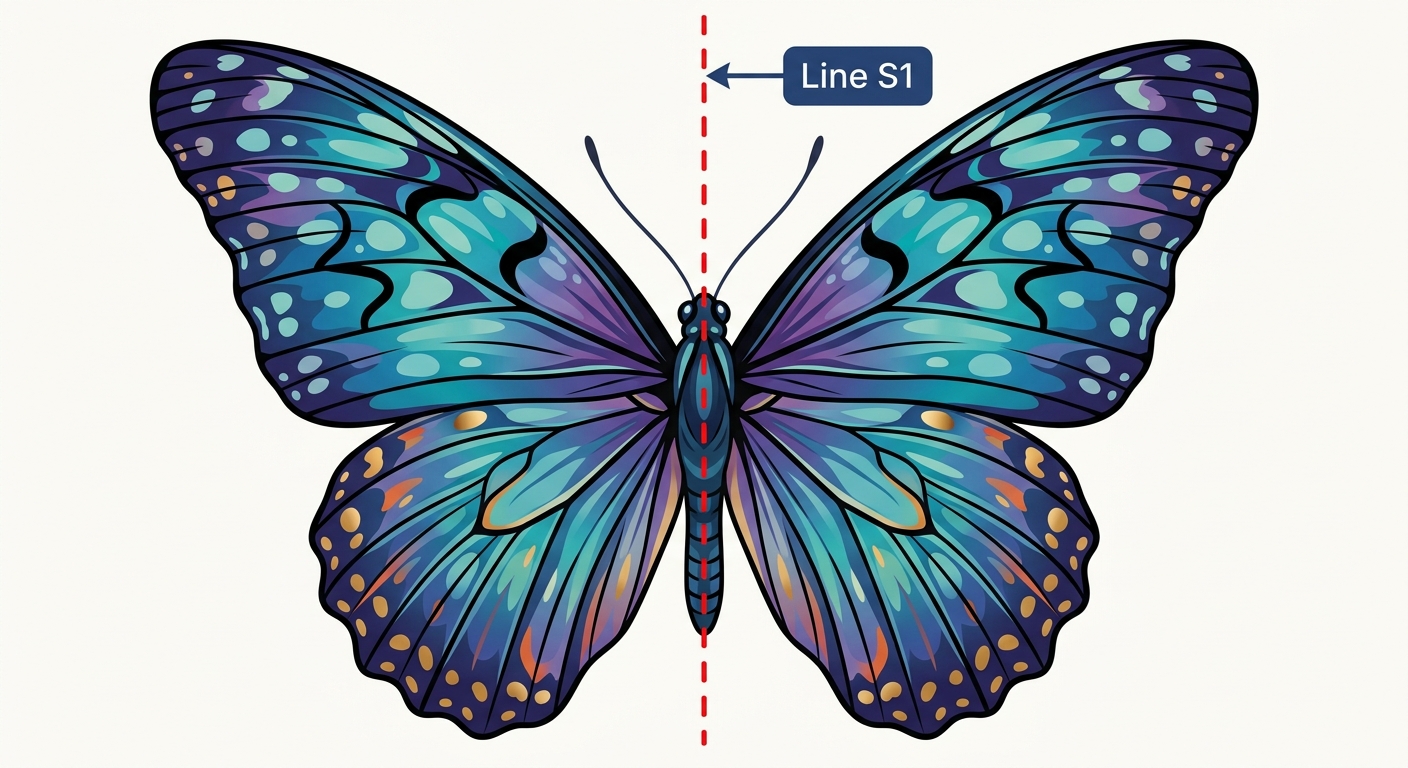
The diagram shows a butterfly design with a dashed vertical line through its centre.
a
State the total number of lines of symmetry in the butterfly design. [1]
b
Identify the orientation of this line of symmetry as vertical, horizontal, or diagonal. [1]

Solutions
2QuestionIdentifying Line Symmetry in ShapesAssessment Practice
4 marks~6 minCriterion C
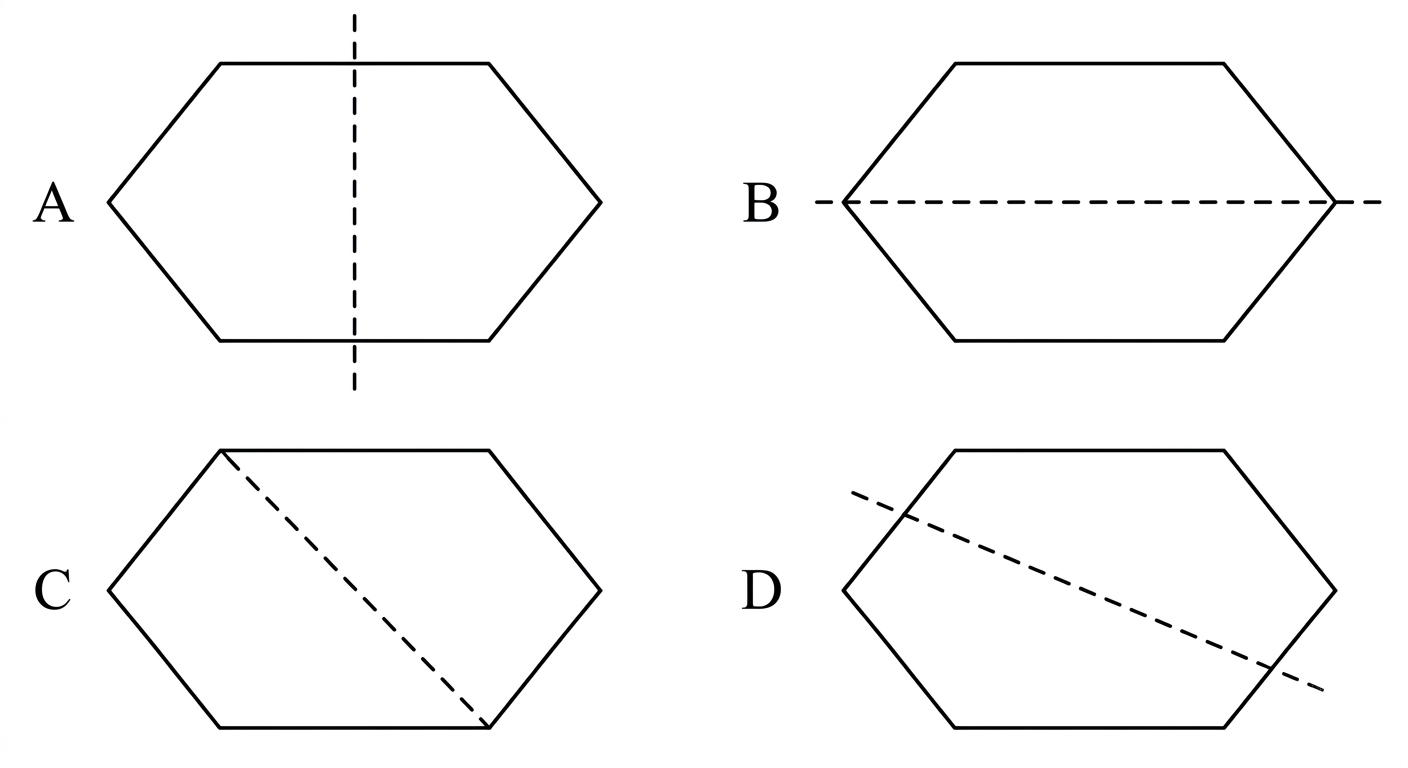
The four irregular hexagons below each show a drawn line of symmetry.
a
Identify which two hexagons (A, B, C, or D) have a valid line of symmetry. [1]
b
For each valid hexagon you identified, explain how you know the line is a true line of symmetry. [2]
c
Compare the two invalid lines of symmetry. Explain what both drawn lines have in common that makes them fail. [1]
Solutions
3QuestionCreating Symmetrical DesignsAssessment Practice
7 marks~11 minCriterion D
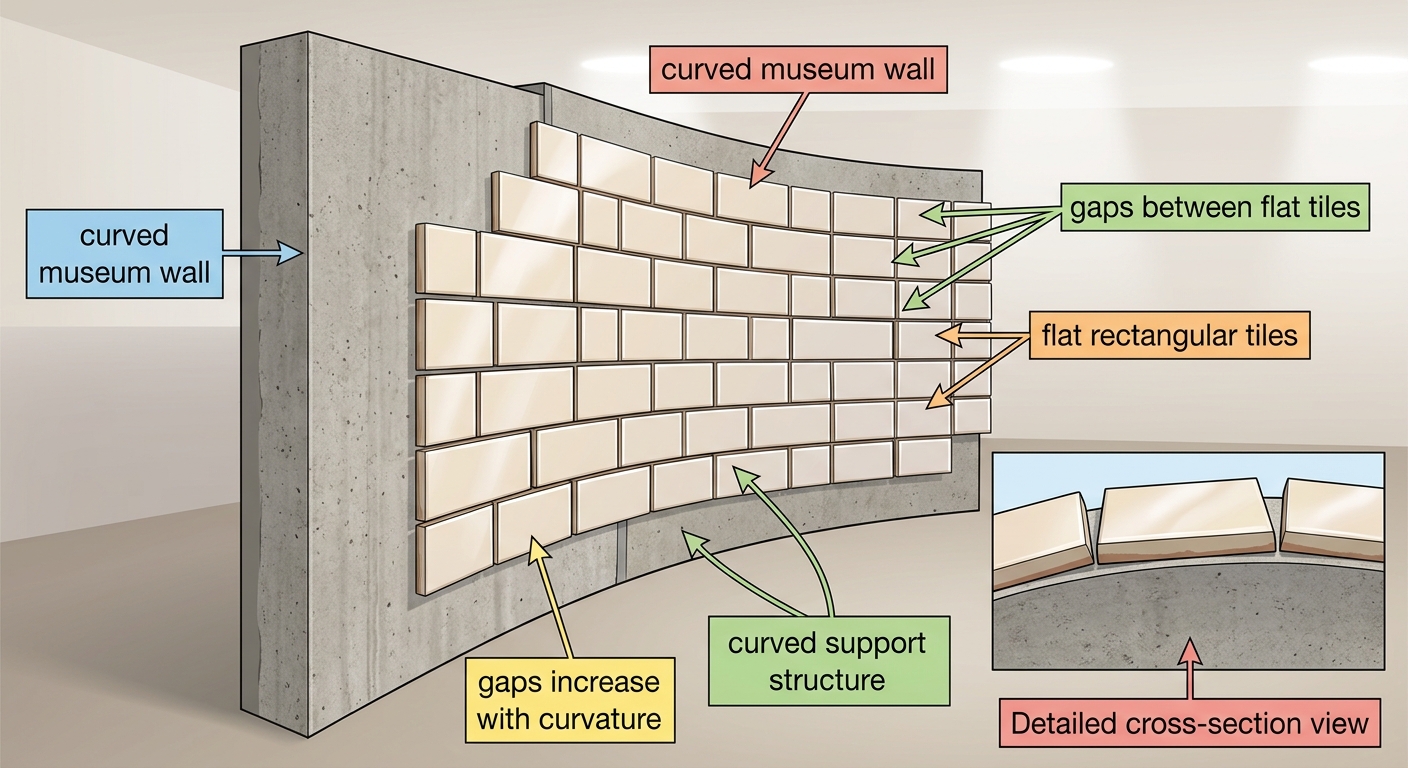
A graphic designer is creating a wallpaper for a curved museum wall. The wall has an area of 45 m². The design uses a tessellation of identical quadrilateral tiles, each with an area of 0.09 m². The designer treats the wall as perfectly flat.
a
Calculate the number of tiles needed for the wall. [2]
b
Explain two reasons why a flat tessellation pattern may not work well on a curved wall. [3]
c
Compare using large tiles versus small tiles on a curved wall, and state which is better suited. [2]
Solutions
4QuestionTessellating Shapes and PatternsAssessment Practice
8 marks~12 minCriterion B
A student claims: "Any regular polygon can tessellate because they are all symmetrical."
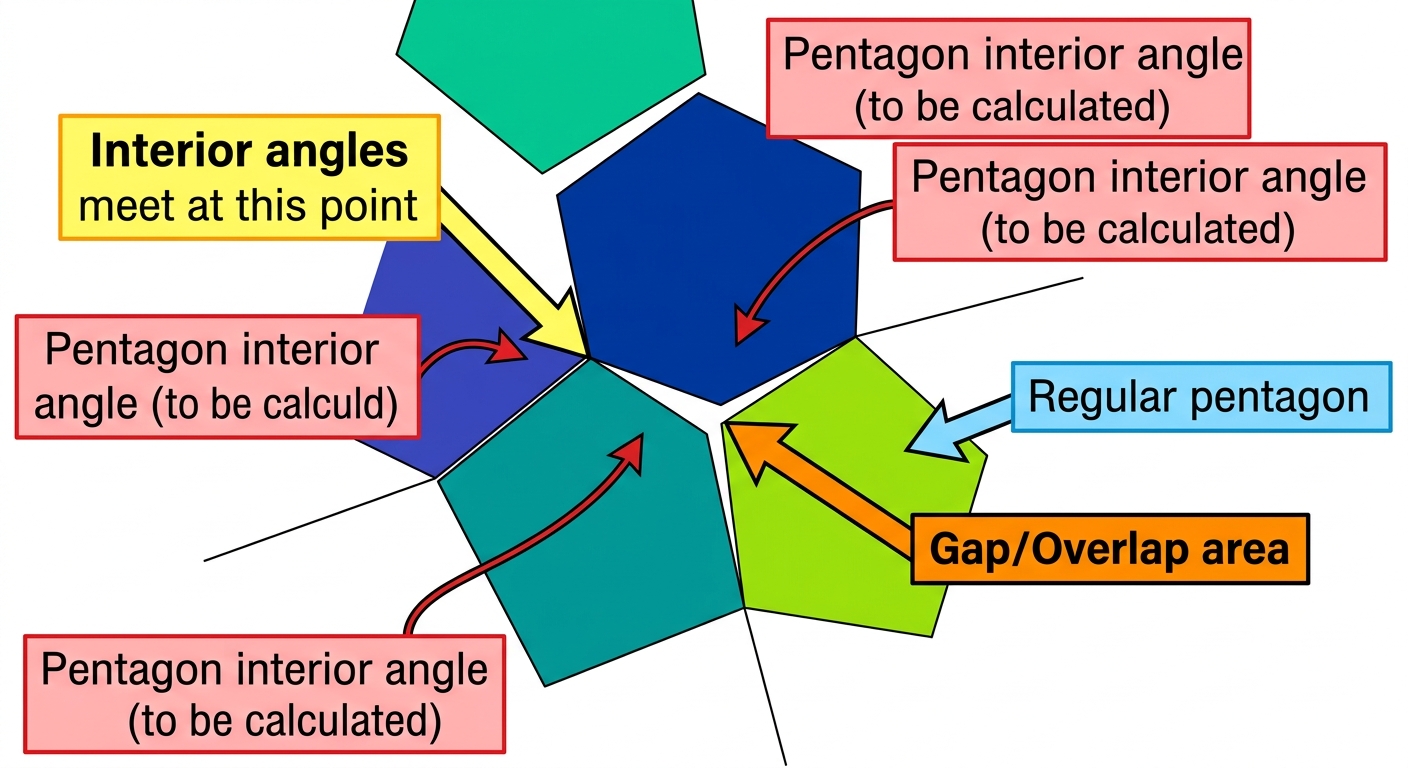
A regular pentagon has an interior angle of . The diagram shows three pentagons meeting at a point, leaving a gap.
Tessellation: a pattern of shapes that covers a surface with no gaps or overlaps.
A regular pentagon has an interior angle of . The diagram shows three pentagons meeting at a point, leaving a gap.
Tessellation: a pattern of shapes that covers a surface with no gaps or overlaps.
a
Calculate the total angle where three pentagons meet at a point. [2]
b
Explain why regular pentagons cannot tessellate. Use your answer to part (a) and the fact that angles around a point must sum to . [2]
c
A regular hexagon has an interior angle of . A regular octagon has an interior angle of . Compare these two polygons and determine which one can tessellate. Show your working for both. [4]
Solutions
That's every free question here — 4 of 63.
+59 more questions, plus Mock Papers & Worksheets, are waiting in Premium.