You're viewing free preview questions — 4 questions previewing here — subscribe to unlock 78 more, plus the Full Question Bank, Mock Papers & Worksheets.Upgrade
Unicellular vs Multicellular Organisms — Free MYP2 Sciences Practice Questions

1QuestionAdvantages and Limitations of UnicellularityConcept Practice
2 marks~3 minCriterion A
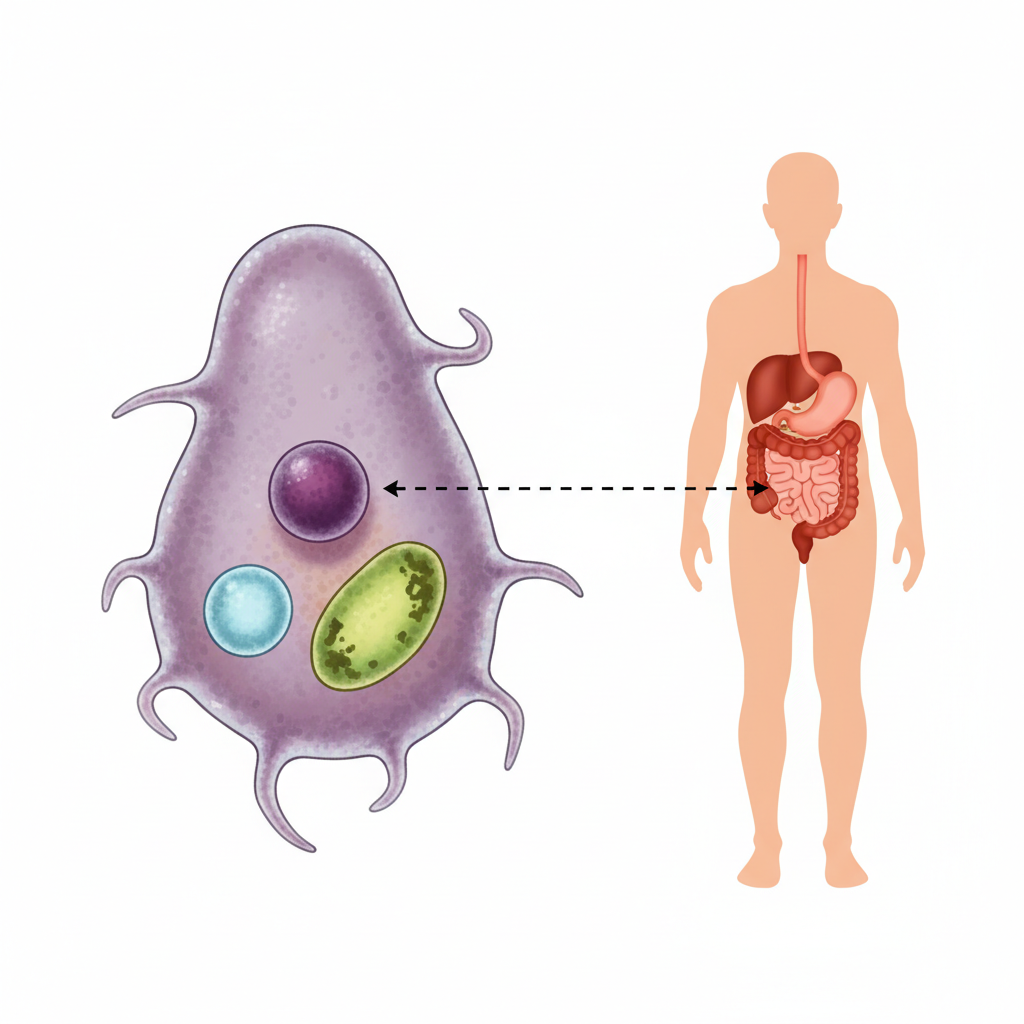
An amoeba is a single-celled organism that must carry out all life processes within one cell.
a
Identify the structure in an amoeba that performs the same function as the human digestive system. [1]
b
Explain how this structure allows the amoeba to digest food. [1]

Solutions
2QuestionAdvantages and Limitations of UnicellularityAssessment Practice
3 marks~5 minCriterion B
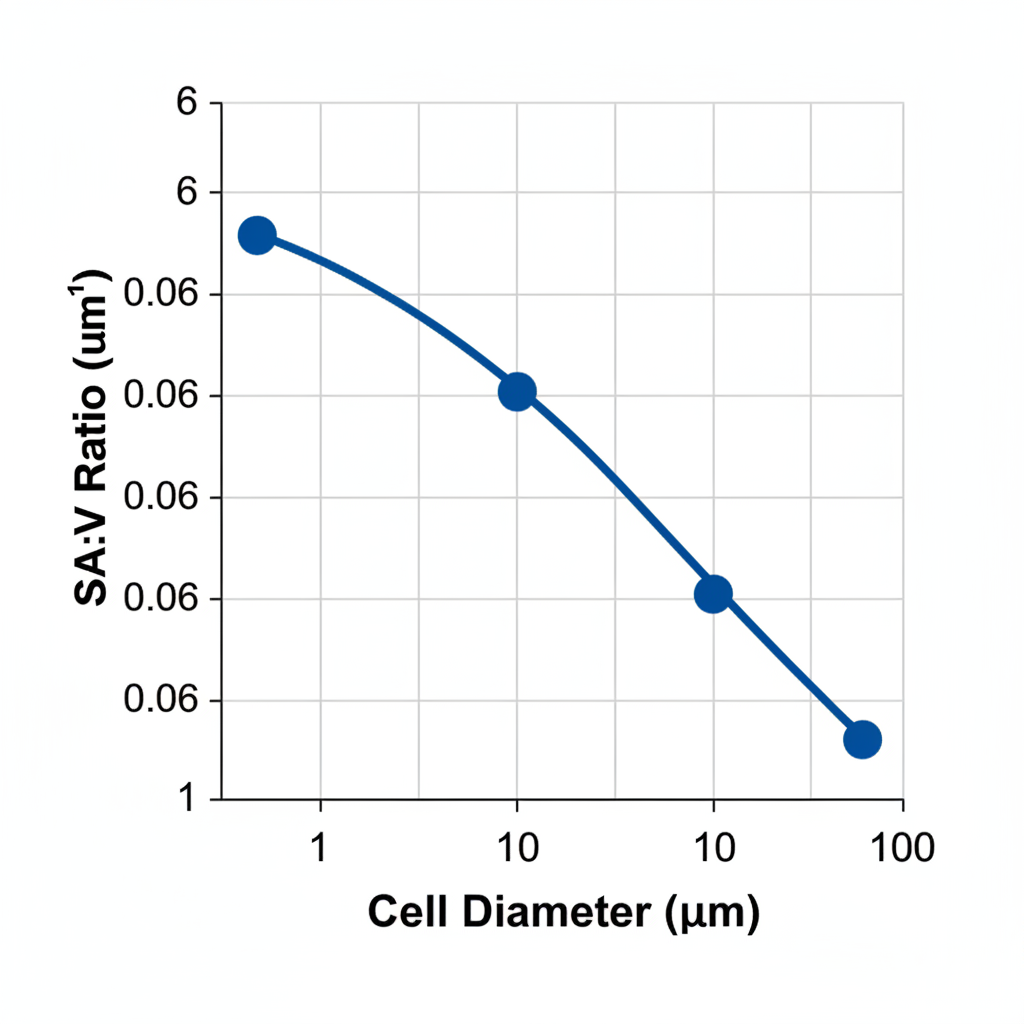
The table below shows the surface area-to-volume ratio (SA:V — how much outer surface a cell has compared to its inner volume) for spherical cells of different sizes.
| Cell diameter (m) | 1 | 10 | 100 |
|---|---|---|---|
| SA | V ratio (m): 6 | 0.6 | 0.06 |
a
Identify the trend shown in the table. [1]
b
Explain why a smaller cell has a higher SA:V ratio. [1]
c
Compare the ability of a 1 m unicellular organism and a 100 m cell to exchange nutrients across their cell membranes. [1]
Solutions
3QuestionExamples of Bacteria Amoeba and ParameciumAssessment Practice
5 marks~8 minCriterion C
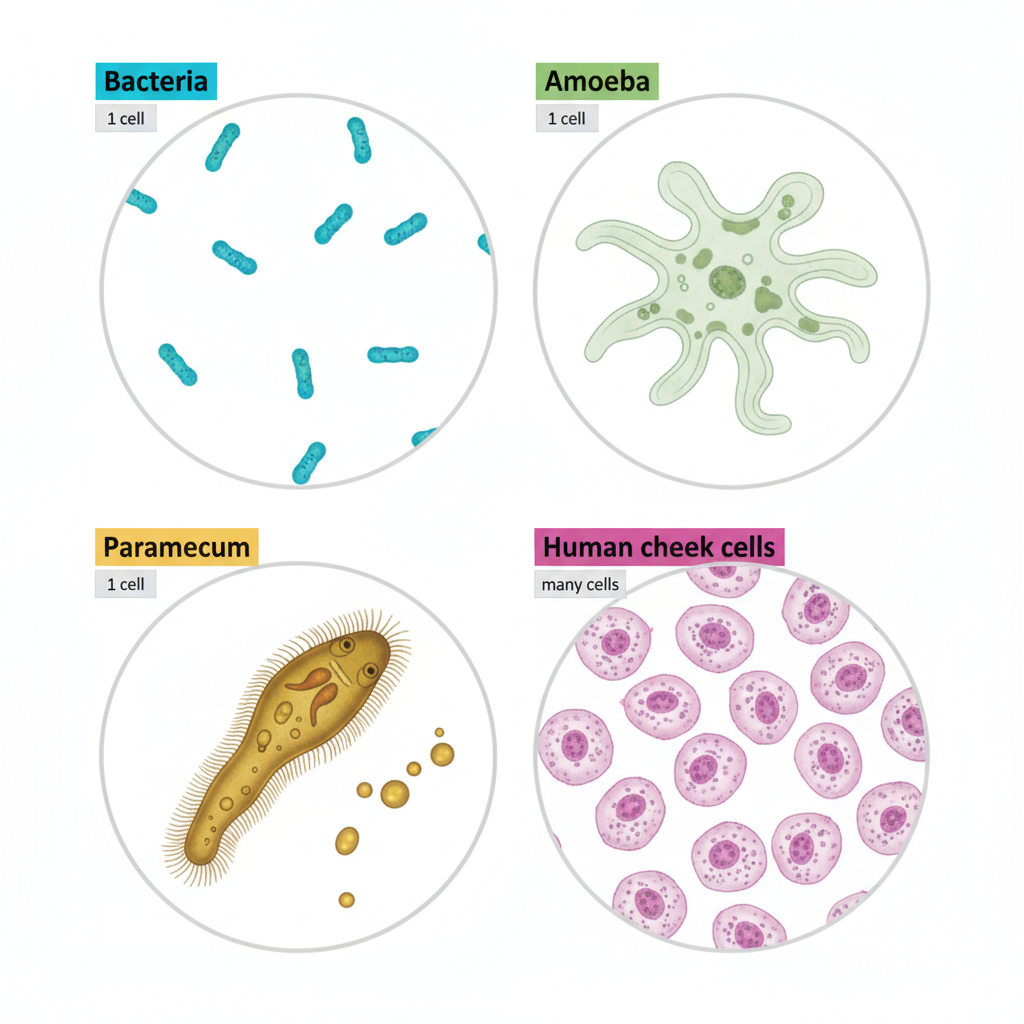
A student observes slides of bacteria, amoeba, paramecium, and human cheek cells under a microscope. She claims: "All of these are unicellular organisms — each is made of only one cell."
Number of cells observed per slide:
Bacteria: 1 — Amoeba: 1 — Paramecium: 1 — Human cheek cell: 1
Number of cells observed per slide:
Bacteria: 1 — Amoeba: 1 — Paramecium: 1 — Human cheek cell: 1
a
Identify which THREE organisms in the data are unicellular (single-celled). [1]
b
Explain why the human cheek cell does NOT come from a unicellular organism, even though only one cell was observed on the slide. [2]
c
Compare the student's claim with the data above, and state whether her claim is valid or invalid. Give a reason for your judgement. [2]
Solutions
4QuestionComparing with Multicellular OrganismsAssessment Practice
6 marks~9 minCriterion D
A farmer is choosing between two fertilizers. Algae fertilizer (made from unicellular organisms) is cheap and grows quickly, but supplies few nutrients per plant. Plant fertilizer (made from multicellular organisms) is costly and slow to produce, but supplies many nutrients per plant.
a
Identify one advantage of using algae fertilizer. [1]
b
Describe one drawback of algae fertilizer compared to plant fertilizer. [2]
c
Compare the two fertilizers and explain which a farmer focused on long-term crop quality should choose. [3]

Solutions
That's every free question here — 4 of 82.
+78 more questions, plus Mock Papers & Worksheets, are waiting in Premium.