You're viewing free preview questions — 4 questions previewing here — subscribe to unlock 69 more, plus the Full Question Bank, Mock Papers & Worksheets.Upgrade
The Periodic Table Introductory — Free MYP2 Sciences Practice Questions

1QuestionGroups and Periods ExplainedConcept Practice
2 marks~3 minCriterion A
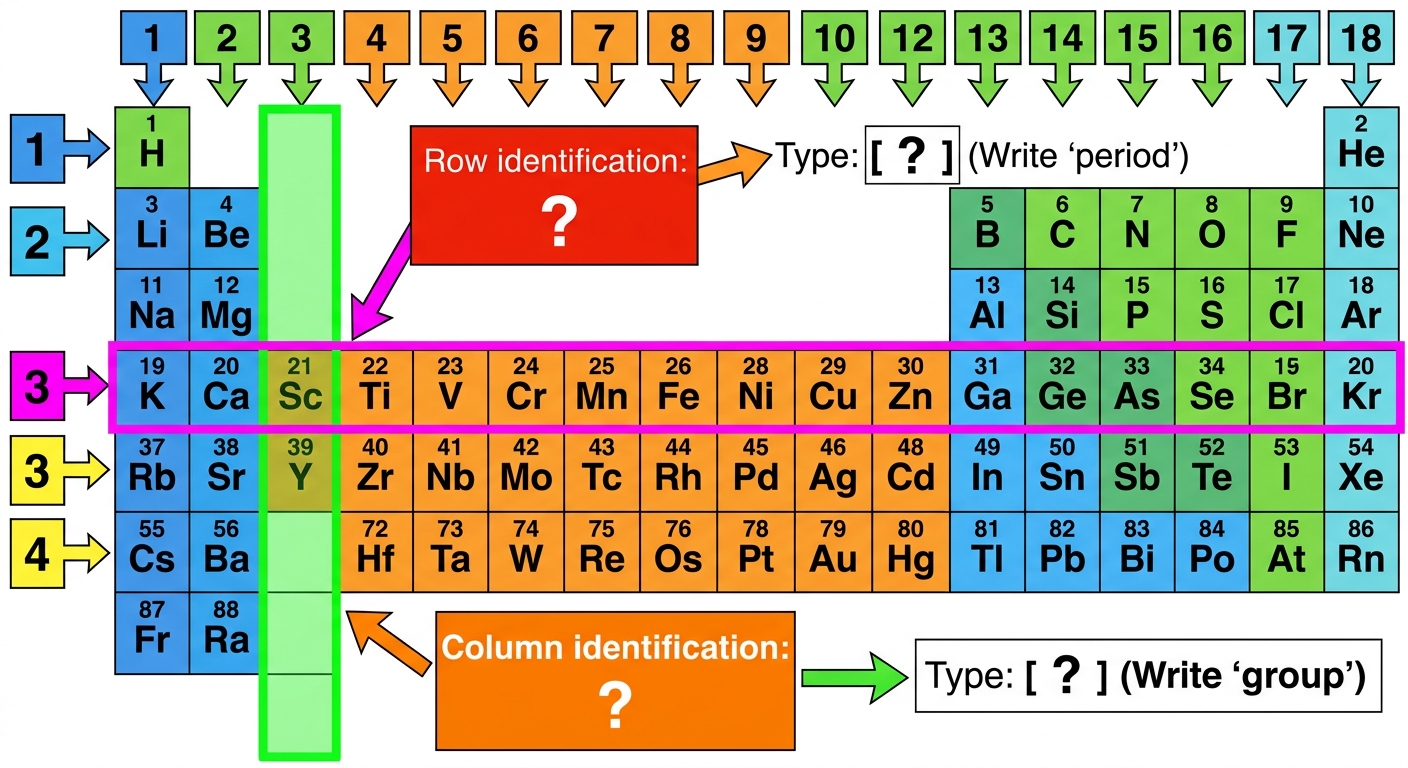
The simplified periodic table below has one row and one column highlighted.
a
Identify the highlighted row by writing its correct scientific name on the answer line provided. [1]
b
Identify the highlighted column by writing its correct scientific name on the answer line provided. [1]

Solutions
2QuestionGroups and Periods ExplainedAssessment Practice
2 marks~3 minCriterion D
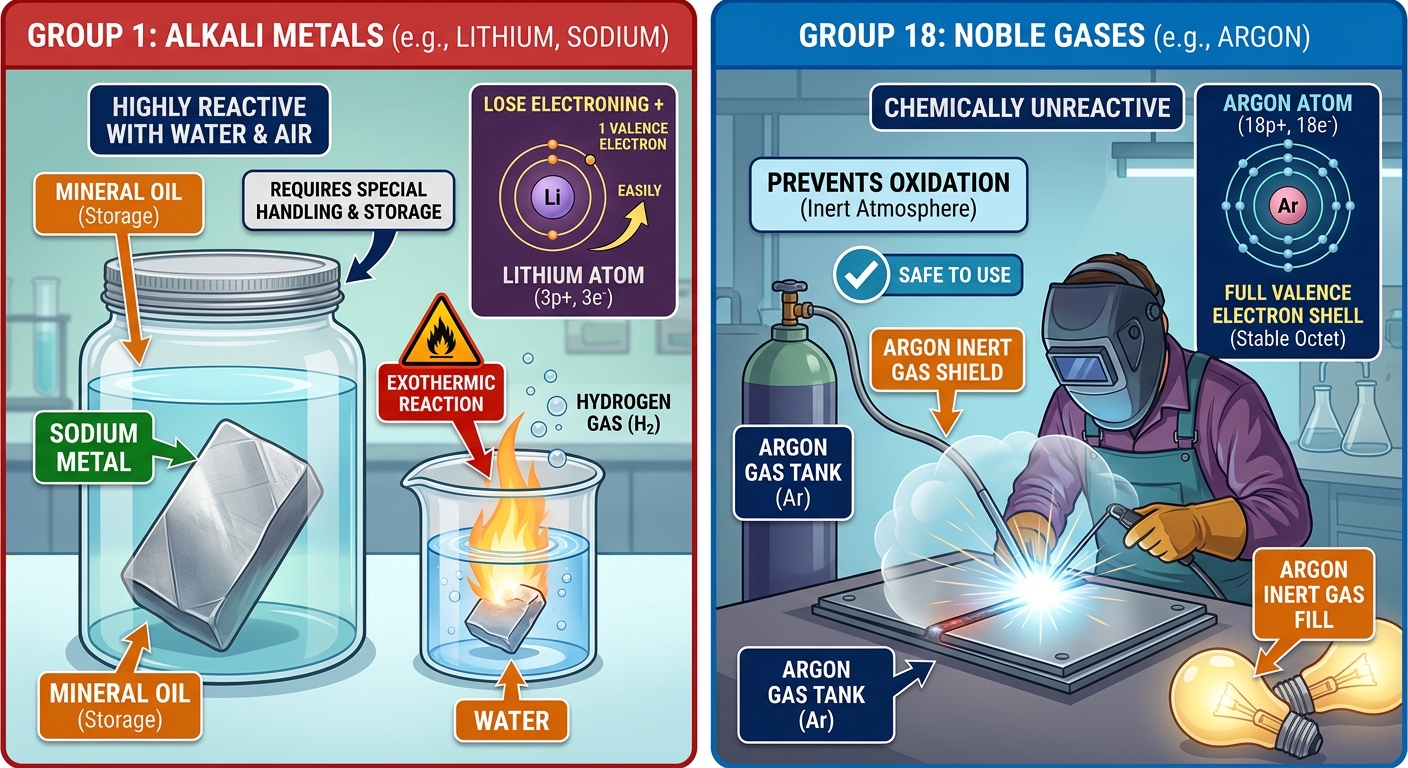
Group 1 elements (such as sodium, ) are highly reactive, while Group 18 elements (such as argon, ) are unreactive (called "noble" or "inert").
Describe one real-world safety implication of understanding these different reactivities. [2]
Describe one real-world safety implication of understanding these different reactivities. [2]
Solutions
3QuestionGroups and Periods ExplainedConcept Practice
2 marks~3 minCriterion B
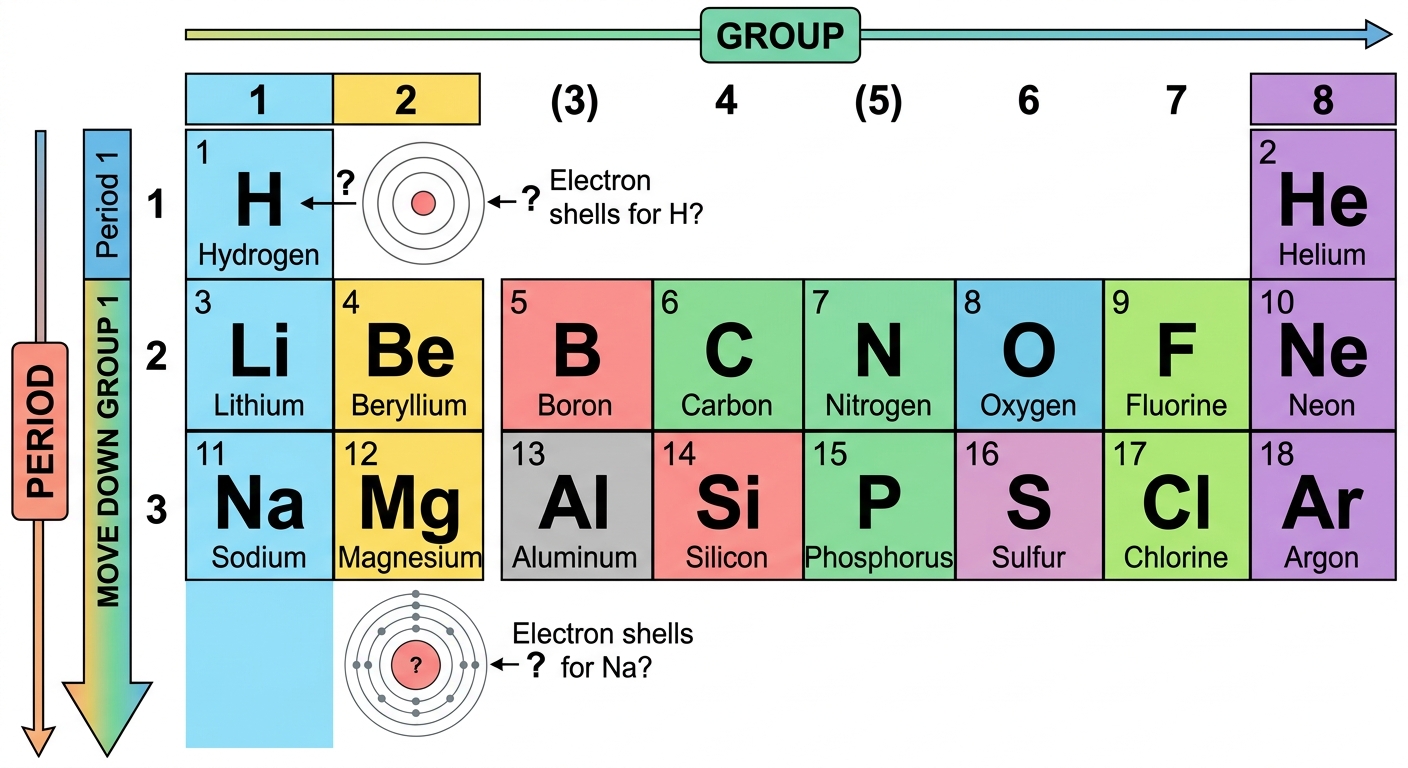
The diagram shows the first 18 elements of the periodic table arranged in groups and periods.
Explain how the number of electron shells (layers where electrons are found) changes as you move down Group 1 from hydrogen () to sodium (). Use the terms shell, period, and group in your answer. [2]
Explain how the number of electron shells (layers where electrons are found) changes as you move down Group 1 from hydrogen () to sodium (). Use the terms shell, period, and group in your answer. [2]
Solutions
4QuestionStructure and Layout of the Periodic TableAssessment Practice
5 marks~8 minCriterion C
A student claims: "Elements in the same group have identical properties."
The data below shows atomic radius (pm — a measure of atom size) and melting point (°C) for two sets of elements.
Group 1 — Li, Na, K
Period 3 — Na, Mg, Al
The data below shows atomic radius (pm — a measure of atom size) and melting point (°C) for two sets of elements.
Group 1 — Li, Na, K
| Atomic radius (pm) | 152 | 186 | 227 |
|---|---|---|---|
| Melting point (°C) | 180 | 98 | 64 |
Period 3 — Na, Mg, Al
| Atomic radius (pm) | 186 | 160 | 143 |
|---|---|---|---|
| Melting point (°C) | 98 | 650 | 660 |
a
Identify one trend in atomic radius for Group 1 elements as you move from Li to K. [1]
b
Describe how melting point changes across Period 3 (Na → Mg → Al), using the data to support your answer. [2]
c
Compare the patterns in Group 1 and Period 3, and use this to evaluate whether the student's claim is valid. [2]
Solutions
That's every free question here — 4 of 73.
+69 more questions, plus Mock Papers & Worksheets, are waiting in Premium.